
Twelve Apostles
The Southern Ocean doesn’t so much arrive at this stretch of the Victorian coast as assault it. The waves have been building unobstructed across thousands of kilometres of open water since leaving Antarctica, and when they meet the limestone cliffs of Port Campbell National Park they do so with a force that has sculpted one of the world’s most dramatic coastlines. The Twelve Apostles — the iconic limestone stacks rising from the churning water below the cliffs — are the most famous product of this geological violence, and they are as extraordinary as every photograph promises.
History of the Twelve Apostles
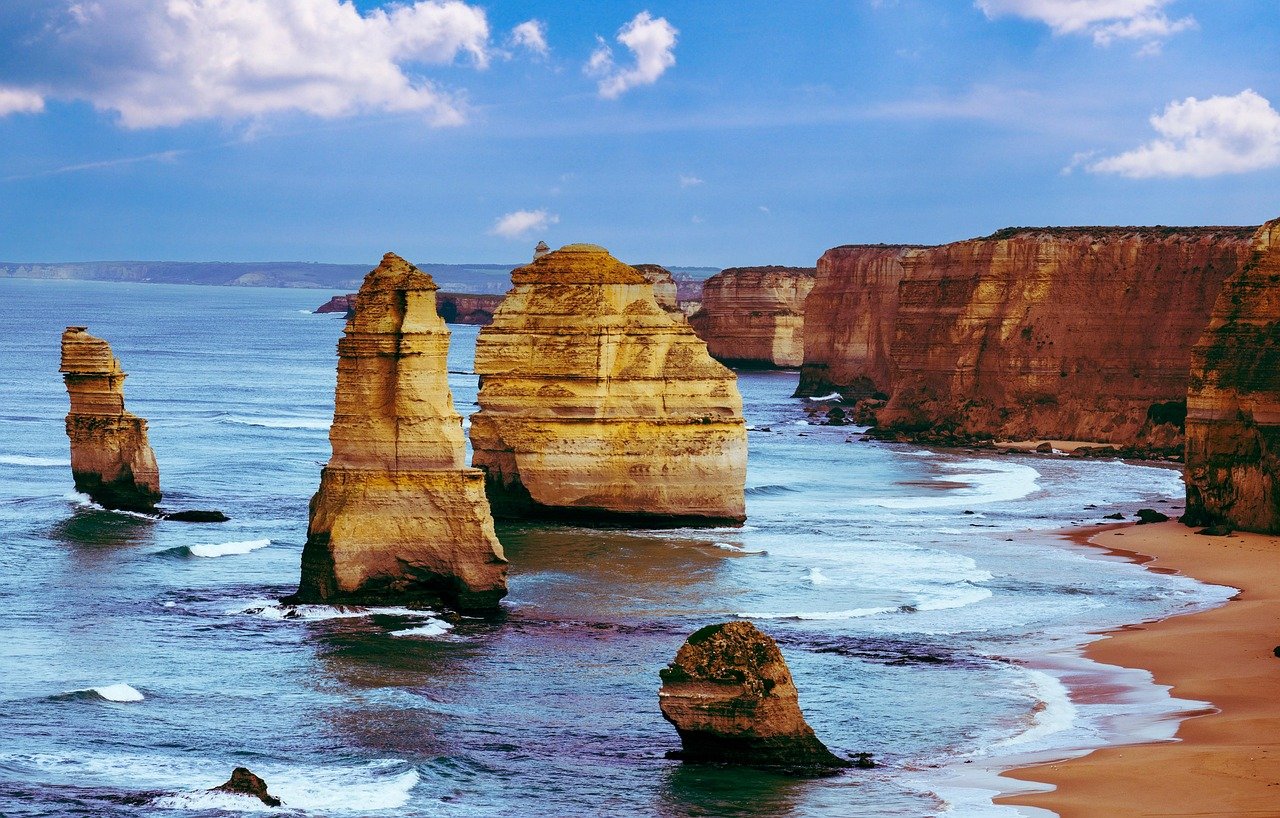
The limestone cliffs and stacks of the Port Campbell coast were formed over approximately 20 million years. The Otway limestone bedrock was laid down as ancient seabed sediment and uplifted as tectonic forces pushed the Australian continent northward. As the coastline receded under the relentless pressure of Southern Ocean waves, erosion created caves in the cliff face, which gradually expanded into arches, and finally collapsed into isolated stacks. The process continues: the stacks are being eroded at a rate of approximately two centimetres per year, and their individual lifespans are measured in centuries rather than millennia.
Despite their name, there were never twelve of the stacks. At the time of naming in 1922 there were nine (the previous name, the Sow and Piglets, was deemed insufficiently poetic for tourism purposes). Over the following decades the number has fluctuated as some stacks collapsed and new ones became distinct formations. As of 2026, eight major stacks remain standing, though the exact count depends on your definition of a qualifying “apostle.” The coastline’s continuing evolution means that visiting today is seeing a moment in an ongoing geological narrative.
What to See
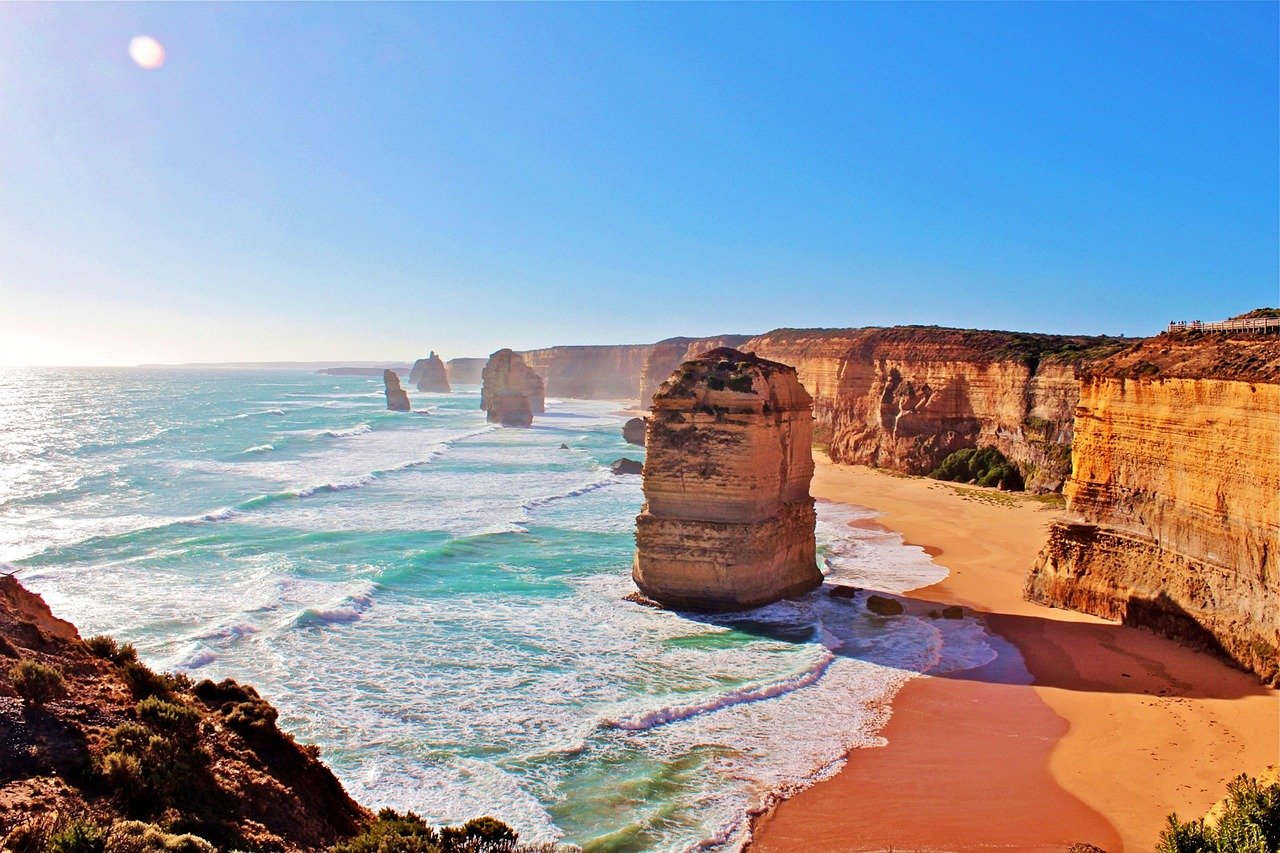
The main viewing area consists of two elevated platforms connected by a tunnel under the Great Ocean Road, with views on both sides of the canyon. The western platform offers the most dramatic view: the full sweep of the stacks against the cliffs, with the Southern Ocean stretching to the horizon. The eastern platform provides a different angle and tends to catch the morning light more directly. Both are accessible by wide, flat paths from the visitor centre car park — the walk is about 300 metres each way on a sealed path.
Loch Ard Gorge, 3 kilometres east of the Twelve Apostles, is arguably even more dramatic: a narrow slot canyon carved into the cliffs where the sea rushes in and out through a narrow mouth. It is named for the iron-hulled clipper ship Loch Ard, which struck rocks nearby in 1878 on its maiden voyage; only two of its 54 passengers and crew survived, swimming ashore through this very gorge. The geological formations here — stacks, arches, and caverns — are no less spectacular than the Apostles themselves, and it draws far fewer visitors.
The Coastline

The Port Campbell coast contains a series of extraordinary geological formations beyond the famous stacks: the Razorback (a long, thin remnant arch), the Island Arch (a complete surviving arch), London Bridge (which lost half its structure in a dramatic collapse in 1990, stranding two tourists on the seaward section), and Gibson Steps, where a steep staircase descends to the beach at the base of the cliffs. At low tide you can walk on the beach between the base of the cliffs and the surging sea — an experience of remarkable drama and scale.
The Great Ocean Road itself, running from Torquay to Allansford, is one of the world’s great scenic drives. Built between 1919 and 1932 by returned soldiers as both a coastal access road and a memorial to fallen comrades of World War One, it follows the cliff edge for much of its 243 kilometres. The section between Apollo Bay and Port Campbell, where the Apostles are located, is the most dramatic — a narrow road clinging to cliff tops above a surf that goes to Antarctica without interruption.
Practical Information
- Entry: Currently free; a visitor fee system via the new Twelve Apostles Visitor Experience Centre is planned (check the Great Ocean Road Coast and Parks Authority website for current status)
- Opening hours: Lookouts and walking trails open 365 days a year from dawn to dusk
- Best time to visit: Sunrise or early morning for the best light and fewest crowds; sunset is spectacular but busier; helicopter tours available in summer
- Duration: 1-2 hours for the Apostles and Loch Ard Gorge combined
- Distance from Melbourne: 275 km; 3-4 hours drive, or a full-day tour from the city
Local Insights
What locals know that guidebooks don’t always tell you:
- Arrive at or before sunrise – the low horizontal light turns the limestone stacks gold and the car park is empty; by 9am the coach tours have arrived and the viewing platforms are crowded.
- The helicopter flights from the helipad near the visitor centre (around AUD 150-165 for 12 minutes) give a completely different perspective and are worth the cost for the aerial photographs.
- London Bridge and the Razorback are 10 minutes drive east and have far smaller crowds than the Apostles themselves – visit them on the same trip.
- Gibson Steps beach is one of the most dramatic places on the coast but the steps are steep and narrow; allow extra time and take extreme care after rain.
- Port Campbell township, 12 km east, has better food options and accommodation than the immediate Apostles area – base yourself there rather than driving back to Colac.
Getting There
- By car: From Melbourne, drive west on the M1 (Western Ring Road) then follow signs to Geelong and the Great Ocean Road; the journey takes 3-4 hours
- By tour: Many Melbourne operators run day tours to the Twelve Apostles; typically depart 7am and return by 9pm including Great Ocean Road stops
- From Port Campbell: The town is 12 km east; drive west on the B100
- No public transport: There is no practical public transport connection to the Twelve Apostles – a car or organised tour is required
Frequently asked questions
Why are they called the Twelve Apostles if there aren’t twelve?
The name was a 1922 marketing decision — the previous name (Sow and Piglets) was deemed unsuitable for tourism promotion. There have never been twelve, and the number fluctuates as stacks collapse and new formations emerge. Eight main stacks are currently visible.
Can I get down to the beach at the Twelve Apostles?
Access directly under the Apostles is restricted for safety reasons. Gibson Steps, 3 km west, provides beach access at the base of similar cliffs and is worth visiting. The beach is accessible at low tide and the cliffs are extraordinary up close.
Is there accommodation near the Twelve Apostles?
Port Campbell township, 12 km east, is the nearest base with hotels, motels, and campsites. The Port Campbell National Park camping area at Princetown is also nearby. Apollo Bay, 100 km east, offers more accommodation options.
What is the best time of year to visit?
The Apostles are spectacular year-round. Summer (Dec-Feb) has more daylight hours and warmer weather but the most crowds. Winter sunrise visits (June-Aug) offer dramatic moody light, smaller crowds, and migratory whales in the bay below the cliffs (June-September).
How do helicopter tours work?
Helicopter flights depart from a helipad adjacent to the car park. Flights of 12-15 minutes circle the Apostles and coastline; longer flights cover Loch Ard Gorge and other formations. No booking is needed for short flights; simply join the queue at the helipad.