
Three Sisters
The Blue Mountains earn their name at dusk, when the haze of eucalyptus oil evaporated from millions of gum trees turns the light a deep, impossible blue that artists have been trying to capture since the 1870s. From Echo Point, 1,065 meters above sea level, the Jamison Valley drops away below your feet — a vast forested canyon system carved by millennia of erosion — and there in the middle distance stand the Three Sisters: a trio of sandstone spires, 922 to 918 meters tall, that have become the icon of these mountains and one of the most recognizable natural landmarks in Australia.
History of the Three Sisters
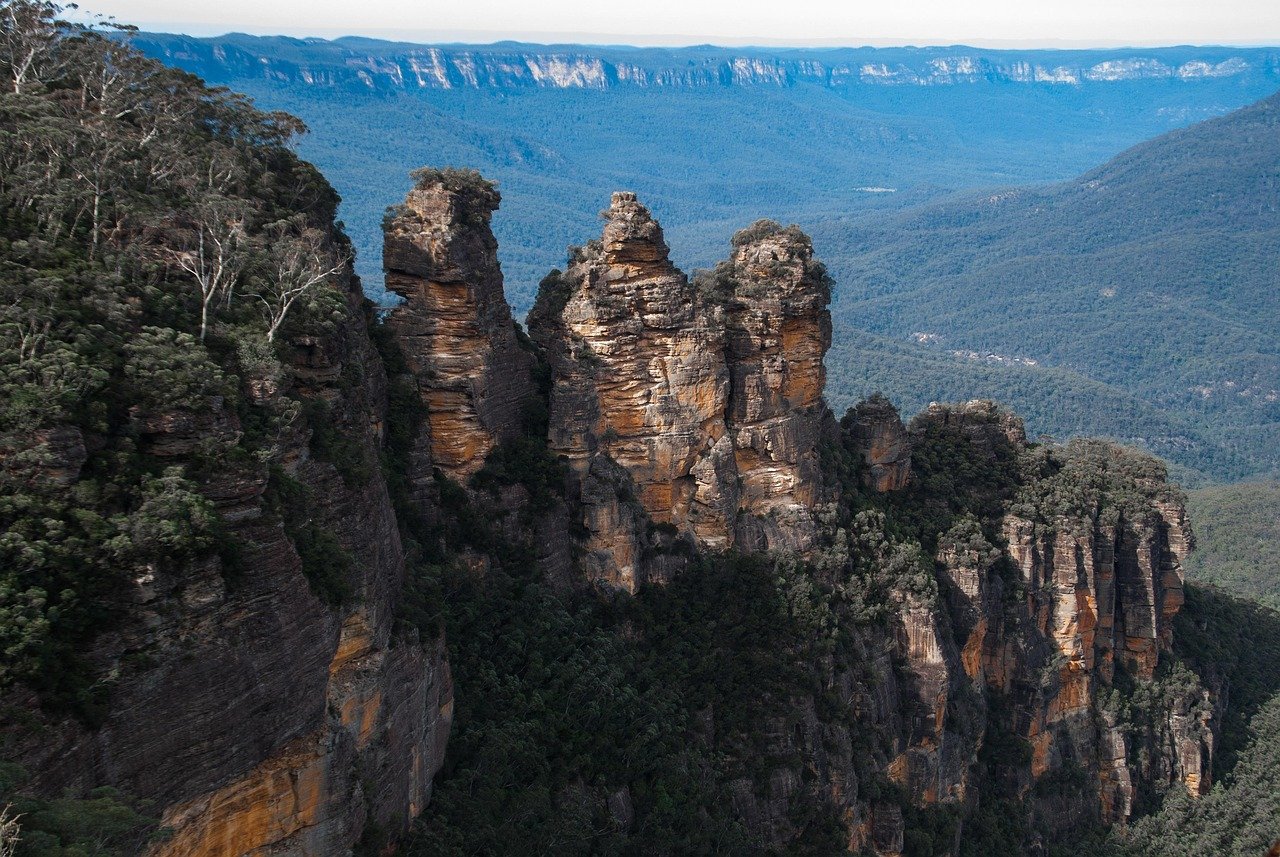
The Three Sisters — named Meehni, Wimlah, and Gunnedoo in the Dharug language — hold deep significance for the local Gundungurra and Darug Aboriginal people, whose connection to this landscape extends back more than 20,000 years. The most widely shared story of the Three Sisters tells of three sisters who were turned to stone by a tribal elder to protect them from a Bunyip (a dangerous water creature) during a battle. The elder was killed before he could restore them, and they remain as stone to this day. As with all Aboriginal cultural narratives, there are aspects of these stories that are sacred knowledge not for general sharing.
European awareness of the Blue Mountains as a natural attraction dates from the early 19th century, when the first successful crossing of the Great Dividing Range in 1813 revealed the plateau system to colonial settlers. The establishment of Katoomba as a health retreat and tourist destination in the 1880s, connected by rail from Sydney from 1868, made the Blue Mountains one of Australia earliest holiday destinations. The Scenic Railway at Katoomba — the world steepest railway, built in 1945 from a coal mine incline — became one of the area’s most famous attractions. In 2000, the Greater Blue Mountains Area was inscribed as a UNESCO World Heritage Site for its exceptional eucalypt diversity and significance to Aboriginal cultural heritage.
What to See
Echo Point, the main viewing platform in Katoomba, provides the classic Three Sisters view and is accessible for all mobility levels — the platform has wheelchair access and railings throughout. The viewing area is most dramatic in the golden hour before sunset, when the light catches the sandstone spires from the west. On clear days, the view extends across the entire Jamison Valley with the plateau walls of the Kanangra-Boyd National Park visible 40 kilometers in the distance.
The Giant Stairway descends from Echo Point into the Jamison Valley and allows visitors to walk to the base of the Three Sisters — an extraordinary experience of scale, since from below the formations are revealed to be part of a continuous cliff face of extraordinary height. The walk takes 30-45 minutes one way and involves approximately 800 stairs; the return is by the Scenic Railway (ticketed separately) or by climbing back up the same stairs. The Scenic World precinct at Katoomba offers the Scenic Railway, Scenic Skyway (gondola over the valley), and a rainforest boardwalk at the valley floor — a full experience package that works well for families.
The Geology
The Blue Mountains are not technically mountains — they are a dissected plateau of horizontally bedded Triassic and Permian sandstones, shales, and coals, uplifted and then deeply eroded by rivers and streams over millions of years. The Three Sisters are a remnant of this erosion process: a finger of harder rock separated from the main plateau escarpment by differential weathering along joint systems in the sandstone. The same process is actively continuing — visually imperceptible on human timescales but measurable by geologists — meaning the Three Sisters, like all Blue Mountains landforms, are ephemeral features in the deep-time context of geology.
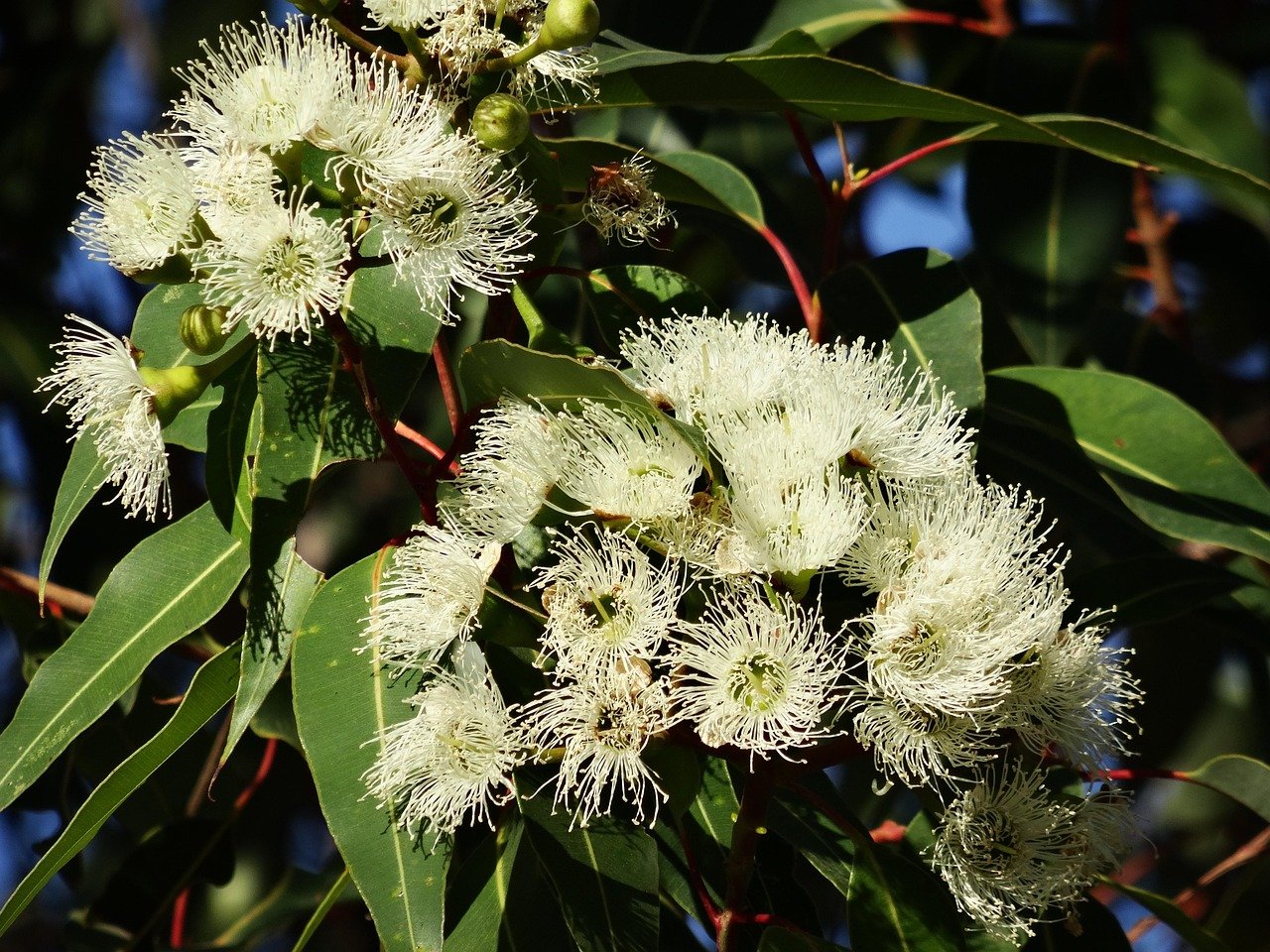
The eucalyptus forest that fills the valleys — over 90 species of eucalypt have been recorded in the Greater Blue Mountains Area — is the reason for the characteristic blue haze. Volatile terpene compounds (particularly eucalyptol) evaporate from the leaves in warm conditions, creating a fine aerosol mist that scatters short-wavelength blue light more effectively than longer wavelengths. This is literally the same optical effect as looking at a distant mountain range — but here it occurs at valley floor level, producing a richness of atmospheric blue that is unique to Australia eucalyptus landscapes.
Practical Information
- Tickets: Echo Point is free. Scenic World passes: adult AUD 55, child AUD 32 (includes all four experiences). Giant Stairway descent is free; Scenic Railway for return costs extra.
- Opening hours: Echo Point viewpoint: always open. Scenic World: daily 09:00-17:00. Katoomba town facilities vary.
- Best time to visit: Autumn (March-May) for crisp clear air and color. Mornings and late afternoons for the best light on the cliffs. Avoid school holiday weekends for Echo Point crowds.
- Duration: 1-2 hours for Echo Point and the Scenic World pass; half a day or more for walking trails into the valley.
- Booking: Scenic World tickets can be purchased online in advance; walk-in available. No booking required for Echo Point itself.
Local Insights
What locals know that guidebooks do not always tell you:
- The Prince Henry Cliff Walk runs for 7.5 km along the escarpment between Echo Point and Sublime Point — a spectacular trail with multiple viewpoints that avoids the tour bus crowds at Echo Point itself.
- The town of Leura, 3 km from Katoomba, has significantly better cafes and restaurants and a more local atmosphere than Katoomba centre — walk or drive between the two.
- The Blue Mountains are notorious for rapid weather changes — a clear morning at Echo Point can turn to dense cloud and rain within an hour. Bring a rain jacket regardless of the Sydney forecast.
- The Scenic Railway descends at 52 degrees — genuinely steep. The first drop is alarming if you are not prepared for it. The cars recline for the descent, which helps, but those with vertigo should consider the Skyway gondola as an alternative.
- Katoomba town has excellent independent restaurants, bookshops, and vintage stores that are worth exploring beyond the tourism infrastructure at Echo Point and Scenic World.
Getting There
- Train: Blue Mountains Line from Sydney Central to Katoomba takes about 2 hours. Trains run frequently throughout the day. Echo Point is 2 km from Katoomba station (bus, taxi, or 30-minute walk).
- By car: Follow the Great Western Highway (M4/A32) west from Sydney — about 90 minutes to Katoomba depending on traffic. Parking at Echo Point is metered and limited in peak season.
- Bus: Explorer buses run a loop between Katoomba station, Echo Point, and Scenic World — a convenient option once you reach Katoomba.
- Day tours: Many Sydney operators offer guided day tours to the Blue Mountains including transport from Sydney CBD.
Frequently asked questions
Why are they called the Three Sisters?
The name comes from an Aboriginal Dreamtime story of three sisters who were turned to stone to protect them from danger during a battle. The individual sisters are named Meehni, Wimlah, and Gunnedoo in the Gundungurra language. The formations stand at approximately 922, 918, and 906 meters.
Can you walk to the base of the Three Sisters?
Yes — the Giant Stairway descends from Echo Point to the valley floor, with a track that passes the base of the spires. The walk involves approximately 800 steps and takes 30-45 minutes down; allow the same or more for the return, or take the Scenic Railway back up at Scenic World.
How far are the Blue Mountains from Sydney?
Katoomba, the main gateway town, is about 100 km west of Sydney — approximately 90 minutes by car or 2 hours by train on the Blue Mountains Line from Central Station.
Is the Scenic Railway scary?
The Scenic Railway descends at 52 degrees — the world steepest passenger railway — for about 415 meters. The cars recline to a nearly horizontal position for the descent. Most visitors find it thrilling rather than frightening, but those with severe vertigo should consider the Skyway gondola instead.
What else can I do in the Blue Mountains?
The Blue Mountains have over 140 km of walking tracks for all fitness levels. Notable experiences include the Wentworth Falls trail, Govetts Leap at Blackheath (the highest waterfall viewpoint), and the Valley of the Waters near Wentworth. The towns of Katoomba and Leura have excellent restaurants, galleries, and independent shops.