
Temple of the Emerald Buddha (Wat Phra Kaew)
The smell of incense reaches you before you enter — a sweet, smoky cloud that drifts from hundreds of joss sticks burning before golden figures at the entrance to the Grand Palace complex. Inside, the cacophony of the Bangkok street gives way to something more formal, more charged. The Temple of the Emerald Buddha (Wat Phra Kaew) stands at the heart of this walled palace city, and even amid the tour groups and the smartphones and the carefully managed visitor flows, its presence is unmistakable. This is the most sacred site in Thailand, and walking its grounds you feel the weight of that reverence.
History of Wat Phra Kaew

The Temple of the Emerald Buddha was established by King Rama I in 1784, the same year he founded Bangkok as the new capital of the Chakri dynasty after the destruction of the previous capital Ayutthaya. The Grand Palace complex, within which the temple stands, was designed as both a royal residence and a religious centre of supreme importance — a statement of the new dynasty’s power and piety. The Emerald Buddha itself, however, is considerably older than the temple that houses it.
The Emerald Buddha is a seated figure approximately 66 cm tall, carved from a single piece of jade (not emerald — the green colour led to the name). Its origins are disputed, with legend placing its creation in ancient India and historical scholarship suggesting a 15th-century Chiang Rai manufacture. The statue passed through several kingdoms — Lampang, Chiang Mai, Luang Prabang, Vientiane — before King Rama I brought it to Bangkok, where it has remained the most revered Buddhist image in Thailand. Three seasonal costumes of gold and precious stones are changed by the King himself three times a year to mark the change of seasons.
What to See
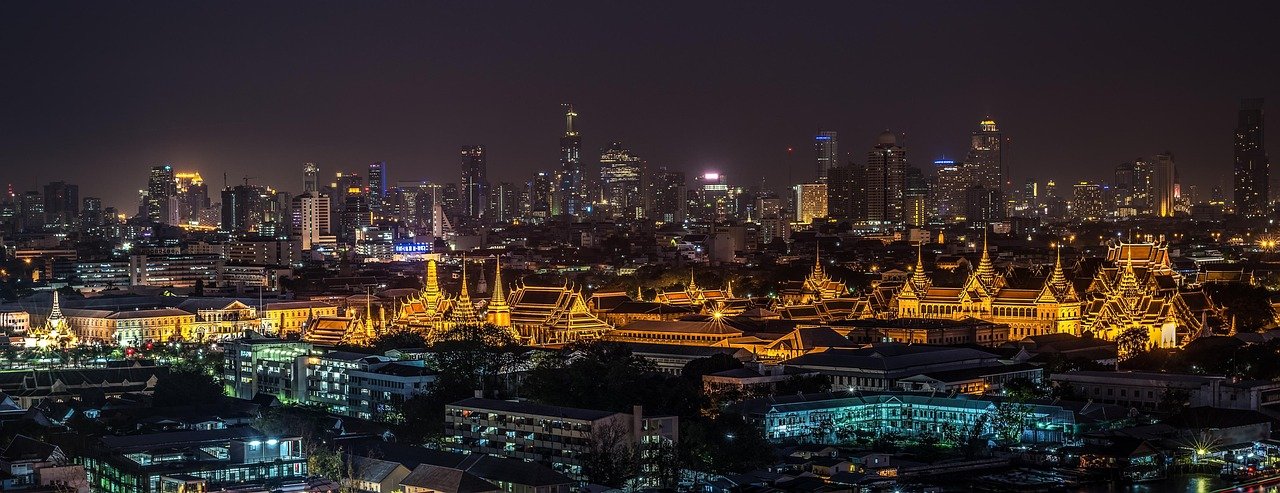
The Temple of the Emerald Buddha is a complex rather than a single building. The bot (main hall) contains the Emerald Buddha, elevated on a high throne and visible only from a distance behind protective barriers — visitors cannot approach the statue but can photograph it from the hall entrance. The surrounding courtyard contains an extraordinarily dense assembly of religious structures: miniature Khmer-style towers, golden chedis, mythological guardian statues, and long galleries covered in murals depicting the Ramakien (the Thai version of the Ramayana epic). The murals, which cover 178 panels around the cloister, are a masterpiece of Thai painting.
Beyond the temple proper, the Grand Palace complex includes several additional palace buildings used for royal ceremonies, the Chakri Maha Prasat Hall (which uniquely combines European and Thai architectural styles), and the Aphon Phimok Prasat (a royal changing pavilion of particular architectural elegance). The adjacent Queen Sirikit Museum of Textiles, included in the admission price, provides an excellent overview of traditional Thai weaving and royal textile heritage.
Sacred Significance

Wat Phra Kaew is not merely a tourist attraction — it is an actively sacred space where Thais come to pray and make offerings. On Buddhist holy days (every full moon, new moon, and quarter moon), the temple fills with worshippers whose devotion is entirely sincere and whose ritual observances create a profound atmosphere. The King of Thailand maintains a direct connection to the Emerald Buddha through the three seasonal costume changes, which are official state ceremonies. Foreign visitors share this space as guests, which is reflected in the strict dress code requirements.
The relationship between Thai Buddhism and the monarchy is inseparable from understanding Wat Phra Kaew. The temple has no resident monks; it exists solely as a royal chapel, and the ceremonies performed here are intimately linked to the ritual life of the Thai state. The gold-spired decorations, the mythological guardian figures, and the elaborate iconography all express a worldview in which the Dharma and the dynasty are mutually sustaining.
Practical Information
- Tickets: THB 500 per person (approximately USD 14); includes entry to Grand Palace and Queen Sirikit Museum of Textiles
- Opening hours: Daily 8:30-15:30 (last entry 15:00)
- Best time to visit: Arrive at opening (8:30) to avoid the worst crowds; avoid visit on Buddhist holy days if you want fewer people, or come specifically on holy days for authentic ceremonial atmosphere
- Duration: 2-3 hours for the full complex including Grand Palace buildings
- Dress code: Shoulders and knees must be covered; sarongs are available to borrow at the entrance for those not appropriately dressed
Local Insights
What locals know that guidebooks don’t always tell you:
- Arrive at 8:30am when the gates open – by 10am the tour groups from cruise ships and coach tours have arrived and the queues are long and the complex is very crowded.
- Beware of tuk-tuk drivers outside the complex who claim the palace is closed for a Buddhist holiday and offer to take you to a gem shop instead – this is a classic scam; the palace is almost never closed to tourists.
- Photography of the Emerald Buddha itself is technically not allowed from inside the bot, but photographs from the entrance are acceptable; tripods are prohibited throughout.
- The combination ticket includes the Queen Sirikit Museum of Textiles which is genuinely excellent and far less crowded; allocate 45 minutes for it.
- Wat Pho (Temple of the Reclining Buddha) is a 5-minute walk south and should be combined with any Grand Palace visit – its single ticket covers multiple buildings and the 46-metre reclining Buddha is remarkable.
Getting There
- By boat: Chao Phraya Express Boat to Tha Chang pier (N9) – most scenic and often fastest approach from the riverside
- By MRT: Sanam Chai station on the Blue Line; 15-minute walk through the historic area
- By tuk-tuk/taxi: Tuk-tuks from the Khao San Road area; metered taxis from anywhere in the city – ask for Na Phra Lan Road
- Address: Na Phra Lan Road, Phra Borom Maha Ratchawang, Phra Nakhon, Bangkok 10200
Frequently asked questions
Do I need to buy tickets in advance?
Tickets are purchased at the entrance; there is no online advance booking system currently. Arriving early avoids the long queues that form by mid-morning. The ticket price is fixed and there are no discounts.
What happens if I am not dressed appropriately?
Visitors who are not appropriately dressed (shoulders or knees exposed) can borrow covering clothing at the entrance at no additional charge. The dress code is strictly enforced; visitors who refuse to comply will not be admitted.
Can I see the Emerald Buddha up close?
The Emerald Buddha is displayed on a high throne inside the main hall and is visible from the entrance but not accessible for close inspection. The statue itself is relatively small (66 cm); the elaborate setting and context make its impact far greater than the physical scale would suggest.
Is photography allowed inside the temple?
Photography is allowed throughout the complex including inside the bot, but photographing the Emerald Buddha directly from within the hall is technically restricted. From the hall entrance, photographs are acceptable. Drone photography is strictly prohibited.
Is the Grand Palace still used by the Thai royal family?
The Grand Palace is no longer used as a royal residence; the royal family now lives at Chitralada Royal Villa and Dusit Palace. However, the Grand Palace and Wat Phra Kaew are used for important royal and state ceremonies throughout the year.