
Sant Pau Recinte Modernista
From the far end of Avinguda Gaudí, it appears as a vision: pavilions of warm red brick capped with blue-and-gold mosaic domes, arranged around a garden where orange trees scent the air and the Sagrada Familia rises in the distance framed exactly between two of the buildings. The Recinte Modernista de Sant Pau is one of the most beautiful architectural complexes in Europe — a hospital designed by Lluís Domènech i Montaner as a place where art, nature, and cutting-edge medical care would combine to heal patients through beauty itself. Built between 1901 and 1930, it is now a UNESCO World Heritage Site and a testament to the extraordinary ambition of Catalan Art Nouveau.
History of Sant Pau Recinte Modernista
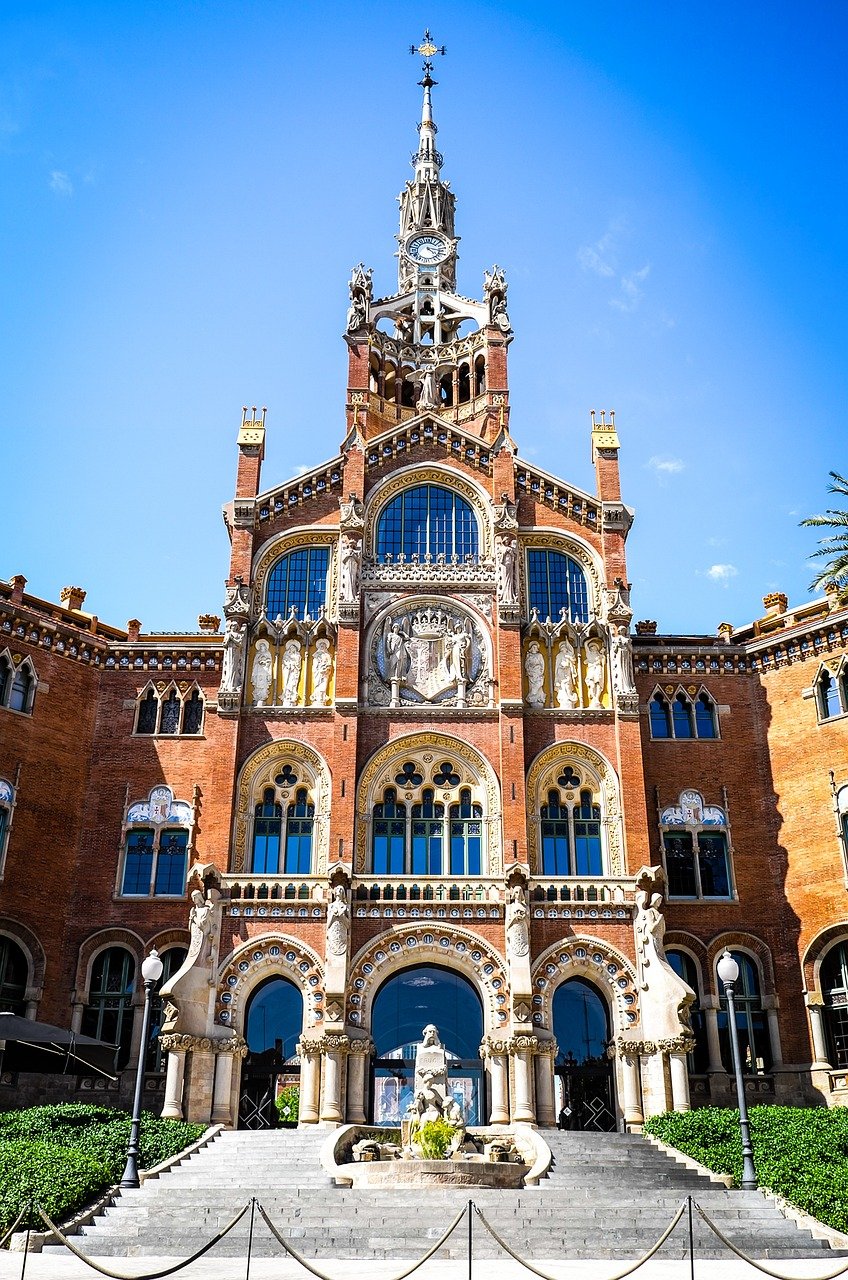
The Sant Pau complex was commissioned in 1889 by Catalan banker Pau Gil, who donated his fortune for the construction of a new hospital that would replace the overcrowded medieval Hospital de la Santa Creu in the Gothic Quarter. Gil specified in his will that the hospital be designed to serve the poor free of charge and that it incorporate gardens and works of art as part of the therapeutic environment. The commission went to Lluís Domènech i Montaner — Gaudi chief rival and arguably his equal as an architect — who designed a complex of 48 pavilions arranged around underground corridors to minimize patient transport between departments.
Construction began in 1901 and the first phase (12 pavilions) opened in 1930. A second phase by Domènech i Montaner son and grandson added more pavilions through the 1960s. The hospital complex operated as a functioning medical facility until 2009, when it moved to a new modern building. The historic pavilions were then systematically restored over five years and opened as a cultural space in 2014. UNESCO designated the complex as a World Heritage Site in 1997, together with the Park Guell and the Palau de la Musica Catalana, recognizing its significance as one of the masterworks of European Art Nouveau.
What to See
The main entrance pavilion sets the tone for the entire complex: a ceremonial building faced in red brick with towers, mosaic medallions, and sculptural decoration in the Catalan Modernista style. From here, a central axis leads through the garden, which is planted with medicinal and ornamental species and designed with the therapeutic landscape theory of the late 19th century — the idea that connection to nature aided recovery. The garden view from the main pavilion entrance, with the Sagrada Familia framed in the distance along Avinguda Gaudi, was a deliberate visual alignment by Domènech i Montaner, creating a dialogue between the two great works of Catalan Modernisme.
The individual pavilions are all different in their decorative schemes while sharing the overall red-brick and mosaic palette. The Administration Pavilion, the Hydroelectric Station (with its extraordinary hypocaust heating system), and the main hospital wards with their Art Nouveau tile work and stained glass windows are all open to visitors. The underground gallery system connecting all pavilions is particularly memorable — a tunnel of pale glazed tile with arched ceilings through which patients were once transported between departments without exposure to the elements.
The Art and Architecture
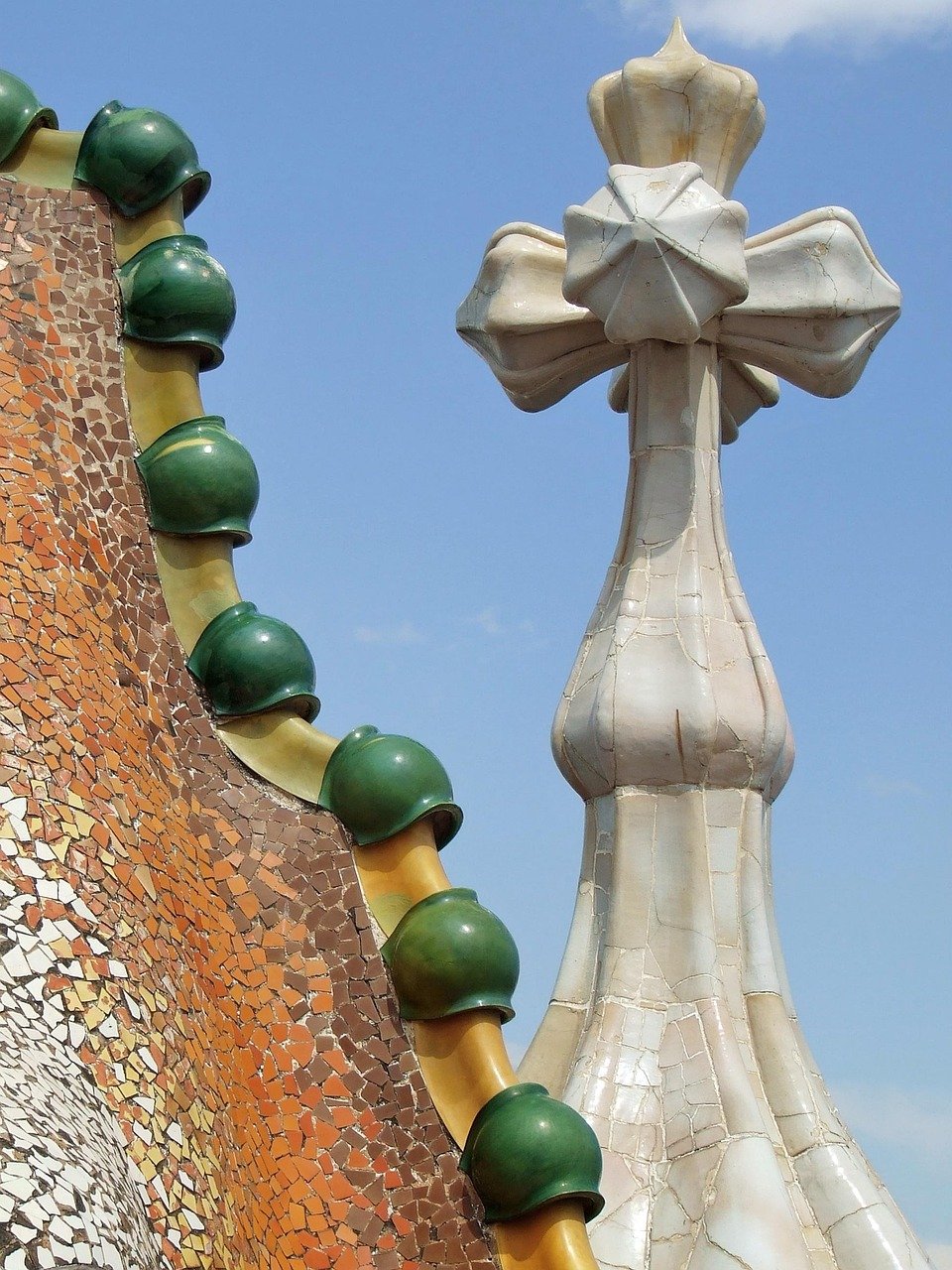
Domènech i Montaner filled the Sant Pau complex with an extraordinary density of applied art: mosaic cladding using trencadis (broken tile) technique in blues, greens, and golds; sculptural groups representing allegories of medicine, science, and charity; carved stone reliefs on the gateway arches; and stained glass windows in the ward pavilions that flood the interiors with colored light. The total artwork program employed dozens of artists and craftsmen over the course of three decades, creating a building complex that is as much a museum of applied arts as a work of architecture.
The structural system is as innovative as the decoration. Domènech i Montaner used a combination of brick vaulting and early reinforced concrete to create wide-span interiors without internal columns — providing flexibility for medical use while allowing the extraordinary decorative freedom that defines the buildings externally. The color theory underlying the mosaic schemes was not arbitrary: specific colors were selected for their psychological effects on patients, reflecting the therapeutic design philosophy that guided the entire project. Blue and green dominated wards for general patients; warmer colors were reserved for more intense medical areas.
Practical Information
- Tickets: Adults EUR 15; reduced EUR 10.50 (students, seniors, Barcelona Card). Children under 12 free. Audio guide included. Online tickets recommended in summer.
- Opening hours: Monday-Saturday 10:00-17:30 (April-October until 18:30), Sunday 10:00-14:30. Last entry 30 minutes before closing.
- Best time to visit: Weekday mornings for the fewest crowds and best light in the garden. The complex is beautiful in any season.
- Duration: 1.5-2 hours for the full self-guided audio tour including underground gallery.
- Booking: Online at santpaubarcelona.org; strongly recommended in summer months. Walk-in tickets available at the entrance subject to capacity.
Local Insights
What locals know that guidebooks do not always tell you:
- The view down Avinguda Gaudi from the Sant Pau main entrance toward the Sagrada Familia is one of the most extraordinary architectural alignments in Barcelona — spend time with this view before entering the complex.
- The underground tunnel connecting the pavilions is often the highlight for visitors who explore the full complex — it is cool, photogenic, and gives a sense of how the hospital actually functioned.
- Sant Pau is on the tourist circuit but significantly less crowded than the Sagrada Familia or Park Guell — often you can have entire pavilions to yourself even in peak summer.
- The complex is included in the Barcelona Card, which also covers the Sagrada Familia entrance — a good value combination if you are planning multiple major Modernista sites.
- The terrace cafe in the complex gardens serves reasonable food at Barcelona museum prices — eating here under the orange trees with the dome pavilions around you is a genuinely special experience.
Getting There
- Metro: Line 5 (Guinardo/Hospital de Sant Pau station) — 2-minute walk to the entrance. Or Line 2/5 (Sant Pau/Dos de Maig).
- On foot: 10-minute walk from the Sagrada Familia along Avinguda Gaudi — a beautiful approach that allows the alignment of the two buildings to become apparent.
- Bus: Routes 19 and 47 pass the entrance on Carrer de Sant Antoni Maria Claret.
- Taxi/Grab: Ask for “Recinte Modernista de Sant Pau” — well known to all Barcelona drivers.
Frequently asked questions
Is Sant Pau Recinte Modernista worth visiting?
Yes — most visitors rank it among their top two or three Barcelona experiences. The combination of architectural beauty, the extraordinary density of applied art, and the manageable crowd levels (compared to the Sagrada Familia) makes it essential for anyone with more than two days in the city.
How does Sant Pau compare to the Sagrada Familia?
They are different in scale and function. The Sagrada Familia is an ongoing construction project of enormous ambition. Sant Pau is a complete, finished complex that can be fully explored on a single visit. Both are UNESCO World Heritage Sites and masterworks of Catalan Modernisme. If choosing between them for a half-day visit, the Sagrada Familia wins on spectacle; Sant Pau wins on intimacy and completeness.
Was Sant Pau actually a functioning hospital?
Yes — the complex served as Barcelona primary public hospital from 1930 until 2009. Generations of patients were treated in the same mosaic-decorated pavilions that visitors now explore. The move to a modern facility allowed the historic buildings to be carefully restored for cultural use.
What is the underground gallery at Sant Pau?
A system of underground corridors connecting all the pavilions, built so that patients could be transported between departments without being exposed to Barcelona weather. Now restored and open to visitors, it provides a unique view of the complex from below and is one of the most architecturally distinctive elements of the site.
Can I take photos inside Sant Pau?
Yes — photography is freely permitted throughout the complex, including the underground gallery and all the open pavilion interiors. Tripods are not permitted during busy periods to avoid blocking other visitors.