
Priene
Climbing the stepped streets of ancient Priene on a warm Aegean morning, with the Temple of Athena Polias emerging from the pine-scented hillside and the vast plain of the Maeander delta spread below, it becomes easy to understand why Alexander the Great was so taken with this city that he financed its temple himself. Priene is one of the best-preserved examples of Hellenistic urban planning anywhere in the ancient world — a city laid out with mathematical precision on a steep hillside, its grid of streets unchanged since the 4th century BCE, its theater still open to the Anatolian sky.
History of Priene
Priene was founded — or rather refounded at its current location — around 350 BCE when the original coastal city became landlocked as the Maeander River progressively silted up its harbor. The new city was laid out according to the Hippodamian plan, a grid system of streets intersecting at right angles attributed to the Greek urban planner Hippodamus of Miletus. This rationalist approach to city design, with blocks of equal size and clear functional zoning, was considered the height of progressive civic thinking in its day. Priene became the showpiece city of Ionian urban planning.
Alexander the Great visited Priene in 334 BCE during his campaign against Persia and made a direct gift toward the construction of the Temple of Athena Polias — one of the most important examples of Ionic temple architecture in the ancient world, designed by Pytheos who also designed the Mausoleum of Halicarnassus. The inscription recording Alexander’s dedication was found by archaeologists and is now in the British Museum in London. After Alexander, Priene became part of the Seleucid Empire, then the Pergamon Kingdom, and finally the Roman province of Asia, continuing to function as a city until the Byzantine period when silting of the river finally cut it off completely from the sea.
What to See
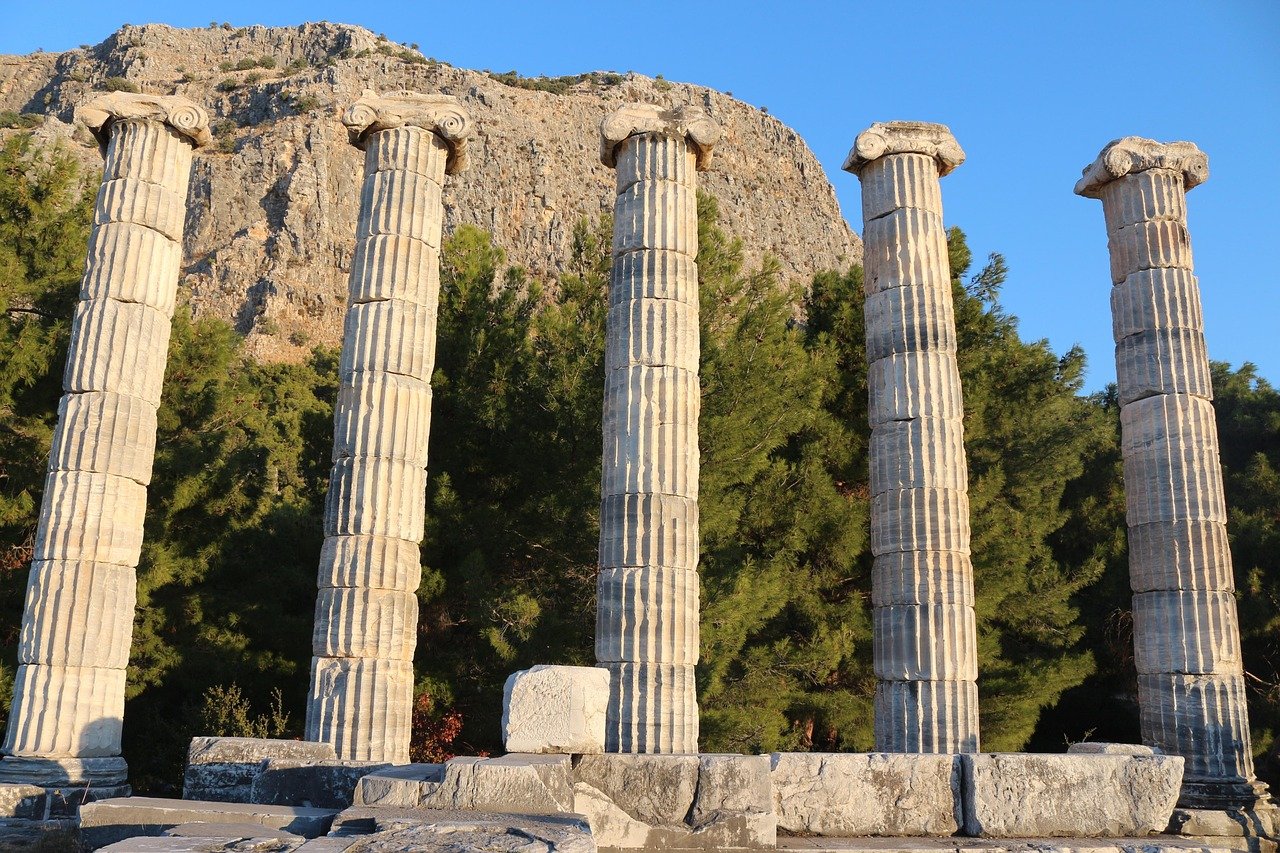
The site stretches across a steep hillside below the dramatic rocky acropolis of Mount Mycale. The most imposing monument is the Temple of Athena Polias, of which five columns were re-erected in the 1960s — they give a powerful impression of the original building’s scale and proportions. The adjacent sacred precinct, with its altar base still in place, is where Priene’s most important religious ceremonies took place. Below the temple, the well-preserved bouleuterion (council chamber) demonstrates the civic sophistication of Hellenistic urban culture: covered seating for around 640 citizens, with a central altar for sacrifices before official meetings.
The theater, cut into the hillside to the east, is among the best-preserved small Greek theaters in Asia Minor, with its marble proedria seats (reserved for important citizens) still intact in the front rows. The agora — the central marketplace and civic heart of any Greek city — occupies a large level terrace in the middle of the site, surrounded by the foundations of stoas (colonnaded walkways) and civic buildings. Private houses are also visible throughout the grid, giving an unusually complete picture of how an ordinary Hellenistic city looked and functioned.
The Grid City Plan
What makes Priene uniquely valuable among ancient sites is the completeness of its Hippodamian grid. Unlike Ephesus or Miletus, where later Roman rebuilding obscured earlier layouts, Priene was largely abandoned while still in its Hellenistic form, preserving the original street plan with extraordinary clarity. The city was divided into six distinct zones: the religious precinct, the civic center (agora and bouleuterion), the theater district, the gymnasium, residential neighborhoods, and the military zone. Each zone occupied its logical position within the grid, demonstrating an early and sophisticated approach to functional urban zoning.
Walking the ancient streets of Priene — still paved with their original stones, with kerbstones, doorway thresholds, and drainage channels intact — creates an unusually immediate connection to daily ancient life. You can trace the route from a private house to the agora, then up to the temple, following the same path that Priene’s citizens walked 2,300 years ago. The ruts worn into the street stones by wheeled traffic are still visible in some sections. This tactile quality of Priene, absent from many more famous ancient sites, is what makes it a deeply rewarding destination for visitors willing to explore it carefully.
Practical Information
- Tickets: Approximately 300 TRY (around USD 10-12) for adults; reduced for students and museum card holders. Prices change with Turkish lira fluctuations — check current rates on arrival.
- Opening hours: Daily 08:00-19:00 in summer (April-October); 08:00-17:00 in winter. The site is open every day including holidays.
- Best time to visit: April-June and September-October for pleasant temperatures and fewer crowds. July-August is very hot — bring water and start early.
- Duration: 2-3 hours for a thorough visit of the main site. Add 30-45 minutes if climbing to the acropolis for panoramic views.
- Booking: No advance booking required. The site rarely gets crowded even in peak season — arrive mid-morning for the best light on the temple columns.
Local Insights
What locals know that guidebooks do not always tell you:
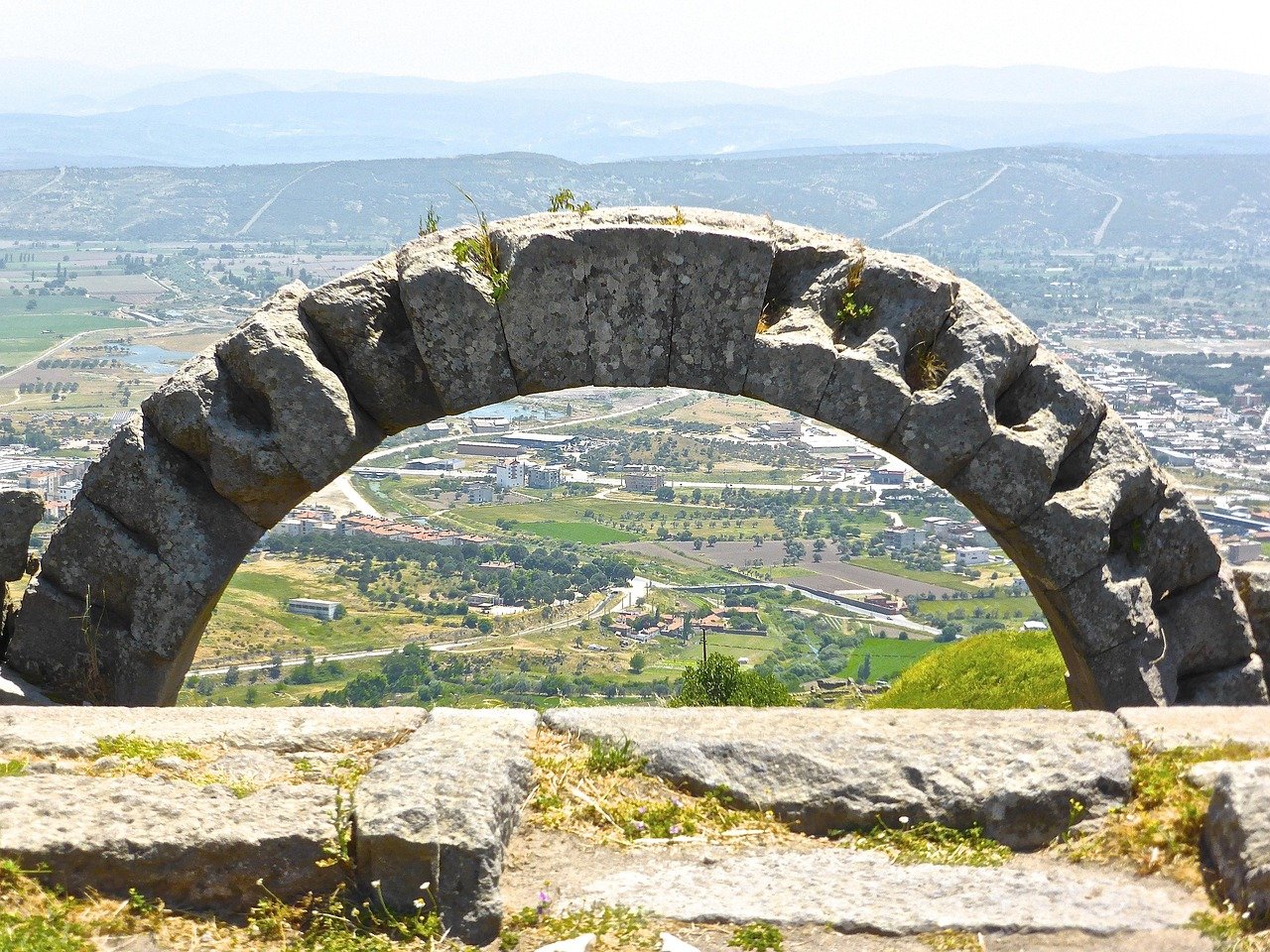
- The climb to the acropolis above the main site adds about 45 minutes but rewards with extraordinary panoramic views over the Maeander plain and across to Miletus — one of the finest vantage points in the Aegean region.
- Priene receives a fraction of the visitors that Ephesus gets — you can often have major monuments entirely to yourself, even in summer. The experience is more intimate and contemplative than at busier sites.
- The village of Gullubahce at the foot of the site has a handful of simple restaurants serving fresh fish and local mezes — significantly better and cheaper than the tourist restaurants near Ephesus.
- The coastal Aegean light in late afternoon is extraordinary at Priene — the five re-erected columns of the Temple of Athena glow gold against a deep blue sky for about an hour before sunset.
- Combine Priene with nearby Miletus (28 km) and Didyma (48 km) for a full-day ancient cities circuit — one of the finest classical archaeology routes in Turkey.
Getting There
- By car: Follow signs from Soke town center, 16 km west. Parking available at the site entrance.
- Bus: From Soke bus station, dolmus (shared minibuses) run to Gullubahce village at the base of the site; service is approximately hourly.
- From Kusadasi: About 55 km by road, easily combined with a day trip to Ephesus and Miletus.
- Taxi: From Soke, a taxi to Priene costs approximately 150-200 TRY; negotiate a waiting fee if you want the driver to bring you back.
Frequently asked questions
How does Priene compare to Ephesus?
Priene is smaller and sees far fewer visitors than Ephesus, but offers something Ephesus cannot: an almost complete Hellenistic city plan largely undisturbed by later Roman rebuilding. Archaeologically, Priene is arguably more significant for understanding Greek urban life. If you only have time for one, Ephesus wins on spectacle; Priene wins on authenticity and intimacy.
Is the site wheelchair accessible?
The main entrance path and lower agora area are manageable, but the steep ancient streets and rocky terrain throughout much of the site make full access difficult without mobility assistance. The temple area at the top is not accessible by wheelchair.
What was Alexander the Great’s connection to Priene?
Alexander visited in 334 BCE and donated funds for the completion of the Temple of Athena Polias, with a dedicatory inscription that was found by archaeologists and is now in the British Museum. This royal patronage reflects how important Priene was as a symbol of Ionian Greek civilization at the time.
Can I combine Priene with other ancient sites in a day?
Yes — the classic route is Priene + Miletus + Didyma, all within 50 km of each other. With a car, this circuit takes a full but rewarding day. Most Kusadasi and Bodrum tour operators offer this combination as a day excursion.
Is there a museum at Priene?
There is no on-site museum. The most important finds from Priene, including Alexander’s dedicatory inscription and architectural fragments from the Temple of Athena, are in the British Museum in London and the Istanbul Archaeological Museum.