
New Synagogue
The golden dome of the New Synagogue rises above the rooftops of Berlin’s Mitte district like a declaration — a deliberate, gleaming statement in gilded copper that Jewish life in this city is not erased, that the building rebuilt after the destruction of Kristallnacht and the war still stands on the same street where it was inaugurated in 1866 before an audience that included Otto von Bismarck. The Oranienburger Strasse, which the synagogue anchors at its midpoint, is today one of Berlin’s most vibrant streets; but the history embedded in this building gives that vibrancy a particular, complicated texture that makes a visit here something more than cultural tourism.
History of the New Synagogue
The New Synagogue was constructed between 1859 and 1866 to designs by Eduard Knoblauch and Friedrich August Stüler in a Moorish revival style, taking inspiration from the Alhambra in Granada. At its inauguration in 1866, it was the largest synagogue in Germany, seating 3,200 worshippers. The choice of Moorish architecture was deliberate: it referenced the golden age of Jewish culture in Al-Andalus (medieval Islamic Spain) and positioned the German Jewish community as part of a broader Mediterranean civilisation rather than simply an eastern European immigrant community. The building’s interior was celebrated as one of the most beautiful in Berlin, with intricate stucco work, coloured glass, and gilt decoration of extraordinary quality.
On Kristallnacht (9–10 November 1938), the Night of Broken Glass, Nazi stormtroopers and civilians across Germany burned and destroyed Jewish property. In Berlin, the New Synagogue was attacked — but it was saved from burning by the local police precinct commander, Wilhelm Krützfeld, who ordered his men to extinguish the fire and stand guard, citing the building’s status as a protected monument. Krützfeld was subsequently reprimanded for his actions, but his intervention saved the shell of the building. Allied bombing in 1943 did significant damage, and the ruins stood through the postwar period. In 1988 the East German government began restoration, and the dome and facade were rebuilt and reopened as the Centrum Judaicum cultural and museum centre in 1995. The original main hall was not rebuilt — its footprint is marked in the ground as a memorial.
What to See
The building today functions as the Centrum Judaicum — a documentation centre for the history of Berlin’s Jewish community. The permanent exhibition covers the history of Berlin’s Jewish community from the seventeenth century to the present, with particular attention to the pre-war period when Berlin had one of Europe’s largest and most culturally productive Jewish populations, and to the persecution and murder of the community between 1933 and 1945. The exhibition is chronological, well-documented, and allows visitors to follow specific family stories across the full arc from emancipation to catastrophe.
The restored facade and dome are the building’s most spectacular elements and are accessible via the exhibition galleries. The dome viewpoint, reached by a tight internal stair, provides a panoramic view over Mitte’s rooftops that is unique in this part of the city — on a clear day the television tower at Alexanderplatz and the cathedral on Museum Island are both visible. Below the dome, the restored prayer gallery space functions as an event and exhibition venue. The footprint of the destroyed main sanctuary is marked in the courtyard behind the facade with a symbolic line of stones.
The Oranienburger Strasse Community
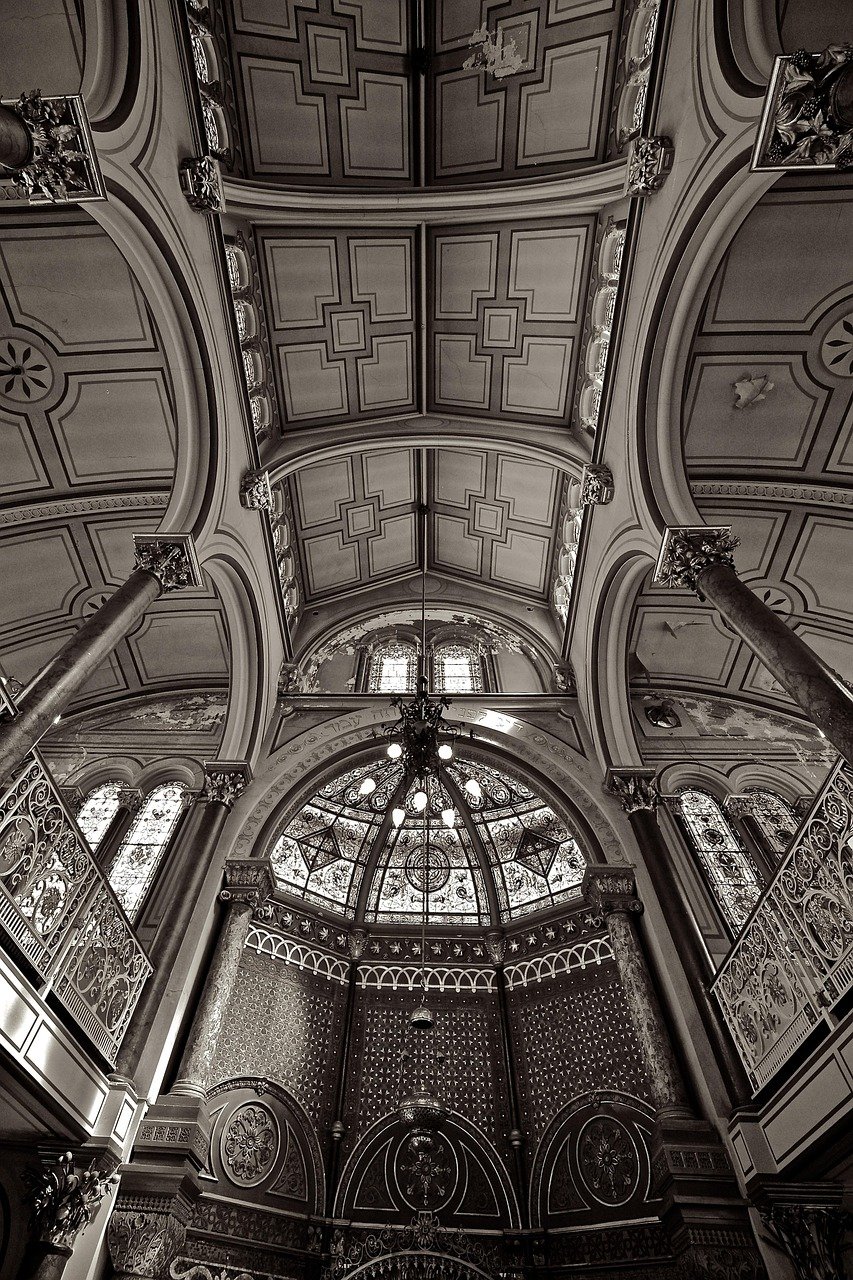
The Oranienburger Strasse was the cultural heart of Berlin’s Jewish community throughout the nineteenth and early twentieth centuries, and the streets between the synagogue and Hackescher Markt still bear traces of this history — former Jewish-owned businesses, prayer houses, and community institutions can be identified in the building fabric of the neighbourhood. The area is now one of Berlin’s most fashionable districts, full of cafes, galleries, and restaurants, but the layers of history beneath the contemporary vibrancy are accessible through the Centrum Judaicum’s guided neighbourhood tours.
The nearby Anne Frank Zentrum on Rosenthaler Strasse extends the memorial context of the synagogue visit, focusing on the life of Anne Frank and the broader history of children who experienced Nazi persecution. The Hackescher Markt, with its famous restored Art Nouveau Hackesche Höfe courtyards, provides a pleasant and architecturally interesting continuation of a walk through this historically rich district. The Museum of Jewish History (Jüdisches Museum Berlin) in Kreuzberg, designed by Daniel Libeskind, provides the broader philosophical and historical framework that complements the New Synagogue’s community-specific focus.
Practical Information
- Tickets: Adults €8; reduced €5; dome access included in standard ticket
- Opening hours: Monday–Friday 10:00 am–6:00 pm; Sunday 10:00 am–6:00 pm; closed Saturday (Shabbat) and Jewish holidays
- Best time to visit: Weekday mornings for the fewest visitors; the dome panorama is best in morning light
- Duration: 1–2 hours for the exhibition and dome climb
- Booking: Tickets available at the entrance; no advance booking required for individuals
Local Insights
What locals know that guidebooks don’t always tell you:
- The building is an active Jewish community site — ceremonies and events take place in the restored gallery and you may occasionally encounter the building partially closed for religious or community events. Check the calendar on the Centrum Judaicum website before visiting.
- The security screening at the entrance (metal detector, bag check) is standard for Jewish institutions in Germany and should be expected. The process is efficient and respectful.
- The nearby Hackesche Höfe (five minutes walk east) are Berlin’s finest surviving Art Nouveau courtyard complex — a pleasant post-visit walk through eight interconnected courtyards that were heavily used by the Jewish community in the early twentieth century.
- The small reconstructed prayer room in the building gives a sense of what the original 1866 interior may have looked like — the quality of the Moorish plasterwork detailing is extraordinary even in this partial form.
- The Neue Synagogue’s Wikipedia entry and the Centrum Judaicum website both contain extensive documentation of the building’s history that enriches a visit if read in advance.
Getting There
- S-Bahn: S1/S2/S25 to Oranienburger Strasse; the synagogue is directly visible from the station exit
- U-Bahn: U8 to Weinmeisterstrasse; 5-minute walk north on Rosenthaler Strasse
- Tram: M1, M6 to Oranienburger Strasse/Tucholskystrasse
- On foot: 10 minutes from Hackescher Markt S-Bahn; 15 minutes from the Spree promenade
Frequently asked questions
Is the New Synagogue an active place of worship?
Yes — the restored gallery and smaller prayer spaces function as an active synagogue and community centre. The building is both a museum and memorial (the Centrum Judaicum) and a living religious and cultural centre for Berlin’s Jewish community. Visitors are welcome, but respectful behaviour and appropriate dress are expected.
Is the New Synagogue safe to visit?
Yes — the building has professional security at the entrance and is carefully protected. Jewish institutions in Germany receive special police protection, and the neighbourhood of Oranienburger Strasse is one of Berlin’s safest and most populated tourist districts.
Can I climb to the dome?
Yes — dome access is included in the standard exhibition ticket. The climb involves a relatively tight internal stair. The dome level provides an exceptional panoramic view over Mitte and is not to be missed on a clear day.
How does the New Synagogue relate to the Jewish Museum Berlin?
The Centrum Judaicum in the New Synagogue focuses specifically on the history of Berlin’s Jewish community from the seventeenth century to the present. The Jüdisches Museum Berlin in Kreuzberg (Daniel Libeskind’s iconic building) takes a broader thematic approach to 2,000 years of Jewish history in German-speaking lands. Both are highly recommended and complement each other well; most visitors who are seriously interested in German Jewish history visit both.
When was Wilhelm Krützfeld recognised for saving the synagogue on Kristallnacht?
Wilhelm Krützfeld was reprimanded at the time for his actions in preventing the burning of the synagogue. He was recognised posthumously in 1990 when the Centrum Judaicum was established, and a plaque commemorating his actions was installed on the building. The story of his intervention has become one of the most-cited examples of individual moral courage during Kristallnacht.