
Metropolitan Cathedral (Catedral Metropolitana)
At the eastern edge of Plaza de Mayo, facing the Casa Rosada across a vast paved square that has witnessed every major moment of Argentine history, stands the Metropolitan Cathedral — a neoclassical colossus whose twelve granite columns represent the twelve apostles and whose interior shelters one of the most sacred sites in the entire country. Entry is free. The cathedral is open every day. And yet it remains one of the most undervisited major landmarks in Buenos Aires, overshadowed by the political drama of the square outside and the tourist infrastructure of nearby attractions. That oversight is Buenos Aires visitors’ loss and patient explorers’ gain: few places in the city offer as much history, architecture, and emotional resonance per square metre.
History of the Metropolitan Cathedral
A church has stood on this corner of Plaza de Mayo since 1580, barely a decade after the founding of Buenos Aires itself, making it one of the oldest continuously active religious sites on the continent. The first structure was a simple adobe building that collapsed and was rebuilt repeatedly as the young colony struggled with resources, earthquakes, and neglect. Construction of a more permanent church began in the mid-seventeenth century, but the building underwent so many additions, demolitions, and reconstructions over the following two hundred years that what stands today is the product of centuries of accumulated decisions rather than a single architectural vision. The current neoclassical facade — the twelve columns, the high pediment with its elaborate carved frieze depicting the reunion of Joseph and his brothers from the Book of Genesis — was added in 1863 by the French architect Prosper Catelin and his successors, giving the cathedral the formal, civic appearance it presents to the square today.
The cathedral’s significance to Argentine national identity extends well beyond its role as the seat of the Archbishop of Buenos Aires. In 1836, the remains of General José de San Martín — the liberator of Argentina, Chile, and Peru, a figure of mythological status in the country’s national narrative — were brought here from France and interred in the mausoleum that now occupies the cathedral’s north nave. San Martín’s presence transforms the building from a merely important church into a national shrine of the first order, and it is not unusual to see Argentine visitors standing before the mausoleum in genuine contemplation, paying respects to the man who secured the independence of three nations. The cathedral also gained renewed global attention in 2013 when one of its former bishops, Jorge Mario Bergoglio, was elected as Pope Francis — the first pope from the Americas.
What to See at the Metropolitan Cathedral
The Mausoleum of General San Martín
The mausoleum is the cathedral’s most visited element and rightly so. Designed by the French sculptor Louis-Robert Carrier-Belleuse and inaugurated in 1880, it occupies the north transept and consists of a black marble sarcophagus draped with Argentine, Chilean, and Peruvian flags — the three nations San Martín helped liberate — guarded by three allegorical bronze figures representing each country. An eternal flame burns before the tomb, tended by members of the Grenadiers Regiment, the elite ceremonial unit that San Martín himself founded in 1812. A changing of the guard takes place at 1 pm and 3 pm on weekdays, a brief but ceremonially precise event worth timing your visit around if you can. The sarcophagus is enclosed behind an ornamental iron screen, but close enough to examine in detail. The overall effect is solemn, dignified, and genuinely moving in a way that many more famous monuments are not.
The Cathedral Interior and Side Chapels
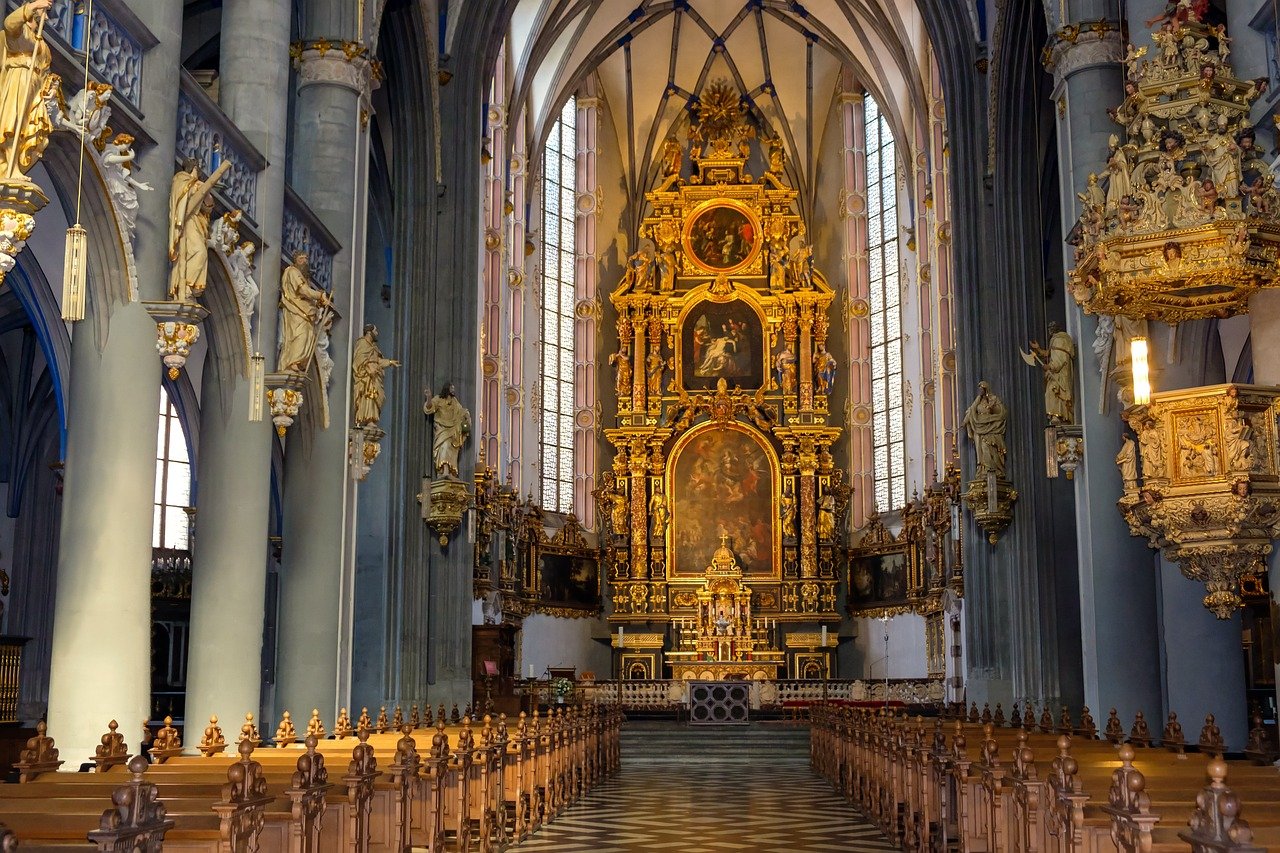
The cathedral’s nave is 76 metres long, flanked by sixteen columns that support a coffered barrel vault. The scale is imposing without being oppressive, and the quality of light — filtered through high clerestory windows — gives the interior a luminous, meditative quality on clear afternoons. The high altar at the far end of the nave is a neo-baroque composition in gilded wood, imported from Spain, and constitutes one of the finest examples of ecclesiastical decorative art in Buenos Aires. A series of side chapels line the nave on both sides, each dedicated to a different saint and containing devotional artworks from the colonial and early republican periods. The Chapel of the Blessed Sacrament, on the south side, is particularly elaborate and usually quiet enough to examine at length. The overall collection of art and furnishings accumulated over four centuries makes the interior feel genuinely different from the tourist-optimised heritage sites that dominate the city centre.
The Changing of the Guard
Outside the cathedral, facing Plaza de Mayo, a permanent guard post of the Grenadiers Regiment stands watch at all times when the building is open. The Grenadiers are Argentina’s oldest and most prestigious military unit, established by San Martín himself, and their ceremonial role at the cathedral mausoleum reflects the directness with which Argentine national mythology connects the liberation movement to Catholic tradition. The changing of the guard at 1 pm and 3 pm is a brief, formal ceremony executed with precision — the kind of ritual that rewards observation even if you have seen similar events elsewhere, because the context here — two metres from the tomb of the man who liberated three countries — gives it a weight that purely ceremonial equivalents in other capitals lack.
Local Insights

Visitors who make the most of the Metropolitan Cathedral generally combine the visit with a broader exploration of Plaza de Mayo and the surrounding historic centre. Here are the strategies that experienced visitors recommend.
- Time your visit to the 1 pm or 3 pm guard change. The ceremony is brief — perhaps five minutes — but seeing the Grenadiers Regiment in their distinctive nineteenth-century dress uniform perform the transition at the mausoleum entrance adds a layer of ceremony to the visit that photographs alone cannot replicate. Arrive 10 minutes early to position yourself near the mausoleum gate.
- Visit on a weekday morning for maximum quiet. The cathedral is quietest between 9 am and 11 am on weekdays when tour groups have not yet arrived from the cruise terminals and the surrounding hotels. This is when you can stand before the mausoleum or examine the side chapels without feeling hurried by the crowd around you.
- Combine with Plaza de Mayo for full context. The square in front of the cathedral is where Argentina’s key historical dramas played out — the May Revolution of 1810, the Dirty War protests of the Madres de Plaza de Mayo, the Falklands War rallies. A circuit of the square before entering the cathedral gives the building’s history far more resonance than visiting it in isolation.
- Dress modestly for entry. As an active place of worship, the cathedral expects visitors to dress with a basic level of modesty — covered shoulders and knees are required. Sleeveless tops and very short shorts are not permitted inside. This is enforced by staff at the entrance; having a scarf or light jacket in your bag prevents any issues.
- Look for the Pope Francis connection. A small display inside the cathedral acknowledges the building’s former bishop Jorge Mario Bergoglio, now Pope Francis, and there are typically references to his papacy in the cathedral literature. For Argentine visitors this is a source of considerable national pride, and the connection gives the building a contemporary global significance that adds an interesting layer to its centuries of history.
Planning Your Visit
- Tickets: Free admission. No charge to enter the cathedral, visit the mausoleum, or observe the changing of the guard. Donations to the cathedral are welcomed but entirely voluntary.
- Opening hours: Monday to Friday 8:00 am – 6:30 pm; Saturday 9:00 am – 5:00 pm; Sunday 9:00 am – 6:00 pm; holidays 10:00 am – 3:00 pm. The cathedral may close briefly for midday services — check the schedule posted at the entrance.
- Best time: Weekday mornings (9–11 am) for the quietest visit. Time your arrival to catch the 1 pm or 3 pm guard changing ceremony if schedules allow. The late afternoon light through the clerestory windows is particularly beautiful between 4 and 6 pm.
- Duration: Allow 45–60 minutes for a thorough visit including the mausoleum, nave, side chapels, and changing of the guard. A quick visit — mausoleum and main altar only — can be accomplished in 20–25 minutes.
- Booking: No booking required. Walk-in visitors are welcome at all opening hours. Large tour groups occasionally fill the nave during midday, but the flow of visitors generally moves quickly through the main highlights.
Getting There
- Subte (Subway): Line A, Plaza de Mayo station is directly adjacent to the cathedral — exit onto Rivadavia and the building is visible immediately to your right. Line D, Catedral station provides an equally direct approach from the Diagonal Norte side.
- By car: Driving to Plaza de Mayo is not recommended — the area is heavily trafficked and parking is very limited. Approach by public transport if at all possible.
- On foot: The cathedral is at the eastern end of Avenida de Mayo, a 10-minute walk from Café Tortoni. From Puerto Madero, it is a 15-minute walk west along any of the connecting streets through the historic centre.
- Taxi/ride-share: Ask for Catedral Metropolitana, Plaza de Mayo, Buenos Aires. Drop-off on Rivadavia (the north side of the square) or San Martín (the west side) places you within a two-minute walk of the entrance.
The Cathedral and Argentine National Identity
The Metropolitan Cathedral occupies a unique position in Argentine national life because it sits at the intersection of faith and politics in a country where that intersection has always been charged. Plaza de Mayo, directly in front of the cathedral’s main steps, is the site where every major political upheaval in Argentine history has been dramatised: the May Revolution of 1810 that began the independence process, the rallies of the Peronist movement in the mid-twentieth century, the protests of the Madres de Plaza de Mayo against the military dictatorship’s disappearances in the 1970s and 1980s, and the celebrations that greeted the return of democracy in 1983. The cathedral has been a witness to all of it — its presence on the square giving each of these events a physical backdrop that connects them, however different their nature, to a longer continuity of Argentine public life. When Pope John Paul II visited Buenos Aires in 1982, during the darkest period of the Falklands War, he prayed at this cathedral in a moment of enormous symbolic weight. When Pope Francis returned to his home city in 2013 after his election, this was the building his thoughts returned to. For Argentine Catholics and secular visitors alike, the Metropolitan Cathedral is not merely a church — it is the place where the country has gone, repeatedly, to mark the things that matter most.
Frequently asked questions
Is the Metropolitan Cathedral free to visit?
Yes, completely free. The Buenos Aires Metropolitan Cathedral charges no admission fee for any visitor, at any time of day, for any part of the building including the Mausoleum of San Martín. This makes it one of the most accessible major historical monuments in the city and a particularly good choice for visitors looking to understand Argentine history without cost. Voluntary donations to support the building’s maintenance are always appreciated but never solicited aggressively. Simply walk in, observe the dress code (covered shoulders and knees), and explore at your own pace.
Who is General San Martín and why is he so important?
José de San Martín (1778–1850) is one of the towering figures of Latin American independence. Born in what is now Argentina, he led the military campaigns that secured independence for Argentina (1816), Chile (1818), and Peru (1821) — an achievement that places him alongside Simón Bolívar as the co-liberator of South America from Spanish colonial rule. He is revered in Argentina with an intensity comparable to how Americans regard George Washington: streets, squares, and institutions throughout the country bear his name, and his mausoleum in the Metropolitan Cathedral is treated as a genuine national shrine rather than merely a tourist attraction.
What is the connection between the cathedral and Pope Francis?
Jorge Mario Bergoglio, who became Pope Francis in March 2013, served as the Archbishop of Buenos Aires from 1998 to 2013 and therefore used the Metropolitan Cathedral as his primary church during that period. He celebrated Mass here regularly, confirmed thousands of Buenos Aires residents within these walls, and is closely associated with the building in the memory of the city’s Catholics. His election as the first Latin American pope is a source of enormous pride in Argentina, and the cathedral’s connection to him adds a living dimension to its historical significance — making it both an ancient monument and a site of contemporary relevance.
Can I attend a religious service at the Metropolitan Cathedral?
Yes. The Metropolitan Cathedral is an active place of worship and celebrates Mass regularly throughout the week, including multiple services on Sundays. Visitors are welcome to attend Mass as participants or respectful observers. Mass times are posted at the cathedral entrance and on the official Buenos Aires tourism website. Attending a service — even as a non-Catholic observer — offers a genuinely different experience from a standard tourist visit, particularly the Sunday morning Mass which tends to draw a full congregation of Buenos Aires residents and creates an atmosphere that purely sightseeing visits rarely achieve.