
Memphis
Twenty kilometres south of Cairo, in a muddy delta village called Mit Rahina, lies what remains of the greatest city the ancient world ever built. For more than three thousand years, Memphis was Egypt’s administrative capital, the seat of the pharaohs, and the home of Ptah — the creator god who spoke the world into existence. Almost nothing of that city stands today. The Nile’s annual floods dissolved the mud-brick palaces back into the earth, and medieval builders systematically quarried the limestone. What survives — a colossal statue of Ramesses II, a magnificent alabaster sphinx, and the haunting traces of the Temple of Ptah — is enough to make a visit to Memphis one of the most affecting stops on Egypt’s ancient-sites circuit.
History of Memphis

Memphis was founded around 3100 BCE when the legendary king Menes — or Narmer, as he is known from archaeological evidence — unified Upper and Lower Egypt into a single kingdom and chose this strategic point at the Nile Delta’s apex as his capital. The city’s original Egyptian name was Inbu-Hedj, meaning “White Walls,” after the gleaming painted fortress that first defined the settlement. Later it became Men-nefer, corrupted through Greek into Memphis. From the First Dynasty through to the New Kingdom, Memphis was the beating heart of Egyptian political life, the place where kings were crowned, where armies were mustered, and where the most skilled craftsmen in the ancient world congregated around the great workshops of the royal court.
The city’s principal deity was Ptah, the craftsman-creator whose theology held that all things were created through thought and speech rather than physical action — a sophisticated philosophical concept unique in the ancient world. His temple at Memphis, the Hut-ka-Ptah (“Enclosure of the Soul of Ptah”), is believed by some scholars to be the origin of the very word “Egypt,” through the Greek rendering Aigyptos. The temple complex was one of the largest in the ancient world, rivalling Karnak in its heyday. Memphis retained its importance even after Thebes and later Alexandria eclipsed it politically; through the Late Period and the Ptolemaic era it remained a city of immense religious prestige, and Alexander the Great received his Egyptian coronation here in 332 BCE.
What to See at Memphis
The Colossal Statue of Ramesses II

The centrepiece of the Mit Rahina open-air museum is the colossal limestone statue of Ramesses II — a recumbent giant housed in a purpose-built museum building near the entrance. Originally the statue stood over 13 metres tall at the entrance to the Temple of Ptah; when discovered in 1820 by Giovanni Caviglia, it was found face-down in the soil, its lower legs already lost to later building activity. It now reclines on a raised platform, and visitors circumnavigate it on elevated walkways that bring you face-to-face with extraordinary detail: the cartouches inscribed on the shoulders, the finely carved pleating of the royal kilt, and the serene, idealised features that Ramesses II used on monuments from Nubia to the Levant to project an image of divine kingship. An identical statue, also from Memphis, now stands in the Grand Egyptian Museum forecourt near Cairo. Seeing the original here, in the city where it was carved, adds a layer of context that the GEM display cannot provide.
The Alabaster Sphinx

A short walk from the Ramesses colossus, the Alabaster Sphinx of Memphis sits in an open enclosure surrounded by palms. Carved from a single block of calcite alabaster — the warm, translucent stone Egyptians called “true stone of Hatnub” — it weighs approximately 80 tonnes, measures 8 metres long and 4 metres tall, and is the second-largest sphinx in Egypt after the Giza Sphinx. Unlike the Giza sphinx, which is carved from the living bedrock of the plateau, the Memphis sphinx was quarried and transported, a feat of logistics that underlines the city’s extraordinary resources. The sphinx is believed to date from the New Kingdom period, possibly the reign of Amenhotep II or Thutmose IV of the 18th Dynasty, though its face cartouches were never completed, leaving its royal identity unresolved. The alabaster glows with an almost supernatural luminosity in morning light, and the sculptor’s mastery of the stone — smoothed to a near-mirror finish on the body while leaving the mane with deliberate texture — makes it one of the finest pieces of surviving Egyptian statuary.
The Mit Rahina Museum Context
The open-air museum at Mit Rahina was established in the 1950s to protect the most significant surface monuments of Memphis from agricultural encroachment and casual looting. It is a modest but well-maintained site: paved pathways connect the key exhibits, interpretive signs provide context in English and Arabic, and small attendants stationed at the main exhibits can answer basic questions. A roofed building protects the Ramesses II colossus from weathering; the alabaster sphinx sits in an open-air enclosure with a low metal fence. The site’s compactness is actually an asset — everything is walkable within 15 minutes at a relaxed pace, and the human scale of the museum makes it accessible even to visitors with limited mobility or time constraints.
The Temple of Ptah Ruins and Apis Embalming Tables
The open-air museum grounds also contain scattered architectural fragments from the Temple of Ptah — column bases, limestone blocks with hieroglyphic inscriptions, and sections of paving that give a floor plan impression of a complex that once extended over several hectares. The most unusual objects are the Apis embalming tables: enormous alabaster slabs used for the ritual mummification of the sacred Apis bulls, Ptah’s living earthly manifestation. Each table is slightly concave with slanted guttering channels that directed ritual fluids during the embalming process. They are among the most specific and unusual artefacts at the site — objects that make the ancient religious practices feel concrete rather than abstract. Several statues of Ramesses II in various states of preservation stand throughout the grounds, and near the south end of the museum a weathered limestone sphinx from the Old Kingdom provides a quieter counterpoint to the alabaster sphinx’s perfection.
Local Insights
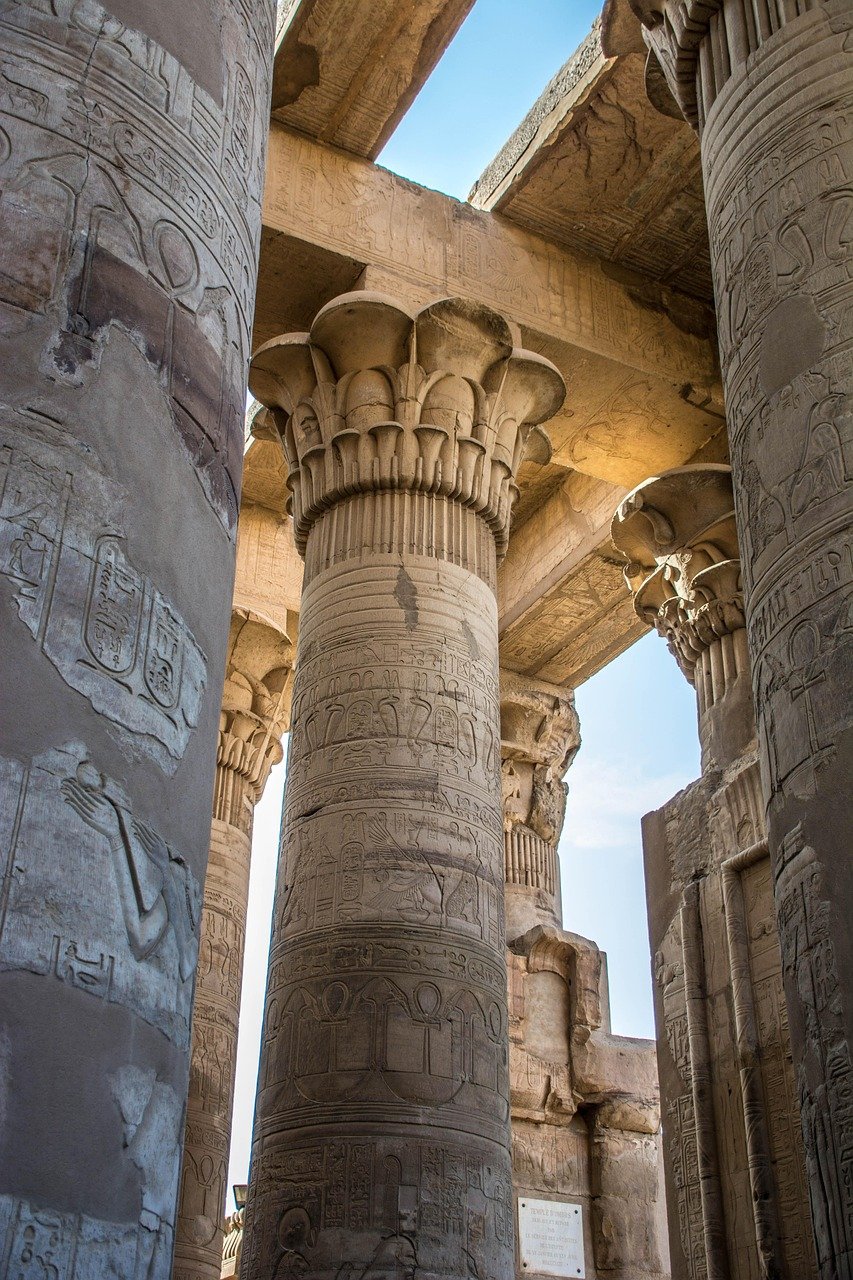
Memphis is smaller and quieter than most Egypt guidebooks suggest — which is precisely part of its appeal. These insights will help you make the most of it.
- Memphis is best visited as a 45-minute stop on the Dahshur–Saqqara circuit, not as a standalone day trip. The open-air museum covers a compact area and most visitors see everything comfortably in under an hour. The real reward is the combination: having walked among three sites spanning 1,500 years of pyramid-building, you leave with a narrative arc that no single site can provide.
- Visit the Ramesses colossus from the upper walkway first, then go back down for close-up details. The elevated walkway gives you the full recumbent figure in context; the lower level reveals the extraordinary quality of the surface carving. Most visitors walk around once from one level — do both circuits to see the statue properly.
- The alabaster sphinx is particularly beautiful at low-angle morning light. Arrive before 10 AM and the early sun rakes across the stone surface at a shallow angle, illuminating the texture of the mane and the translucency of the calcite. By midday the light is flat and the sphinx loses much of its visual drama.
- Hire a guide who specialises in Memphis specifically. Most Cairo tour operators bundle Memphis as a quick stop; guides who know the site well can point out inscriptions and architectural fragments that are easily missed. Ask specifically for a guide with Memphite archaeology knowledge when booking through local operators near the site.
- The museum building is not air-conditioned. In summer (May–September), the metal roof and enclosed walls make the Ramesses statue building hot and airless by mid-morning. Plan your visit before 10 AM in summer, or bring a portable fan. The outdoor sphinx area at least benefits from any available breeze.
Planning Your Visit
- Tickets: 200 EGP adults / 100 EGP students (approximately USD 4 / USD 2 at current exchange rates). Covers access to all areas of the Mit Rahina open-air museum including the colossus building, alabaster sphinx enclosure, and outdoor archaeological areas. Egyptian nationals pay reduced rates.
- Opening hours: Daily 8:00 AM – 5:00 PM year-round. The site is compact and most visitors finish well before noon. No separate timed entry or advance booking required for general admission.
- Best time: October through April for comfortable temperatures. Morning visits (8–10 AM) offer the best light on the alabaster sphinx and significantly cooler conditions inside the colossus building. The site is less crowded on weekday mornings.
- Duration: 45 minutes to 1 hour for most visitors. History enthusiasts who want to study the temple fragments and read the interpretive signage should allow 1.5 hours.
- Booking: No advance booking required. Walk-up admission purchased at the entrance gate, cash only (Egyptian pounds). Organised tours that include Memphis as part of a day circuit can be booked through GetYourGuide, Viator, or local Cairo operators.
Getting There
- By tour / private vehicle: The standard approach. Memphis sits on the main Dahshur–Saqqara day-trip circuit; organised private tours from Cairo cost USD 45–70 per person including transport and a guide. Alternatively, negotiate a full-day taxi rate of 500–750 EGP from Cairo.
- By car: Memphis (Mit Rahina village) is approximately 25 km south of central Cairo on the west bank of the Nile. Follow the Corniche el-Nil or Desert Road south toward Badrasheen and look for Mit Rahina signage. The drive takes 30–40 minutes without traffic. Parking is available at the site entrance.
- On foot / public transit: Minibuses from Giza (Midan al-Haram) serve the general Mit Rahina area but leave you 1–2 km from the museum entrance. A local tuk-tuk completes the journey for around 20–40 EGP. This route requires effort and time but is feasible for budget travellers.
- Taxi / ride-share: Uber and Careem operate from Cairo to Mit Rahina at approximately 100–160 EGP one way. Arrange the return trip with your driver before they depart, or book a return Uber in advance — availability at the site itself is limited and can require a 15–20 minute wait.
Frequently asked questions
Is Memphis Egypt worth visiting?
Yes, though with realistic expectations. Memphis is not a sprawling archaeological park like Luxor’s Karnak or even the Giza plateau — it is a compact open-air museum preserving the most important surviving fragments of one of history’s greatest cities. The Colossus of Ramesses II and the Alabaster Sphinx are world-class objects that deserve unhurried attention. The real value of Memphis lies in the itinerary it anchors: as the midpoint in the Dahshur–Memphis–Saqqara circuit, it provides crucial historical context, placing the pyramid-building era in the wider story of Egyptian civilisation. Visitors who skip it miss a piece of that narrative.
What happened to the ancient city of Memphis?
Memphis was gradually abandoned as a major urban centre from around the 7th century CE onwards, its population drawn to the growing Islamic capital of Fustat (later Cairo) to the north. Over the following centuries, the Nile’s annual floodwaters dissolved the mud-brick structures that formed the majority of the city’s buildings, returning them to the earth. Medieval builders systematically robbed the limestone from monumental structures to use in mosques, walls, and houses in Cairo. Today, the city lies buried beneath modern Mit Rahina village and the surrounding agricultural land; only the heaviest stone objects — the alabaster sphinx, the limestone colossus — were too large to move and survived on or near the original surface.
How far is Memphis from Cairo and Giza?
Memphis (Mit Rahina) is approximately 25 km south of central Cairo and around 20 km southwest of the Giza Pyramids. By road, the drive from Cairo takes 30–40 minutes under normal traffic conditions; from Giza it is approximately 25 minutes. Memphis is conveniently positioned between Dahshur (15 km further south) and Saqqara (10 km to the northwest), making it the natural midpoint in a single-day ancient-sites circuit. Most visitors combine all three sites in one day, typically departing Cairo by 8 AM and returning by 2–3 PM.
What is the significance of the Alabaster Sphinx at Memphis?
The Memphis Alabaster Sphinx is the second-largest sphinx in Egypt and one of the finest examples of ancient Egyptian stone carving. Weighing approximately 80 tonnes and carved from a single block of calcite alabaster, it dates from the New Kingdom period — likely the 18th Dynasty, around 1400 BCE. Its significance lies partly in the material: alabaster was prized by Egyptians as a sacred stone associated with divine purity, making a sphinx carved from it a uniquely powerful religious object. The unfinished royal cartouches on its shoulders mean we cannot definitively identify which pharaoh it represents, adding an unresolved mystery to its considerable visual appeal.