
Memorial to the Murdered Jews of Europe (Holocaust Memorial)
In the heart of Berlin, just steps from the Brandenburg Gate and the Reichstag, a field of 2,710 grey concrete pillars stretches across nearly two hectares of the city’s most storied ground. The Memorial to the Murdered Jews of Europe is not a comfortable place. That is precisely the point. Designed by American architect Peter Eisenman and opened on May 10, 2005 — sixty years after the end of World War II — it is one of the most powerful and disquieting public memorials ever built. As you step between the stelae and the ground begins to slope unexpectedly beneath your feet, the pillars rising from knee height to towering overhead, a creeping sense of disorientation takes hold. This is grief given physical form: not as a monument to victory, but as a confrontation with the scale of what was lost.
History of the Memorial to the Murdered Jews of Europe

The origins of the memorial lie in a citizen initiative launched in 1988 by television journalist Lea Rosh and historian Eberhard Jäckel, who began advocating for a central national site in West Germany to honour the six million Jewish victims of the Nazi Holocaust. Their campaign gained momentum after German reunification, and the site they eventually proposed — the former Nazi Minister Gardens north of the old Reich Chancellery, a location saturated with the geography of the Third Reich — carried enormous symbolic weight. The debate that followed was one of the most prolonged and contentious in postwar German cultural history, touching on questions of memory, responsibility, aesthetics, and national identity that Germany was still actively working through decades after the war’s end.
In 1999, after years of public discussion and two international design competitions, the German Bundestag voted to approve the memorial and selected American architect Peter Eisenman’s design. Construction began in 2003. When the memorial officially opened in May 2005, it became the Federal Republic of Germany’s central acknowledgment of its responsibility for the Holocaust — a permanent, unmistakable presence at the symbolic heart of the reunified capital. The choice of Eisenman’s deliberately disorientating design over more conventionally symbolic proposals was itself a statement: Germany would not memorialize its victims with triumph or comfort, but with complexity and unease. The underground Information Centre, which opened simultaneously, added a layer of direct historical documentation to complement the abstraction of the stelae field above.
What to See at the Memorial
The Field of Stelae
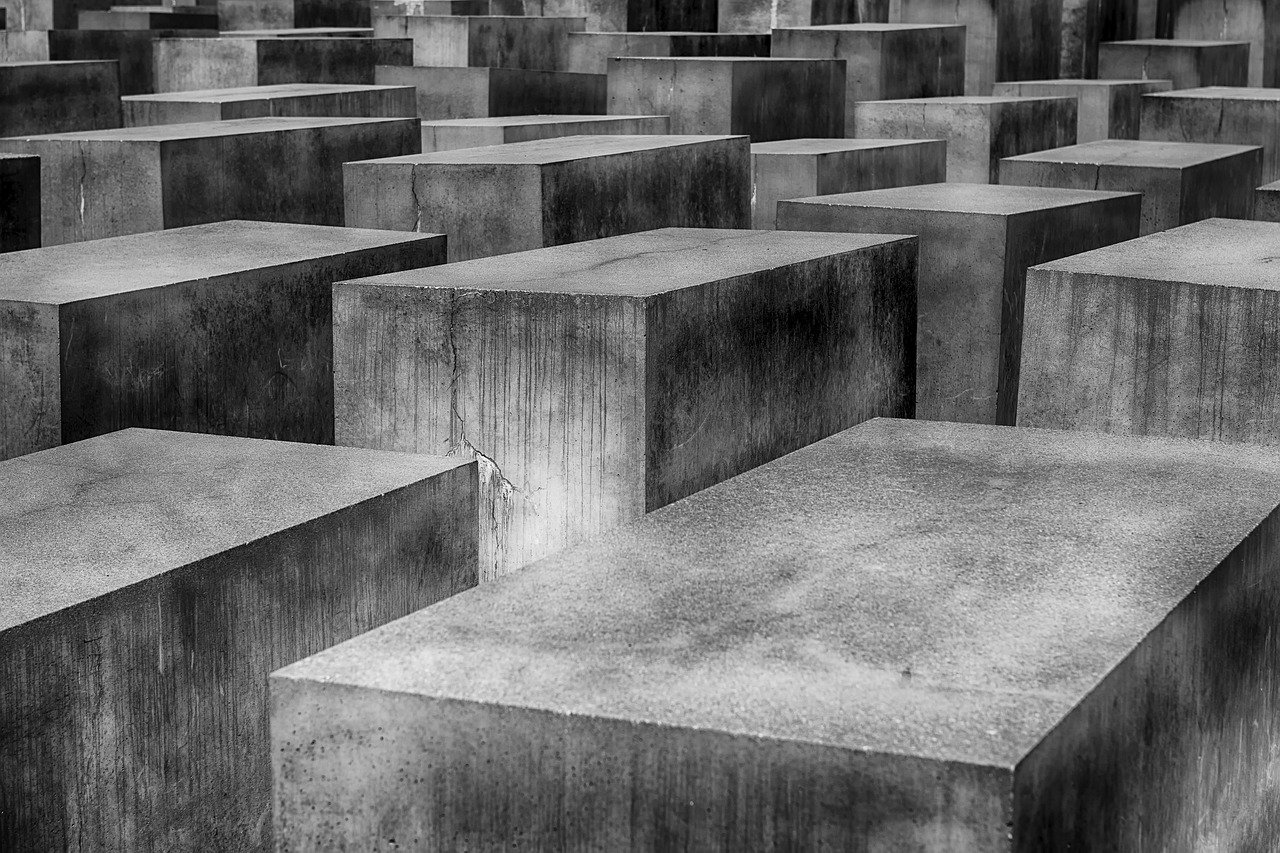
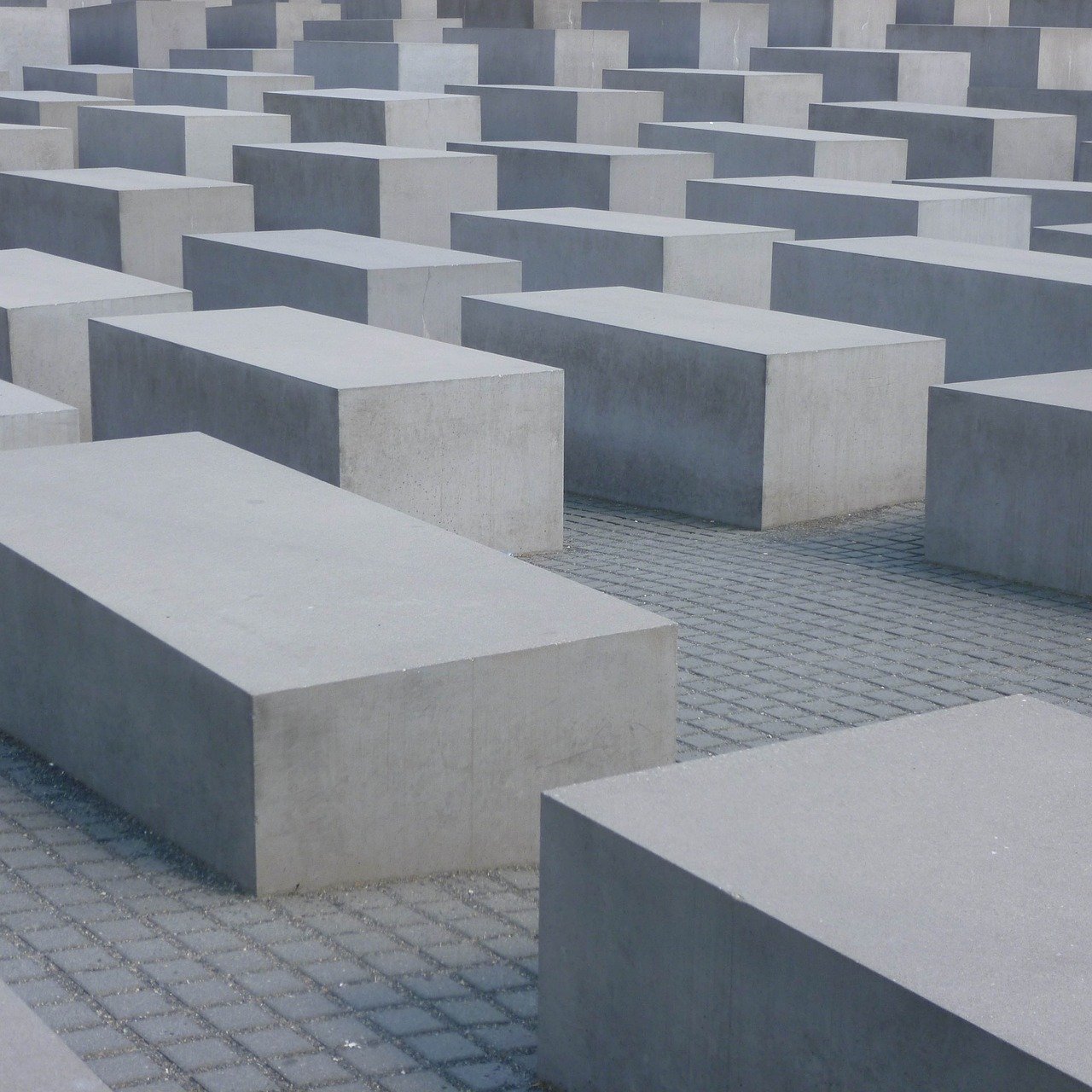
The field of stelae is the memorial’s defining experience. The 2,710 concrete pillars — each measuring 0.95 metres wide by 2.38 metres long but varying dramatically in height from ground level to 4.7 metres — are arranged in a precise grid across a gently undulating landscape of 19,073 square metres. Eisenman’s design introduces subtle but profound instability: the ground is not level, and as visitors move deeper into the field, the pillars rise above head height and sight lines to the surrounding city disappear. The rational grid of the outside world gives way to a labyrinthine interior that is simultaneously open and confining, ordered and disorienting. This effect was entirely intentional. Eisenman described the design as evoking “a system that has lost touch with human reason” — a metaphor for how the bureaucratic machinery of the Nazi state transformed rational administration into systematic murder. The stelae are smooth, grey, and unmarked. They carry no names, no dates, no images. The absence of identification is itself part of the memorial’s meaning: the individual lives lost to the Holocaust were beyond enumeration, and any attempt to name them all would be inadequate. The field is accessible from all four sides and is open around the clock, every day of the year, without admission charge. Many visitors find that early morning — before the tourist crowds arrive — offers the most affecting experience, when mist sometimes pools between the pillars and the city’s noise recedes.
The Underground Information Centre
Beneath the field of stelae lies the memorial’s second, and equally powerful, dimension: an 800-square-metre underground Information Centre that transforms the abstraction of the stones above into the documented reality of individual human lives. The centre is accessed via a discreet entrance at the southern corner of the field and is divided into five themed rooms, each designed to present a different dimension of the Holocaust. The Room of Dimensions uses floor-to-ceiling text panels illuminated in shifting light to present statistics and context: the scale of persecution, the geography of extermination, the timeline of the Nazi regime’s systematic murder of European Jews. The Room of Families traces the specific fates of fifteen Jewish families from across Europe — families from Germany, France, Poland, Hungary, and the Soviet Union — through photographs, letters, and testimonies. The Room of Names lists the names and brief biographies of every identified Jewish Holocaust victim, a recitation that takes nearly seven years to complete in its recorded form. The Room of Sites maps the geography of the Holocaust across Europe: the ghettos, the concentration camps, the death camps, the mass shooting sites. Together, these rooms accomplish what the field above cannot: they give individual faces, names, and stories to the six million. The Information Centre is open Tuesday to Sunday, 10:00am to 6:00pm, and entry is free of charge.
The Surrounding Memorial Landscape
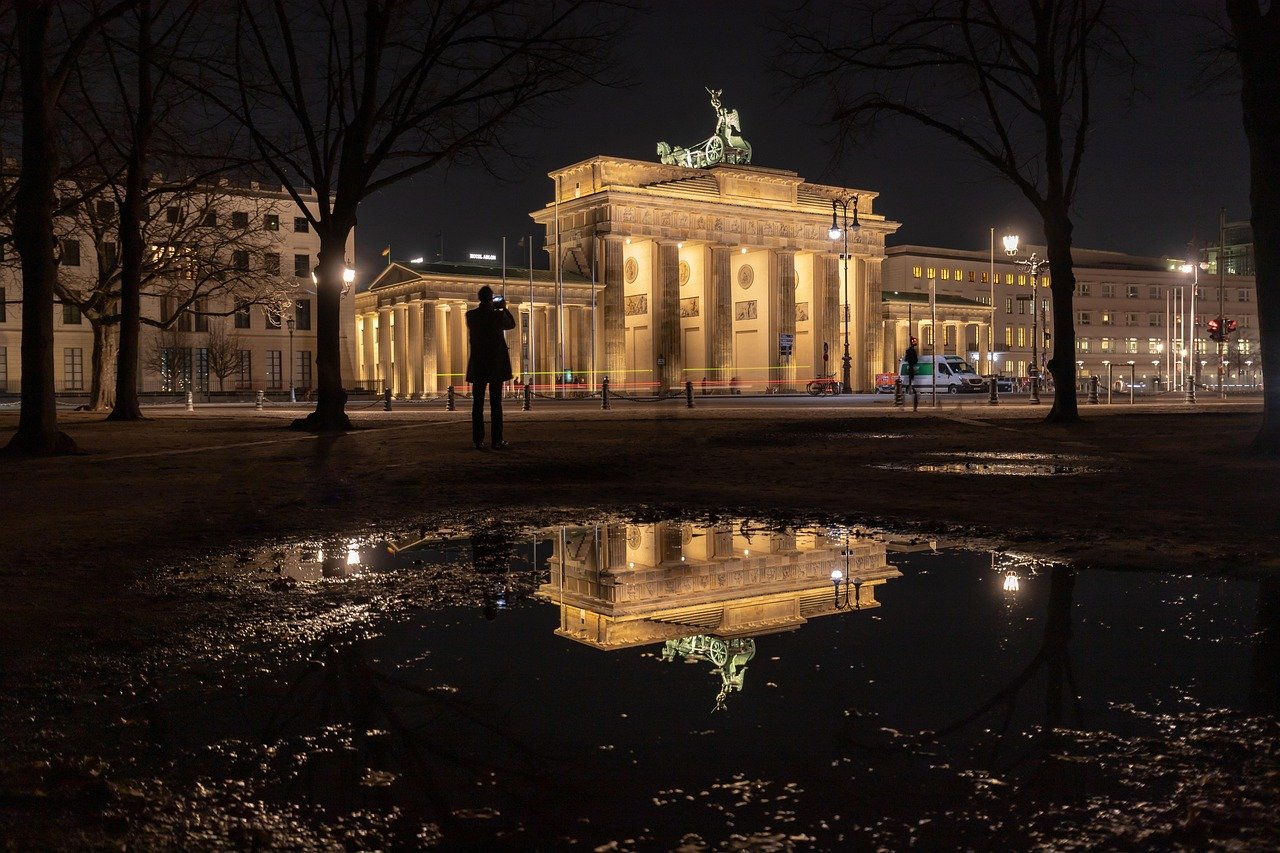
The Memorial to the Murdered Jews of Europe does not stand alone. It anchors a broader landscape of Holocaust memory in central Berlin that rewards further exploration. A short walk south leads to the Memorial to the Sinti and Roma Victims of National Socialism, a circular pool memorial in the Tiergarten designed by Dani Karavan and opened in 2012. Nearby, the Memorial to the Homosexuals Persecuted under Nazism consists of a single concrete block with a window through which a film of two men kissing plays on a continuous loop. Together with the T4 Memorial commemorating victims of the Nazi euthanasia program, these sites form a cluster of remembrance in the government district that traces the full scope of the Third Reich’s persecution. The Brandenburg Gate is visible from the northern edge of the memorial field, and Potsdamer Platz is a short walk to the south, making this area highly walkable for visitors combining Holocaust memory with broader Berlin sightseeing.
Local Insights
The memorial is free and open around the clock, but a few practical considerations will make your visit significantly more meaningful.
- Visit the Information Centre before the stelae field, not after. Most visitors explore the concrete pillars first and descend to the Information Centre afterward, but the reverse order is profoundly more affecting. Understanding the documented history of specific families and individuals before walking the abstract field above gives the stelae an emotional weight they cannot carry on their own. Allow at least 60 minutes in the Information Centre and another 30 to 45 minutes in the field.
- Download the free audio guide app before you arrive. The Stiftung Denkmal foundation offers a free multilingual audio guide through its website and as a mobile download. The app provides context for both the stelae field and the Information Centre rooms, and is far more informative than reading the on-site panels alone. Audio guide devices are also available to rent at the Information Centre entrance for EUR 3.
- Arrive early in the morning or at dusk for the most powerful atmosphere. The memorial transforms with the light. Early morning mist between the pillars and the low golden light of late afternoon create very different emotional registers than the midday tourist peak. The field is open 24 hours, and sunset visits — when the concrete catches the warm evening light and crowds thin dramatically — are especially memorable.
- Behave respectfully throughout the site. The memorial has no formal rules against movement, running, or climbing the stelae, but these behaviours are widely considered disrespectful and draw strong reactions from other visitors. The site is first and foremost a place of mourning, not a playground or photographic prop. Approach it with the same quiet consideration you would bring to any graveyard or place of worship.
- Plan your visit to the Information Centre around the closure schedule. The underground exhibition is closed on Mondays, and also closes on November 16 to 23, December 24 to 26, and from 4pm on December 31. The field of stelae above is always accessible regardless of Information Centre hours. Check stiftung-denkmal.de for the latest schedule and any temporary closures for renovation.
Planning Your Visit
- Tickets: Free — no ticket required. Both the field of stelae and the underground Information Centre are free to enter. Audio guide devices available at the Information Centre entrance for EUR 3 (EUR 2 reduced price). Guided tours in easy German available through the foundation from EUR 60 for groups.
- Opening hours: Field of stelae: open 24 hours, 7 days a week, year-round. Information Centre: Tuesday to Sunday, 10:00am to 6:00pm. Closed Mondays, November 16 to 23, December 24 to 26, and from 4:00pm on December 31.
- Best time: Early morning (before 9:00am) or late afternoon (after 4:00pm) for the fewest crowds and best light. Weekday mornings are the quietest. Spring and autumn offer ideal walking weather in Berlin.
- Duration: Allow a minimum of 90 minutes for the Information Centre plus a walk through the stelae field. A thorough visit with the audio guide takes 2 to 2.5 hours. The field alone can be experienced in 20 to 30 minutes.
- Booking: No booking needed; open-air site. The stelae field requires no reservation. The Information Centre is walk-in only and does not require advance booking, though it may have a short queue during busy periods.
Getting There
- Metro/U-Bahn: U-Bahn line U55 to Brandenburger Tor station, a 3-minute walk east. Alternatively, S-Bahn lines S1, S2, and S25 to Brandenburger Tor S-Bahn station, also a short walk.
- Bus/Tram: Bus line 100 stops at Brandenburger Tor, directly adjacent to the memorial. Bus 200 stops at Kulturforum, a 5-minute walk south. Tram M5, M6, and M8 stop at Hackescher Markt, approximately 15 minutes on foot.
- On foot: A 10-minute walk south from the Brandenburg Gate, or 15 minutes west from Checkpoint Charlie. The memorial is directly adjacent to the Tiergarten park and visible from the main tourist thoroughfare along Ebertstrasse.
- Taxi/ride-share: Request drop-off at Cora-Berliner-Strasse 1, 10117 Berlin. Taxis from Berlin Hauptbahnhof cost approximately EUR 8 to 10 and take 5 to 8 minutes. Uber, Bolt, and Free Now all serve the address.
Frequently asked questions
Why are there exactly 2,710 concrete stelae?
Architect Peter Eisenman has said that the number 2,710 was not chosen for symbolic significance — it simply reflects how many pillars fit optimally within the available site area given the grid spacing and the path widths needed for visitors to move comfortably between them. Some visitors and commentators have attached meaning to the number regardless, noting that it is close to (but not equal to) the number of Jewish communities destroyed in the Holocaust. Eisenman himself consistently resisted attaching explicit symbolic meaning to the design, preferring visitors to construct their own interpretations of the space.
Is the memorial appropriate for children?
The memorial is suitable for children of all ages, though parents should be prepared to answer difficult questions about what the site commemorates. Many Berlin families visit regularly, and the space — with its maze-like field of pillars — can feel like a natural environment for children to explore. The underground Information Centre contains graphic historical photographs and testimony that parents may wish to preview before bringing very young children. The foundation offers specific educational programs for school groups, and materials tailored to different age groups are available at the Information Centre entrance.
What happened to the site before the memorial was built?
The 19,073-square-metre site was part of the former Nazi Ministerial Gardens (Ministergärten), a strip of land in what became the death strip of the Berlin Wall during the Cold War years. The area sat in East Berlin’s no-man’s land for decades, largely inaccessible and increasingly overgrown. After reunification, the cleared site was used temporarily as a parking lot before the memorial campaign gained sufficient momentum to secure the land for its current purpose. The proximity to the former location of Hitler’s Reich Chancellery — whose underground bunker (the Führerbunker) lies just blocks away beneath a residential car park — adds another layer of historical resonance to the location.
Can I take photographs at the memorial?
Photography is permitted throughout the memorial field and within the Information Centre, with the exception of the Room of Families, where photography is prohibited out of respect for the privacy of the families documented there. Flash photography is not permitted anywhere in the Information Centre. Many visitors find the interplay of shadow and light within the stelae field to be extraordinarily photogenic, and the memorial appears frequently in photography collections. The foundation asks only that photographs be taken with appropriate dignity and that the site not be used as a backdrop for inappropriate or disrespectful imagery.