
Meeting of Waters (Encontro das Aguas)
Few natural spectacles anywhere on Earth match the sheer drama of what happens a few kilometers east of Manaus, where the dark, tea-colored Rio Negro collides with the pale, sandy-brown Rio Solimões and yet — impossibly — refuses to mix. The two rivers surge side by side for nearly six kilometers, each holding its color, temperature, and chemistry like two stubborn neighbors sharing a fence. Scientists call it a density-driven stratification phenomenon. Travelers call it the Encontro das Águas, the Meeting of Waters, and it is one of the Amazon’s most arresting sights. Accessed by boat from Manaus, this natural wonder pulls visitors into the reality of the Amazon Basin: vast, powerful, and operating entirely on its own terms.
History of the Meeting of Waters
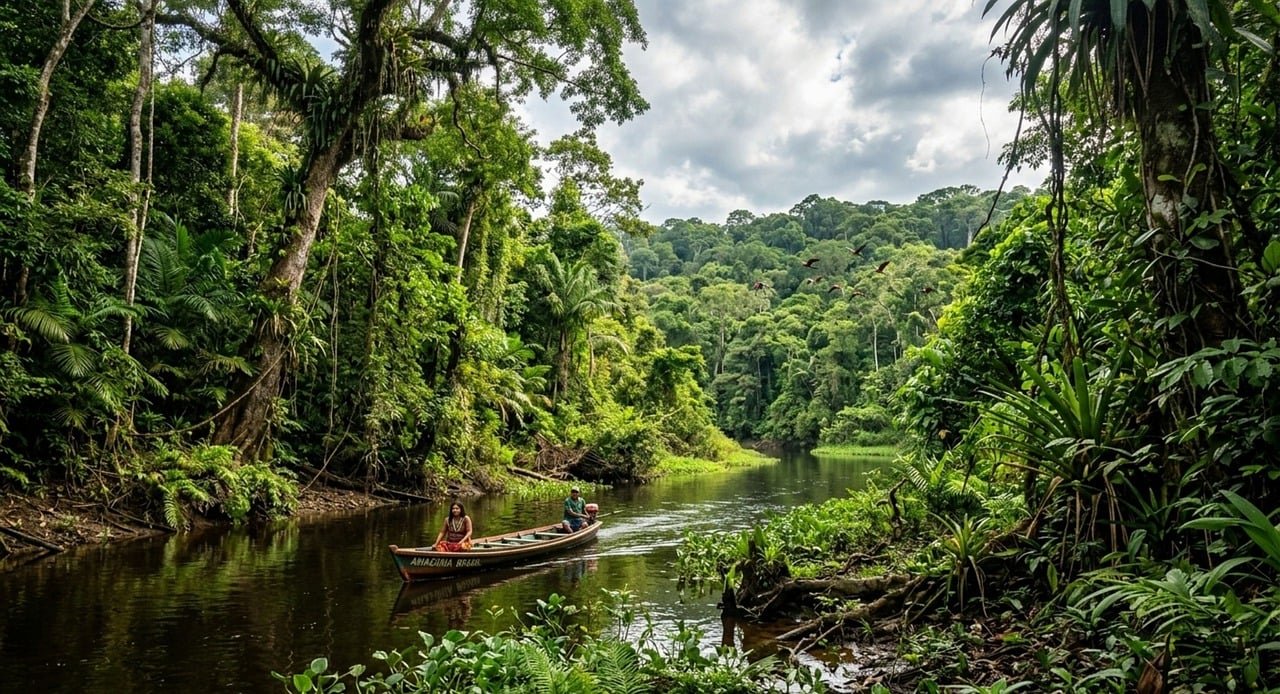
The Meeting of Waters has been a landmark of orientation and wonder for thousands of years. Indigenous peoples of the upper Amazon understood this confluence as a boundary between worlds — the dark Rio Negro rising from the Colombian interior and Venezuelan highlands, the lighter Solimões descending from the Andean foothills with its load of Andean sediment. Early Portuguese and Spanish explorers navigating the Amazon system in the 16th century noted the dramatic color contrast in their journals, astonished that two mighty rivers could travel in apparent parallel rather than blend immediately at their junction.
The scientific explanation, developed in the 19th and 20th centuries, reveals how physics underlies the spectacle. The Rio Negro runs warmer — around 28°C — and moves slowly at roughly 2 km per hour. It is also acidic and nearly sediment-free, its dark color coming from dissolved organic matter: tannins from decomposed leaves and plants washed in from the blackwater forests of the interior. The Rio Solimões, by contrast, is colder at around 22°C, flows at 4–6 km per hour, and carries vast quantities of fine sediment eroded from the Andes, giving it that distinctive milky-brown color. The differences in temperature, density, flow speed, and acidity prevent the two water bodies from mixing for kilometers downstream. Eventually turbulent eddies gradually blend them into the lower Amazon, but not before delivering one of the most astonishing hydrological displays on the planet. The American hydrologist Robert Meade described it as “the greatest hydrologic spectacle on Earth.”
What to See at the Meeting of Waters
The Color Boundary — Where Two Rivers Meet
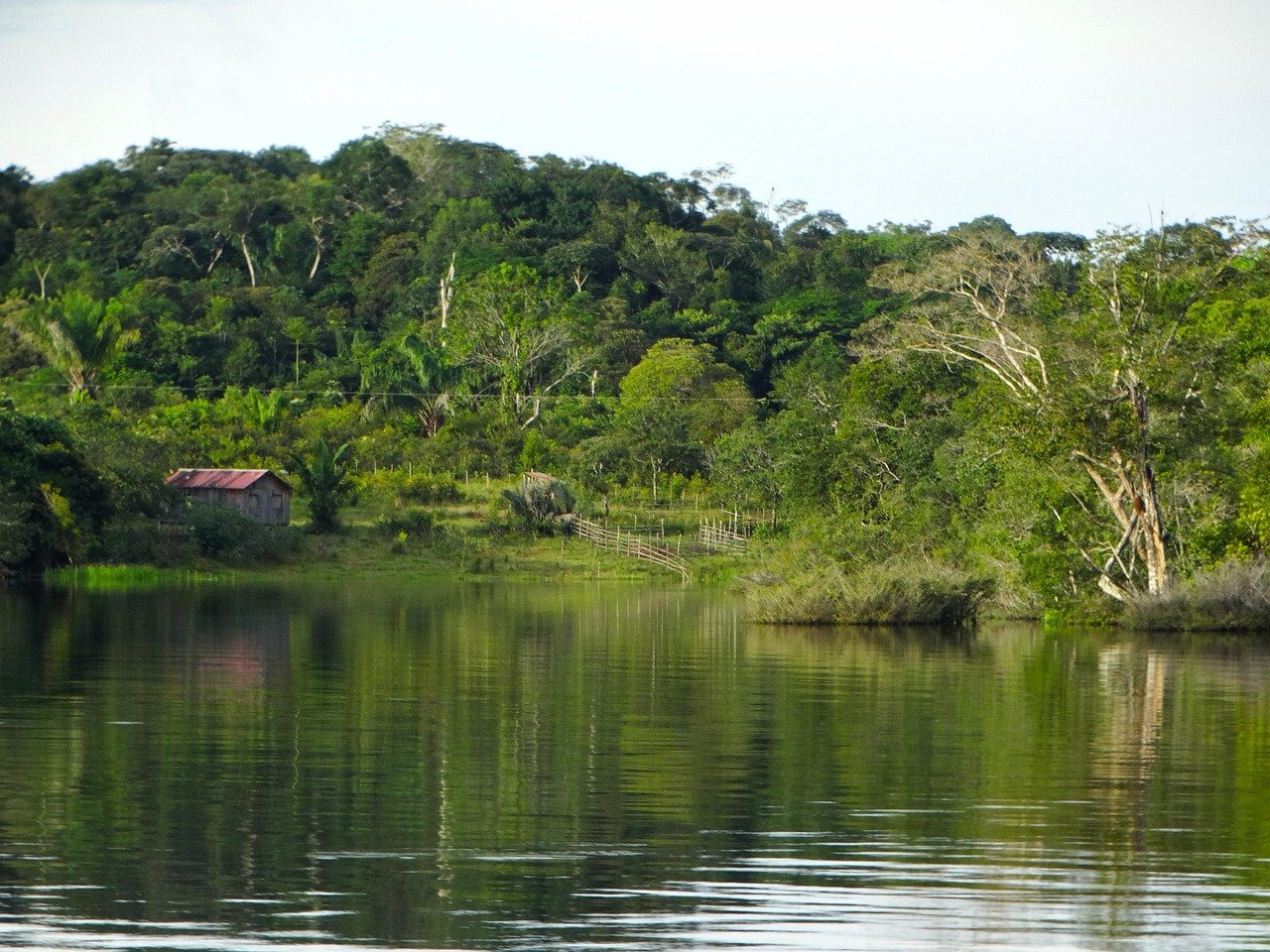
The main event is the visible boundary between the two rivers — a sharp, sinuous line of dark and light water that your boat can approach closely enough to see eddies and swirls at the exact interface. Tour operators navigate right to the confluence point so you can dangle your hands into each river in turn and feel the temperature difference yourself — a few degrees that your fingertips register immediately. From above, the contrast is so extreme that the boundary is visible in satellite images and has been photographed from the International Space Station. Standing on the bow of a motorboat at this junction, with forest-lined banks stretching to the horizon in every direction, gives a visceral sense of the Amazon’s impossible scale. The spectacle is most dramatic between January and July when the rivers are running high after the wet season rains.
Lake January (Lago Januário) and Wildlife
Most tours to the Meeting of Waters also include a stop at Lake January (Lago Januário), a protected ecological reserve just off the main Amazon channel near the confluence. Here, small canoes replace the motorboat and guides paddle visitors through narrow blackwater channels beneath an unbroken forest canopy. Victoria amazonica — the giant Amazonian water lily whose pads can support a small child — grows here in extraordinary numbers during the high-water season. Pink river dolphins (boto) are frequently sighted in these channels, surfacing with surprising nonchalance near the canoes. Guides are adept at locating sloths, caimans, and tropical birds including toucans and kingfishers resting in the riverside vegetation. Lake January is often described by visitors as the most intimate and magical section of the day.
Floating Village of Catalão and the Pirarucu
Many extended tours include a visit to the floating village of Catalão, a small community built on pontoons that rises and falls with the river’s seasonal flood cycle. Here, local families keep giant pirarucu fish — one of the world’s largest freshwater fish, reaching up to 3 meters in length — in underwater enclosures and invite visitors to feed and observe them up close. The pirarucu is a living fossil, largely unchanged for millions of years, and seeing one surface to breathe air (they are obligate air-breathers, surfacing every 5–20 minutes) is startling. These community visits provide direct income to river families and offer a genuine window into Amazonian riverside life.
Local Insights
Experienced Amazon travelers have learned these lessons the hard way so you do not have to:
- Insect repellent is non-negotiable. Mosquitoes and other biting insects are present throughout the day, not just at dawn and dusk. Use a DEET-based repellent rated 30% or higher and apply before boarding the boat. Loose long-sleeved shirts in light fabric provide good coverage without overheating in the Amazon humidity.
- Morning departures are best for wildlife. Tours departing at 8–9 am catch the best wildlife activity, particularly for birds and river dolphins. Midday heat and light flatten contrast on the water, making the color boundary slightly less vivid. Early starts also beat the worst heat of the day in Manaus, which regularly reaches 35°C.
- Book with a licensed, safety-certified operator. Dozens of operators run these tours, with significant variation in boat quality, guide expertise, and safety equipment. Look for operators registered with the Amazonas State tourism authority (ETUR), with life jackets for all passengers and experienced bilingual guides. Reviews on TripAdvisor and GetYourGuide are a reliable filter.
- The high-water season offers the best overall experience. Between January and July, the rivers are swollen and the color contrast is at its most dramatic. Flooded forest sections of Lake January become navigable by canoe, and wildlife density near the water’s edge increases significantly as animals move to higher ground and concentrate near accessible channels.
- Bring cash in Brazilian reals for the floating village. Credit cards are not accepted at Catalão or other floating community stops. Local families sell handmade crafts, local fruit, and snacks — having R$ 50–100 in small bills lets you buy directly from residents and support the local economy without hassle.
Planning Your Visit
- Tickets: Tours start from approximately R$ 150–240 per person for a half-day speedboat tour to the confluence; full-day tours including Lake January and floating village run R$ 300–500 per person with lunch included. Prices vary by operator and group size.
- Opening hours: Tours depart year-round from Manaus port (Flutuante Turístico or Hotel Tropical pier), typically at 8:00 am and 1:00 pm. The natural phenomenon itself is accessible at any time of day.
- Best time: January through July (high-water season) for the most dramatic color contrast, best wildlife sightings, and access to flooded forest channels. August through December (low-water season) is still excellent and river dolphins are easier to spot in shallower channels.
- Duration: Half-day tours run 3–4 hours; full-day tours including Lake January and village visits run 6–8 hours with lunch. A full day is strongly recommended for first-time visitors.
- Booking: Book at least 24–48 hours in advance through your hotel, a reputable tour agency, or platforms like Viator and GetYourGuide. Walk-up tours are available at the Manaus waterfront but quality is variable.
Getting There
- By boat: All tours depart by boat from Manaus city waterfront — either the Flutuante Turístico (Tourist Floating Dock) near the city center or the pier at the Hotel Tropical, about 20 minutes from the city center. Your tour operator will provide the exact departure point.
- By car/taxi to the dock: From Manaus city center, Uber and taxis take about 10–15 minutes to the central waterfront. From the airport, allow 30–40 minutes depending on traffic. Parking is available near the Tourist Floating Dock for those with rental cars.
- On foot: The central waterfront departure point is walkable from several Manaus hotels in the historic center — approximately 10–15 minutes from Praça da Saudade.
- Taxi/ride-share: Uber operates in Manaus. A ride from the city center to the tourist dock costs around R$ 15–25. From Eduardo Gomes International Airport (MAO), budget R$ 50–80 for a taxi or rideshare to the waterfront.
Frequently asked questions
Why do the two rivers not mix at the Meeting of Waters?
The phenomenon is caused by significant physical differences between the Rio Negro and the Rio Solimões. The Rio Negro flows at roughly 2 km per hour with a water temperature around 28°C and has very low density due to its near-sediment-free composition. The Rio Solimões moves faster at 4–6 km per hour, is cooler at approximately 22°C, and carries heavy Andean sediment that increases its density. These differences in speed, temperature, density, and pH create a stable layering effect where the two water bodies resist mixing and run parallel for nearly 6 kilometers before gradually merging into the lower Amazon River.
Can I swim at the Meeting of Waters?
Swimming at the exact confluence point is not standard practice on most tours — the boat traffic and currents in the main channel make it inadvisable. However, some tour operators include swimming stops in protected areas of Lake January or calmer backwater channels during the excursion. If swimming is important to you, confirm with your tour operator before booking. The blackwater of the Rio Negro is naturally low in parasites and biting insects due to its acidity, making it generally safer for swimming than the sediment-rich Solimões. Your guide will always indicate safe locations.
Will I see pink river dolphins (boto)?
Pink river dolphins (Inia geoffrensis, known locally as boto) are regularly sighted on tours to the Meeting of Waters and Lake January, though sightings are never guaranteed. They are most commonly seen in the calmer channels of Lake January and along the edges of the Rio Negro near flooded forest areas. Dolphins are most active in the morning, making early departures the best strategy. Some community visits include dolphin-feeding experiences, though conservation-minded travelers should seek operators who keep interactions minimal and naturalistic rather than shows involving captive animals.
Is the Meeting of Waters suitable for children?
Yes — the Meeting of Waters is one of the most family-friendly excursions available from Manaus. Children are typically captivated by the color boundary, giant water lilies, and wildlife sightings. Most reputable operators provide life jackets in children’s sizes and have experience with young passengers. For families with very young children (under 3), a shorter half-day speedboat tour to the confluence and back is less tiring than the full-day version. The floating village visit, with its enormous pirarucu fish, is particularly popular with older children. Bring hats, sunscreen, and snacks for the boat journey.
The Science Behind the Spectacle
The Meeting of Waters has fascinated scientists for as long as they have been studying river systems. The American hydrologist Robert Meade, who spent decades studying the Amazon for the U.S. Geological Survey, described the confluence as “the greatest hydrologic spectacle on the planet” — and the data supports the hyperbole. The Rio Negro delivers roughly 30,000 cubic meters of water per second into the main Amazon channel, while the Solimões contributes nearly 100,000 cubic meters per second. Together they form the lower Amazon, the world’s mightiest river by volume, carrying approximately 20 percent of all fresh water entering the world’s oceans.
The visual boundary between the two rivers — that sharp, sinuous line of dark and light — is technically called a shear zone, where two fluid bodies of different densities resist mixing. Turbulent eddies at the boundary gradually erode the distinction over the 6-kilometer zone, until the blended waters finally unify several kilometers downstream. Researchers have used the Meeting of Waters as a natural laboratory to study sediment transport, nutrient cycling, and the chemistry of the world’s largest river system. The Rio Negro’s acidity — a pH of around 5 — creates an environment inhospitable to the mosquito larvae that thrive in the more neutral Solimões, which partly explains why the Amazon’s indigenous communities historically preferred blackwater settlements. Standing at the confluence, these dynamics make abstract scientific concepts suddenly vivid and immediate — a reminder that the natural world operates at scales and complexities that take the breath away.