
Magic Fountain (Font Màgica)
As dusk descends over Barcelona’s Montjuic hill each evening, something remarkable happens at the foot of the grand staircase leading up to the Palau Nacional. The Font Magica — the Magic Fountain — comes alive in an explosion of colour, music, and choreographed water that transforms an already beautiful public space into one of Europe’s most beloved free spectacles. Every week, hundreds of thousands of people gather along the wide avenue of Avinguda de la Reina Maria Cristina to witness the fountain’s extraordinary performance: jets of water arcing sixty metres into the air, bathed in shifting lights that cycle through every colour of the spectrum, all choreographed to classical symphonies, film scores, and popular music. This is not merely a fountain — it is a stage, and every show is a performance that leaves audiences breathless, enchanted, and almost always reaching for their phone cameras.
History of the Magic Fountain
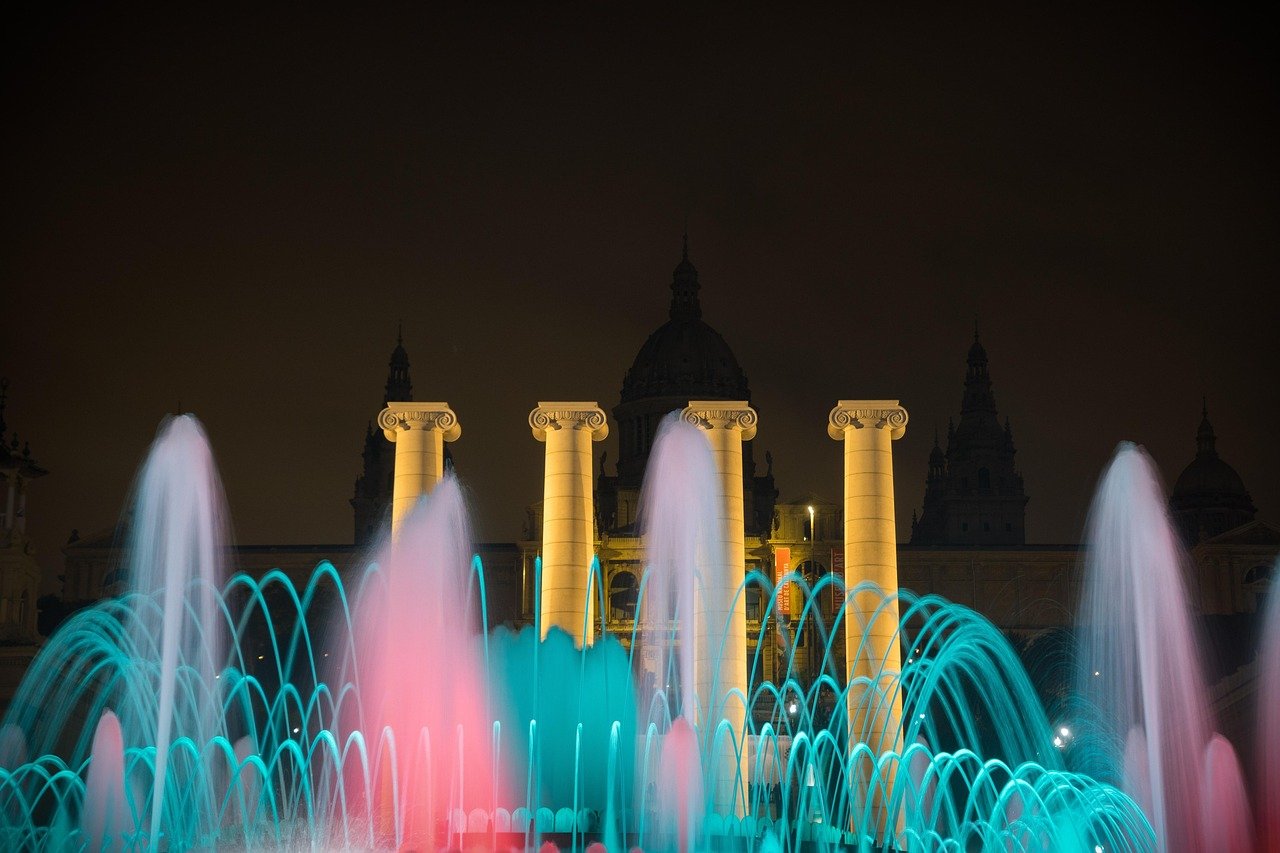
The Magic Fountain of Montjuic was created by engineer Carles Buigas for the 1929 International Exposition of Barcelona, a world’s fair that transformed the entire hillside of Montjuic into a showcase of grand architecture and civic ambition. Buigas was just 26 years old when he submitted his visionary proposal, and the project was considered so audaciously ambitious that many of his contemporaries doubted it could be completed in time. City authorities gave him an extraordinarily tight deadline, and Buigas responded by coordinating a workforce of over 3,000 workers who laboured through the night under electric lights — themselves a novelty in 1929 — to complete the fountain in just under a year. The first performance took place on May 19, 1929, to a crowd of astonished Barcelonans who had never seen anything remotely like the combination of illuminated water jets and colour-changing lights that Buigas had engineered.
The fountain’s subsequent history mirrors the turbulent story of Spain itself. During the Spanish Civil War (1936-1939), the fountain suffered significant damage and lay dormant. For two decades following the war, it remained largely inactive, though partial restorations were attempted in the 1940s and 1950s. It was not until the transition to democracy and the cultural renaissance of the late 1970s and 1980s that the fountain received the comprehensive restoration it required. Barcelona’s selection as the host city for the 1992 Summer Olympics provided the impetus and funding for a complete rebuild of the fountain’s hydraulic and lighting systems, bringing it back to full operation with modern technology while preserving Buigas’s original conception. Since then the Font Magica has operated as a free public spectacle drawing more than 2.5 million visitors annually, making it one of the most visited attractions in Spain. Today the fountain incorporates 3,620 water jets circulating 2,600 litres per second, served by 4,760 individual lights capable of producing approximately seven billion distinct light-and-water combinations.
What to See at the Magic Fountain
The Main Show Performance
The centrepiece of any visit to the Font Magica is the light-and-music show itself, and it is best experienced with a little knowledge of what to expect. Each performance lasts approximately 20 minutes and cycles through several different musical sequences — the programming rotates seasonally, drawing from classical music (Beethoven, Strauss, and Mascagni are perennial favourites), popular cinema soundtracks (the themes from The Godfather, Star Wars, and Mission Impossible have all featured), and Catalan and Spanish popular songs. During each musical sequence, the fountain’s 3,620 jets respond to the music in real time, rising and falling, spreading and concentrating, while the lighting shifts through colours that seem to interpret the emotional register of each piece — reds and oranges for dramatic passages, cool blues for lyrical sections, rainbow combinations for triumphant finales. The centrepiece jet can reach 52 metres in height, a startling sight against the illuminated backdrop of the Palau Nacional on the hill above. Multiple shows run back-to-back throughout the evening, so visitors who arrive late can simply wait for the next performance to begin — usually within 15 to 20 minutes of the previous one ending.
The Broader Montjuic Setting
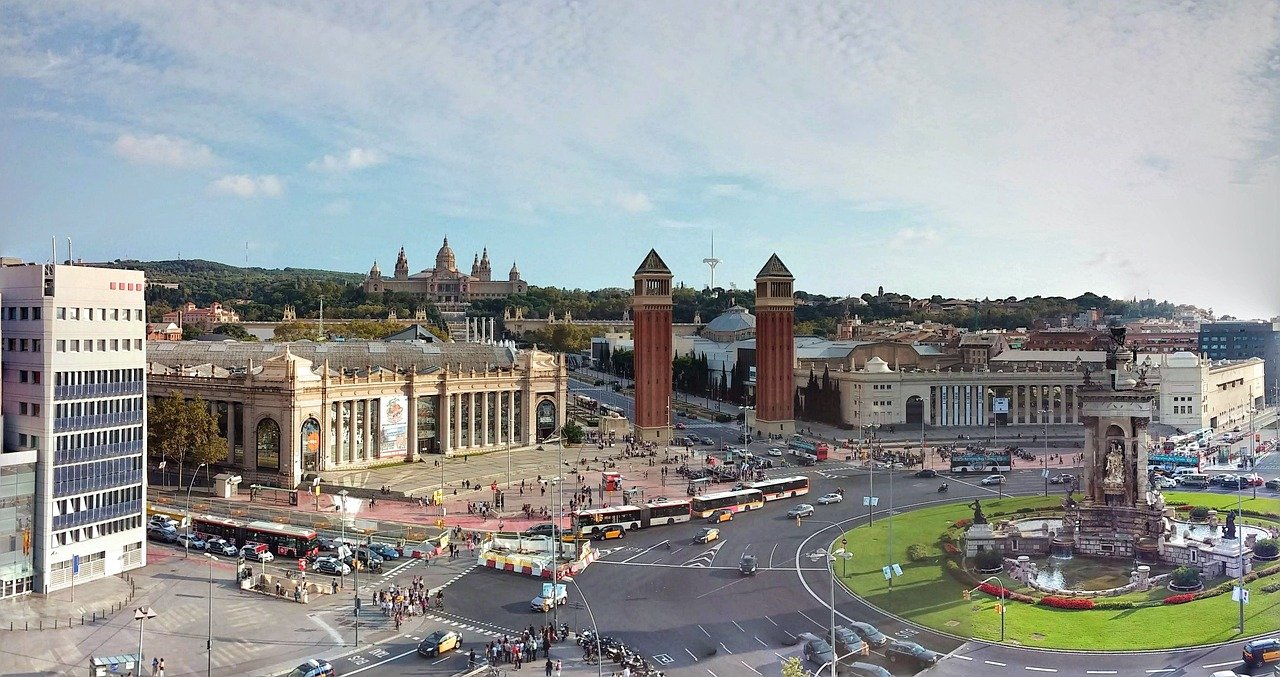
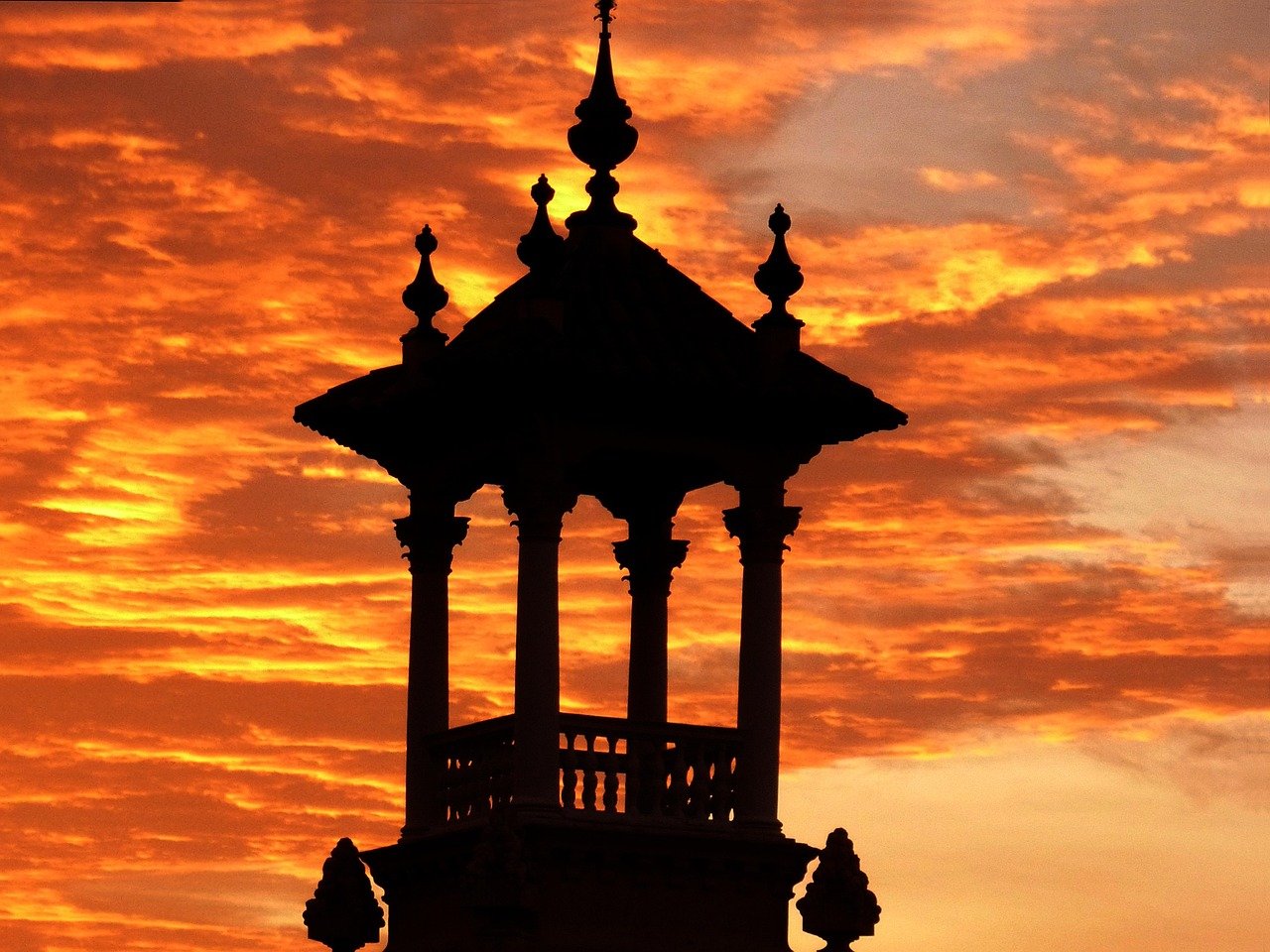
The Magic Fountain does not exist in isolation — it is the focal point of one of Barcelona’s grandest urban compositions, a processional axis designed for the 1929 Exposition that stretches from the twin Venetian-inspired towers of Placa Espanya up through a series of cascading fountains and formal gardens to the Palau Nacional (now the Museu Nacional d’Art de Catalunya, or MNAC) at the summit. To fully appreciate the setting, arrive at Placa Espanya itself and walk the entire length of Avinguda de la Reina Maria Cristina toward the fountain — the sequence of fountains, the flanking exhibition pavilions (several of which still host trade fairs today), the view of the illuminated Palau Nacional growing larger as you approach, and finally the Font Magica itself compose a theatrical promenade that was meticulously designed to create exactly this sense of crescendo. The setting sun framing the Palau Nacional creates one of Barcelona’s most photographed panoramas, and arriving before the show to enjoy this transition from daylight to theatrical illumination is itself a rewarding experience.
Placa Espanya and the Venetian Towers
At the lower end of the Montjuic axis, the great circular Placa Espanya anchors the entire composition with two distinctive towers modelled on the campanile of Saint Mark’s in Venice — a deliberate reference chosen to signal Barcelona’s Mediterranean identity and ambitions. The square itself is one of Barcelona’s major traffic hubs, but at its centre a grand fountain (designed by Josep Maria Jujol, one of Gaudi’s collaborators) celebrates the union of Spain’s four rivers. On the far side of the square stands Las Arenas, a repurposed 19th-century bullring now converted into a shopping and entertainment centre whose rooftop terrace offers an excellent 360-degree view of the city and the Montjuic hillside. This combination of architectural layers — the 1929 Exposition infrastructure, the repurposed 19th-century arena, the backdrop of Montjuic’s gardens and castle — makes the area around the Magic Fountain one of the richest single spaces for urban history in all of Barcelona, rewarding visitors who take time to look beyond the fountain itself.
Local Insights

Barcelona residents who have attended dozens of Font Magica shows know tricks that most tourists never discover. Here are five genuine insider tips for getting the most from your visit.
- The steps leading to the MNAC behind the fountain offer the best elevated viewing angle. Most visitors cluster at ground level directly in front of the fountain, where the view can be partially obscured by the crowd. Instead, climb the grand staircase toward the Palau Nacional — even halfway up the steps you will have an elevated perspective that places the entire fountain in its full setting, with the illuminated jets visible against the city beyond. The crowd thins rapidly with each step you climb.
- Arrive 30 to 45 minutes before the first show to claim a good position. The Font Magica draws enormous crowds, particularly in summer when queues can stretch back toward Placa Espanya. The show is free and unticketd — there are no reserved spots — so position is entirely a matter of arrival time. Earlier shows during the week typically draw smaller crowds than Friday and Saturday nights, when the atmosphere becomes festival-like but space is at a premium.
- Check the wind direction before choosing your viewing spot. The fountain generates significant spray, particularly when the high jets are active and a breeze is blowing. Check which way the wind is blowing from before you settle on a viewing spot — standing downwind of the fountain on a windy night means a free shower, while standing upwind keeps you perfectly dry even during the most spectacular sequences.
- Combine the visit with the Poble Sec neighbourhood for dinner before the show. The Poble Sec district, just a 10-minute walk away on the other side of Montjuic, offers some of Barcelona’s most authentically local dining. Carrer de Blai is famous for its montaditos (small open-faced sandwiches) at exceptionally low prices — you can eat excellently for EUR 8 to 12 per person before heading over for the free evening show, making this one of Barcelona’s best-value evenings out.
- Earlier shows on weeknights are significantly less crowded than peak-time weekends. The first show of the evening on a Tuesday or Wednesday in June or September will have perhaps a quarter of the audience of the 10 PM Saturday show in August. For families with children, or anyone who simply prefers to enjoy the spectacle without a packed crowd pressing from all sides, Tuesday or Wednesday evening visits are strongly recommended over weekend peak hours.
Planning Your Visit
- Tickets: Completely free — no tickets required and no booking needed; simply arrive and find a viewing spot along Avinguda de la Reina Maria Cristina
- Opening hours: Summer season (June to September): shows run Wednesday to Sunday, typically from around 9:30 PM to midnight; winter season (October to May): shows run Thursday to Saturday, from around 7:00 PM to 9:00 PM; the fountain is also open without shows during the day as a visual landmark
- Best time: Weeknights in early summer (June) or early autumn (September) offer the warmest evenings, longest daylight hours for the pre-show setting, and noticeably smaller crowds than peak August weekends
- Duration: Each show lasts approximately 20 minutes; most visitors spend 1 to 1.5 hours at the fountain area including walking the promenade and enjoying multiple show performances
- Booking: No booking required — arrive freely; confirm the current show schedule on the Barcelona City Council website (barcelona.cat) as seasonal dates and times can shift year to year
Getting There
- Metro: Espanya station, served by Line 1 (Red) and Line 3 (Green) — exit directly onto Placa Espanya and walk approximately 300 metres along Avinguda de la Reina Maria Cristina to reach the fountain
- Bus: Lines 13, 23, 37, 55, 150, H12, and H16 all serve Placa Espanya; the Bus Turistic (tourist bus) stops here on both the red and blue circuits
- On foot: A 15-minute walk from Paral.lel metro station through the Poble Sec neighbourhood; 25 minutes from the Gothic Quarter; the approach from Poble Sec through Avinguda del Parallel is pleasant and passes several good restaurants
- Taxi/ride-share: Drop-off at Placa Espanya; note that Avinguda de la Reina Maria Cristina may be pedestrianised during show evenings, so taxis will drop you at the edge of the square; a short walk to the fountain takes under 5 minutes
Frequently asked questions
Is the Magic Fountain really free to visit?
Yes, the Font Magica de Montjuic is entirely free to attend — there are no admission charges, no ticketing, and no booking requirements. This is a public attraction maintained by the Barcelona City Council as a free cultural amenity for residents and visitors alike. Be aware that some websites and operators sell tickets to guided tours or experiences that include the Magic Fountain as part of a broader itinerary, but the fountain viewing itself is always free. Anyone offering to sell you a ticket specifically for the fountain show is misleading you. Simply arrive before showtime, find a good position, and enjoy the spectacle.
How often do shows run and what is the schedule?
Show schedules vary by season and have changed periodically due to drought restrictions and maintenance requirements — it is always advisable to check the current schedule on the official Barcelona City Council website (barcelona.cat) before your visit. As a general guide, summer season (June through September) typically offers shows Wednesday through Sunday, while the rest of the year runs Thursday through Saturday. Shows usually begin around sunset and run for several consecutive performances through to around midnight in peak season. Each individual performance lasts approximately 20 minutes, with brief intervals between shows during which the fountain operates in a simpler mode.
What should I wear and bring to the Magic Fountain?
Comfortable walking shoes are essential as the area involves standing on stone pavement for extended periods. In summer, evenings in Barcelona remain warm enough for light clothing, but a thin layer is useful after 10 PM even in July and August. In spring and autumn, temperatures can drop significantly after dark — a jacket is strongly recommended. Consider bringing a small blanket or folding seat if you want to sit comfortably during the show; the viewing area has no seating. If you are visiting with young children, note that the fountain area has no barriers and can become very crowded — keeping children close is important for safety in peak season.
Can I visit Montjuic and the Magic Fountain in one day?
Absolutely — combining a daytime Montjuic exploration with the evening Magic Fountain show makes for an outstanding full-day itinerary. Montjuic hill offers the Fundacio Joan Miro museum, the Museu Nacional d’Art de Catalunya (MNAC) with its world-class Romanesque collection, the Montjuic Castle fortress with panoramic city views, and extensive gardens including the Jardins de Laribal and Jardi Botanic. The Teleferic (cable car) from Barceloneta or the funicular from Paral.lel station both access the hilltop. Plan to spend 4 to 5 hours exploring the hill in the afternoon, then descend to the fountain area for dinner in Poble Sec before the evening show begins.