
Grand Palace
The approach through the outer courtyard prepares you for something impressive, but nothing quite prepares you for the Emerald Buddha. You pass through a series of gates and suddenly you are standing in the bot of Wat Phra Kaew — a hall shimmering with gold, mirror mosaic, and the deep green of a 15th-century jade image enthroned on a gilded altar eight meters above the floor. Around you, 178 murals tell the story of the Ramayana in epic detail. Outside, the Grand Palace complex stretches in every direction: a city within a city, built across 218,000 square meters, where every surface competes in opulence.
History of the Grand Palace
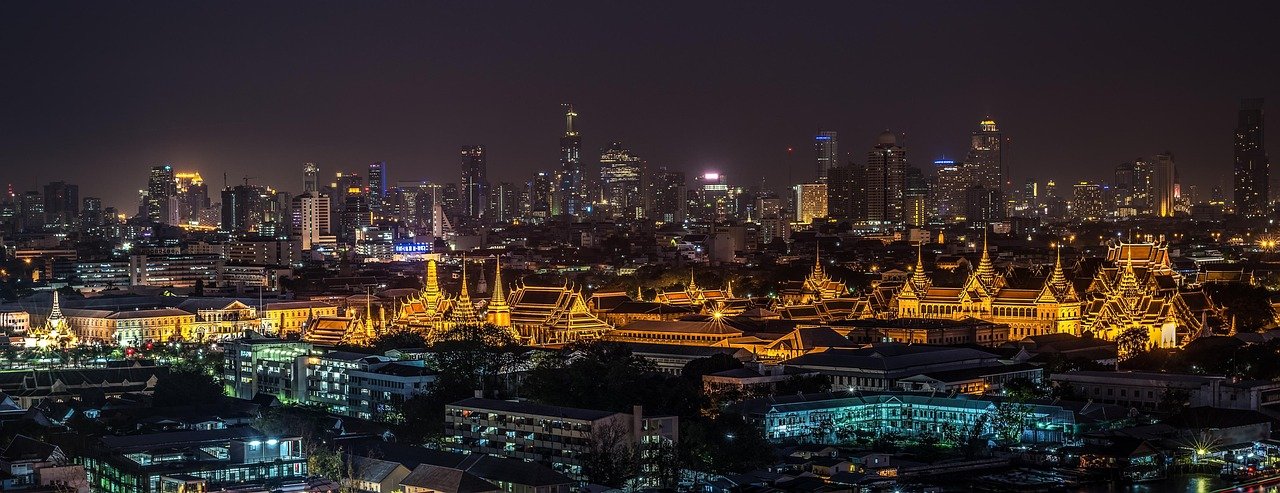
The Grand Palace was constructed in 1782 when King Rama I moved the Siamese capital from Thonburi across the Chao Phraya River to the island of Rattanakosin — an island formed by a loop in the river and a canal dug for the purpose, creating a naturally defensible site. Construction began immediately, with thousands of workers completing the first buildings within a year. The original design was modeled on the Ayutthaya palace complex that had been destroyed by Burmese invaders in 1767, with improvements and elaborations that reflected the ambitions of the new Chakri dynasty.
Each subsequent Chakri king added new buildings, halls, and temples to the complex, creating the layered accumulation of architectural styles — Thai traditional, Khmer-influenced, European neoclassical, and Chinese — that characterizes the Grand Palace today. The Temple of the Emerald Buddha (Wat Phra Kaew) was the first building completed within the palace walls, establishing the sacred core around which secular state buildings were built. The palace was the official royal residence until 1925; today it is used for state ceremonies and ceremonial functions while the royal family lives at Chitralada Palace. The Grand Palace opened to public admission in 1982 to mark the Rattanakosin Bicentennial.
What to See

The Emerald Buddha in Wat Phra Kaew is Thailand most revered image — a 66-centimeter jade Buddha in a meditation posture, dressed in seasonal golden costumes that are changed three times a year by the King himself. Photography inside the bot is not permitted, but the approach through the Wat Phra Kaew complex — past mythological guardians, golden chedis (stupas), and the continuous Ramayana murals on the gallery walls — is itself extraordinary. The murals, originally painted during Rama I’s reign and restored repeatedly since, stretch for 178 panels around the inner gallery and tell the story of Rama’s battle against the demon Tosakan with a detail and energy that rewards slow, careful viewing.
The secular portions of the Grand Palace include the Chakri Maha Prasat Hall (1882), designed by British architects in a Victorian style with traditional Thai tiered roofs, and the Amarin Winitchai Hall, where kings traditionally granted audiences. The Dusit Maha Prasat Throne Hall is considered the finest example of traditional Thai royal architecture in existence. The palace also contains a large model of Angkor Wat, built at a time when Cambodia was under Thai suzerainty, and several small museums with royal regalia and weapons collections.
The Craftsmanship

The Grand Palace is above all a showcase for the extraordinary craftsmanship of Siamese artisans across five generations. Every surface seems to have been addressed: the roof tiles are in five grades from plain terracotta to gilded ceramic; the gable ends of temple buildings display carved and lacquered wood panels backed with colored glass mosaic; the chedis (stupas) are covered in gold leaf applied by hand; the guardian statues at gateway entrances are coated in broken Chinese porcelain in patterns that took years to compose. The scale of the operation — thousands of craftsmen working across decades — produced a building complex that is as much a demonstration of organizational power as artistic achievement.
The restoration of the Grand Palace is ongoing — the murals alone require constant attention, with teams of trained painters working section by section on the continuous Ramayana panels. The traditional crafts required for this restoration — mural painting in the Rattanakosin style, lacquerwork, gilding, and mosaic — are maintained at specialized schools attached to the palace and the Fine Arts Department. Visitors who look carefully will be able to distinguish older, darker sections of the murals from more recently restored areas, creating a living document of the painting tradition across time.
Practical Information
- Tickets: 500 THB adults (approximately USD 14). Children under 120 cm enter free. Ticket includes entry to the Dusit Maha Prasat and the Queen Sirikit Museum of Textiles.
- Opening hours: Daily 08:30-15:30 (last ticket sold). The complex closes at 16:30.
- Best time to visit: Arrive at opening (08:30) to avoid the largest tour groups. October-February for cooler temperatures.
- Duration: 2-3 hours for a thorough visit. Allow more time if you want to read the Ramayana murals in detail.
- Booking: No advance booking; pay at the entrance gate. Dress code strictly enforced — covered shoulders and knees required. Scarves and trousers available to borrow at the entrance.
Local Insights

What locals know that guidebooks do not always tell you:
- Tuk-tuk drivers who offer to take you to the Grand Palace for suspiciously low fares will tell you it is closed and take you to gem shops instead — the palace is almost never closed to visitors during official hours.
- The official audio guide (available at the entrance) is genuinely excellent and worth renting — it provides context for the Ramayana murals that turns an overwhelming visual experience into an intelligible narrative.
- Wat Pho (the Temple of the Reclining Buddha) is a 10-minute walk from the Grand Palace and is best combined in the same visit — enter Wat Pho through its Chetuphon Road gate to avoid paying again at the Grand Palace gate.
- The Queen Sirikit Museum of Textiles, included in the Grand Palace ticket, is housed in a beautiful 1910 building within the complex and is excellent — most visitors skip it in favor of the main temples.
- Boat access via Tha Chang Pier (Chao Phraya Express Boat, Pier N9) drops you at the palace entrance and is significantly faster and more pleasant than road transport during peak hours.
Getting There
- Boat: Chao Phraya Express Boat to Tha Chang Pier (N9) — the fastest and most scenic approach. Ferries run frequently throughout the day.
- Tuk-tuk/Taxi: From Khao San Road about 15 minutes; from Silom or Sukhumvit expect 30-60 minutes in traffic. Use the Grab app for metered taxi prices.
- Bus: Routes 1, 3, 9, 25, 44, 47, 53, 64, 82, and 91 pass the palace area. Check BMTA route maps for current stops.
- On foot: 10-minute walk from Khao San Road through Sanam Luang Park; 15 minutes from Tha Tien Pier via Maharaj Road.
Frequently asked questions
What is the dress code for the Grand Palace?
Covered shoulders and knees are required for all visitors entering the temple buildings. Sleeveless tops, shorts, and short skirts are not permitted. Sarongs and trousers are available to borrow free of charge at the entrance if you arrive underprepared. Closed-toe shoes are not required but sandals must cover the foot.
Can I see the King of Thailand at the Grand Palace?
The royal family no longer lives at the Grand Palace and it is not used for regular court functions. The palace is used for specific state ceremonies, during which it is closed to visitors. The current royal family resides at Dusit Palace and other residences.
Is the Grand Palace worth visiting in 2025?
Yes — despite the ticket price increase to 500 THB, the Grand Palace and Wat Phra Kaew remain the single most extraordinary architectural concentration in Bangkok and arguably in Southeast Asia. The combination of the Emerald Buddha, the Ramayana murals, and the accumulated architectural splendor of five royal generations makes it irreplaceable.
What are the scams near the Grand Palace?
Tuk-tuk scams (drivers claiming the palace is closed and offering to take you elsewhere) are the most common. Gem shop scams involve being taken to overpriced stores on the premise of a “special sale.” Simply walk to the palace entrance and verify opening yourself — it is almost never closed during official hours.
What is near the Grand Palace?
Wat Pho (Temple of the Reclining Buddha) is a 10-minute walk south. Wat Arun (Temple of Dawn) is across the river, accessible by ferry from Tha Tien Pier. Sanam Luang park, National Museum, and the Amulet Market are all within 15 minutes walk.