
Golden Mount (Wat Saket)
The staircase climbs steeply, skirting the flank of the artificial hill as Bangkok's rooftops drop away below, the rattle and hum of the city fading to a background murmur. At the top, a golden chedi glints in the sun and the view opens across the urban sprawl in every direction — a sea of temples, apartment blocks, and tree canopy stretching to the smudged horizon. Wat Saket, the Temple of the Golden Mount, is not Bangkok's grandest temple, but it offers something rarer: perspective. From this 80-metre summit, the city reveals its true scale.
History of Wat Saket
Wat Saket is one of Bangkok's oldest temples, with origins dating to the Ayutthaya period before Bangkok became the Thai capital in 1782. The temple was significantly expanded under King Rama I, who used it as a cremation site for people who died during a plague epidemic in the 1820s — the hill that now supports the golden chedi was partly formed by the mound of earth covering these remains, and the temple has a long association with both death and purification in Bangkok's cultural memory.
The artificial hill — Phu Khao Thong, or the Golden Mount — was begun under Rama III but construction halted when the wet clay subsoil began to sink under the weight. It was completed under Rama IV in the mid-19th century, reinforced with brick walls to prevent further subsidence. A Sri Lankan relic, believed to be a piece of the Buddha's bone, was enshrined within the chedi at the summit — making the site one of Bangkok's most sacred. Every November a famous festival fills the hill and surrounding park with lanterns, market stalls, and devotional activities.
What to See

The climb to the summit winds around the hill in a spiral path lined with trees, bells, and small shrines. The 318 steps are manageable — narrow but not particularly steep — and shade trees and strategically placed benches make the ascent comfortable even in Bangkok's heat. Along the way, small chapels contain Buddha images and elaborate devotional offerings, and the sound of prayer bells rung by passing visitors creates a gentle, contemplative atmosphere.
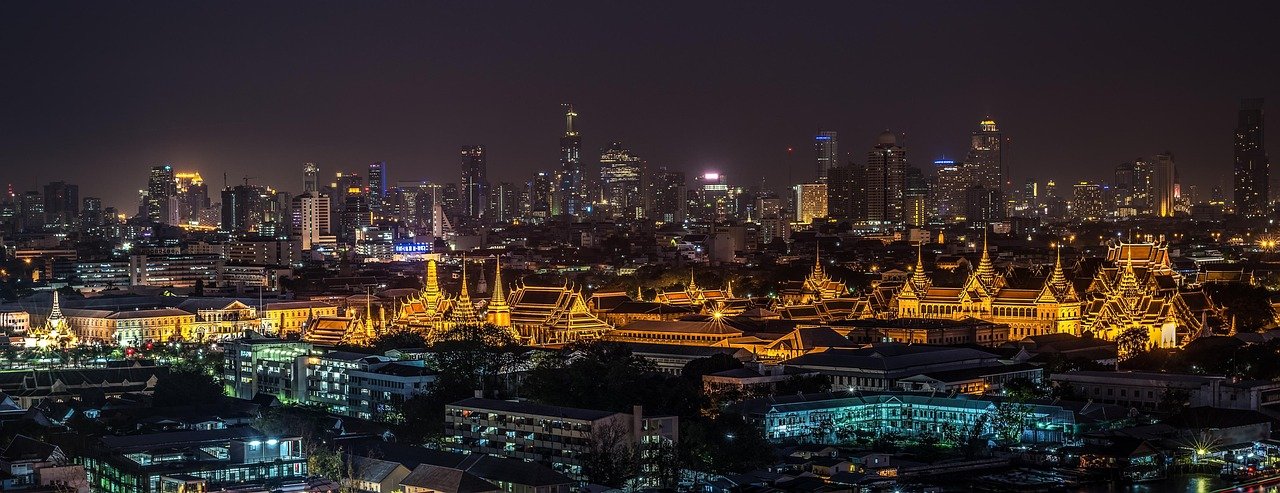
At the summit, the golden chedi and surrounding gallery offer one of Bangkok's best panoramic views. The Chao Phraya River is visible to the west, the Grand Palace and its temple spires are distinctly visible to the south, and on clear days the distant pagoda of Wat Saket itself recedes into the city. The gallery that encircles the chedi has a collection of temple artefacts, religious relics, and historical photographs. A small temple at the base of the hill houses additional Buddha images and makes for a quieter, more contemplative conclusion to the visit.
The Annual Fair
The most spectacular time to visit Wat Saket is during the annual temple fair (Ngan Wat Saket), held over nine evenings around the time of Loy Krathong in November. The hill and surrounding Golden Mount Road are taken over by market stalls, food vendors, traditional performances, and elaborate lantern displays. The golden chedi is illuminated in the evening, and the procession around the hill base draws enormous crowds — it is one of Bangkok's most atmospheric and genuinely local celebrations, largely free of the tourist infrastructure that surrounds many similar events.
During the fair, access to the summit becomes very crowded and queues form on the staircase. Going early in the evening allows a balance between the atmosphere and manageable crowds. The area around the canal at the foot of the hill — the Saen Saep canal — is also strung with lanterns during the fair season, and a boat journey along the canal at dusk is an unexpectedly beautiful way to approach the site.
Practical Information
- Tickets: THB 100 for foreign visitors (approx. USD 3). Children may enter free or at reduced rate.
- Opening hours: Daily 7:00–19:00.
- Dress code: Shoulders and knees covered. Cover-ups available at the entrance.
- Best time to visit: Early morning for fewest visitors and best light; November for the annual fair.
- Duration: 45 minutes–1.5 hours depending on pace.
Local Insights
What locals know that guidebooks do not always tell you:
- Wat Saket sees a fraction of the tourist traffic of the Grand Palace or Wat Pho — early morning visits are genuinely peaceful, with monks, local worshippers, and school groups rather than tour buses.
- The view from the summit to the east includes the Democracy Monument on Ratchadamnoen Avenue — a worthwhile walk to add after descending the hill.
- The temple complex at the base of the hill has a pond with turtles — a long-standing Bangkok custom where releasing turtles is considered to bring good merit. Worth a quiet look.
- The surrounding Banglamphu neighbourhood is one of Bangkok's most atmospheric — old shophouses, traditional market lanes, and the famous Khao San Road are all within 10 minutes walk.
- Combine the climb with a visit to nearby Wat Ratchanadda and Loha Prasat (Metal Castle) — both are within 5 minutes walk and are far less visited than they deserve.
Getting There
- Bus: Multiple city bus routes on Ratchadamnoen Klang Avenue stop near the temple; Routes 2, 15, 39, and others pass close by.
- Saen Saep Canal Boat: The Saen Saep canal express boat stops at Phan Fah Pier, approximately 5 minutes walk from Wat Saket.
- Taxi/Grab: Address: 344 Thanon Chakkraphatdi Phong, Ban Bat, Pom Prap Sattru Phai. From Khao San Road area, about 15–20 minutes walk.
- On foot: 15–20 minutes from Khao San Road; 20–25 minutes from Democracy Monument.
Frequently asked questions
How many steps are there to the top of Wat Saket?
There are 318 steps to reach the summit. The staircase is narrow and winds around the hill, with rest spots along the way. Most visitors of reasonable fitness complete the climb in 10–15 minutes without difficulty.
Is the view from Wat Saket worth the climb?
Yes — it is one of Bangkok's best free-standing panoramic viewpoints and significantly less crowded than the rooftop bars in the central hotel district. The view of the Grand Palace spires, Chao Phraya, and the city's temple landscape is genuinely impressive.
What is the golden chedi at the top of Wat Saket?
The chedi (stupa) was completed under King Rama IV in the mid-19th century and enshrines a sacred relic believed to be a bone of the historical Buddha. The gold-covered structure is visible from many parts of the city.
Is Wat Saket accessible for elderly visitors or those with mobility issues?
The 318 steps make the summit inaccessible for those with significant mobility limitations. However, the temple complex at the base of the hill is accessible and contains worthwhile shrines and peaceful gardens.
What other attractions are near Wat Saket?
Wat Ratchanadda and Loha Prasat (Metal Castle) are 5 minutes walk west. The Giant Swing and Wat Suthat are 10 minutes south. Banglamphu and Khao San Road are 15–20 minutes north on foot.