
Casa Vicens
Long before the Sagrada Familia pierced the Barcelona skyline, before the sinuous stone of Casa Batllo stunned Passeig de Gracia, before La Pedrera redefined what a building could be, there was Casa Vicens. Tucked into a quiet street in the bohemian Gracia neighbourhood, this extraordinary house represents the very beginning of Antoni Gaudi’s architectural journey — his first major commissioned work, completed when he was just 31 years old, and already a declaration of a creative intelligence unlike anything the architectural world had seen before. Open to the public since 2017, Casa Vicens invites visitors into the origins of Gaudi’s genius: a place where Oriental influences collide with Catalan craft traditions, where every surface is a canvas, and where the seeds of an entire architectural revolution are unmistakably present in every tile, gate, and chimney.
History of Casa Vicens
The story of Casa Vicens begins in 1878, when Manuel Vicens i Montaner — a prosperous tile and brick merchant — purchased a plot of land in what was then the independent municipality of Gracia, not yet absorbed into Barcelona. Vicens was young, ambitious, and clearly possessed of an adventurous aesthetic sensibility: rather than commissioning an established architect, he chose the recently qualified Antoni Gaudi, who had received his degree from the Barcelona School of Architecture in 1878 and had almost no completed buildings to his name. Whether Vicens was attracted by Gaudi’s obvious brilliance, his unconventional proposals, or simply by the competitive price a young architect could offer, history does not record. What we do know is that the project Gaudi delivered between 1883 and 1885 exceeded anything Vicens could have reasonably imagined — a building so original in its conception and execution that it immediately established its creator as a figure to watch.
Gaudi’s design process for Casa Vicens was characterised by the same meticulous observation of nature that would define his entire career. The site was covered in marigold flowers when he first visited — so he incorporated the marigold as a primary decorative motif throughout the facade’s ceramic work. He studied Islamic and Moorish architecture, particularly the Alhambra in Granada, and drew on these sources for the muqarnas-inspired vaults of the smoking room and the geometric complexity of the building’s ornamental ironwork. He looked to the Orient for tile patterns, to medieval Catalan architecture for structural principles, and to the natural world for everything else. The result was a building that belonged to no existing style and anticipated several styles that did not yet exist, including Art Nouveau and Expressionism. After serving as the Vicens family’s summer residence for several decades, the house passed through multiple owners and underwent various modifications — some that affected its original character significantly — before being purchased by the Caixa de Manlleu savings bank in 2014. Following careful restoration, Casa Vicens opened to the public in November 2017, and was simultaneously recognised as a UNESCO World Heritage Site, having been included in the broader Gaudi works designation since 2005.
What to See at Casa Vicens
The Exterior and Ceramic Facade

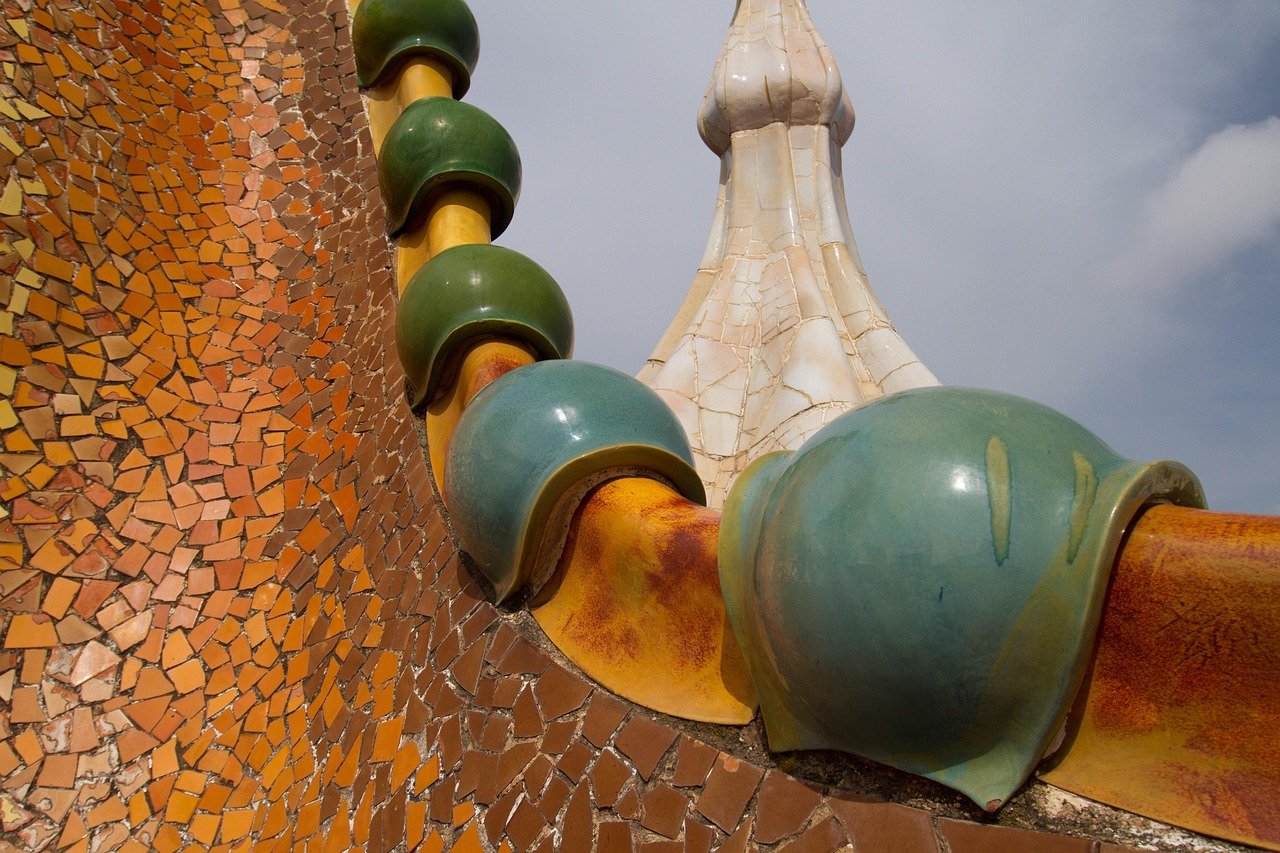
The exterior of Casa Vicens is among the most visually exuberant facades in all of Barcelona, and that is saying a great deal in a city full of architectural show-stoppers. Gaudi covered the lower section of the building in horizontal bands of green-and-white chequerboard ceramic tiles interspersed with larger hand-painted tiles bearing carnation and marigold designs in deep orange — a reference to the flowers that grew naturally on the site. Above this level, the facade shifts to vertical ceramic panelling in blue, green, and orange, punctuated by deeply recessed arched windows of Moorish inspiration framed in elaborate brick and tilework. The roofline is equally dramatic, topped with conical turrets clad in green ceramic scales, pointed finials, and the distinctive chimneys that prefigure the more famous chimneys of Casa Mila by nearly three decades. The iron gates at the garden entrance are a masterpiece of decorative metalwork: designed as giant palm fronds, they were cast from actual palm leaves that Gaudi collected from the site, producing a naturalistic fluidity in iron that appears almost impossible. These gates are among the most photographed details of the building and represent Gaudi’s earliest use of the direct-casting-from-nature technique he would refine throughout his career.
The Smoking Room and Interior Spaces

Inside Casa Vicens, the most immediately astonishing space is the Sala Fumador — the Smoking Room — on the ground floor, designed for the male members of the household to retire after dinner in suitably atmospheric surroundings. Gaudi lined the ceiling with an extraordinary muqarnas vault: hundreds of small stalactite-like plaster formations arranged in concentric rings to create a honeycomb canopy of astonishing complexity, inspired directly by the great ceiling of the Sala de las Dos Hermanas in the Alhambra Palace. The walls are lined with painted tile panels depicting vivid scenes of birds and foliage, and the room’s proportions create an intimate grotto-like atmosphere utterly unlike anything being built in Europe at the time. The adjoining dining room is decorated with three-dimensional mural reliefs depicting fruit — oranges, lemons, and cherries — and birds in an almost tropical profusion, painted in naturalistic colours against cream-coloured plaster. Every room on the principal floor rewards careful attention: door handles are shaped like natural forms, ventilation grilles are disguised as decorative screens, and the relationship between indoor and outdoor space is managed through a garden veranda that anticipates the covered walkways of Park Guell by twenty years.
The Garden and Permanent Collection
Although the original garden of Casa Vicens was reduced significantly when the building’s surroundings were redeveloped in the mid-20th century, what remains is still worth exploring at a deliberate pace. A restored section of the garden includes the original ceramic-tile fountain that Gaudi designed as an outdoor centrepiece — a rare survival from the building’s original exterior decorative programme. The garden also preserves some of the original boundary wall with its distinctive palm-frond ironwork. On the upper floors of the building, a permanent exhibition space documents Gaudi’s design process through architectural models, original drawings, period photographs, and explanatory displays that trace the evolution of his thinking from Casa Vicens through his final work on the Sagrada Familia. Particularly valuable for visitors new to Gaudi’s work, this collection places Casa Vicens within the broader trajectory of his career and illuminates how ideas first expressed here — the ceramic surface, the organic ornamental ironwork, the use of Arabic and Islamic precedents — reappear transformed in his later masterpieces.
Local Insights
Casa Vicens is beloved by those who know it well precisely because it remains under the radar compared to Gaudi’s more famous works. Here are five insider tips from people who have made this building a regular destination.
- Visit first thing in the morning for the best light on the facade and the fewest people inside. The building opens at 10 AM daily, and the first 90 minutes see a fraction of the visitor numbers that arrive from mid-morning onward. The morning sun catches the orange and green ceramic tiles of the exterior from an angle that photographers specifically seek out, and the interior rooms are quiet enough that you can genuinely linger and absorb details that are easy to miss in the afternoon bustle.
- Spend at least 20 minutes in the Smoking Room alone. Most visitors pass through the Sala Fumador in under two minutes on their way to the next room. This is a mistake — the muqarnas ceiling repays sustained upward contemplation, and the painted tile panels depicting birds in foliage become increasingly rich the longer you study them. Carry the audio guide or app to this room specifically, as the explanation of Gaudi’s Alhambra sources transforms your understanding of what you are looking at.
- Combine the visit with a walk through the Gracia neighbourhood. Casa Vicens sits in one of Barcelona’s most characterful residential districts, full of independent shops, neighbourhood squares (Placa de la Vila de Gracia, Placa del Sol, and Placa de la Virreina are all within 10 minutes on foot), and some of the city’s best tapas bars. The Gracia Festa Major in August transforms the neighbourhood’s streets into elaborately decorated festival spaces. A Gaudi visit plus a Gracia neighbourhood walk makes one of the most satisfying half-days in Barcelona.
- Book online for a 10 percent discount and to guarantee entry during busy periods. Unlike the completely sold-out chaos of Casa Batllo in peak season, Casa Vicens generally has capacity available, but online booking still saves money and avoids queuing at the door. The Tiqets platform offers a standard 10 percent discount on advance purchase. The building also participates in the 3 Houses of Gaudi combined pass (EUR 85) with Casa Batllo and Casa Mila, which represents significant savings if you plan to visit all three.
- Do not overlook the upstairs permanent collection and rooftop access. Many visitors focus entirely on the ground-floor rooms and miss the upper floors, where the permanent exhibition provides essential context and the rooftop offers close-up views of Gaudi’s extraordinary chimney designs and a pleasant elevated perspective over the Gracia roofscape toward the Sagrada Familia spires in the distance. The rooftop is also one of the least crowded spaces in the building and a pleasant place to pause and take stock of everything you have seen.
Planning Your Visit
- Tickets: General admission EUR 21 for adults; EUR 19 for students (12 to 15 years), disabled visitors, and seniors over 65; children under 11 free; guided tours (90 minutes) EUR 24; 3 Houses of Gaudi combined pass EUR 85
- Opening hours: April to October daily 10:00 AM to 8:00 PM; November to March Monday 10:00 AM to 3:00 PM, Tuesday to Sunday 10:00 AM to 7:00 PM; closed Christmas Day (December 25) and Epiphany (January 6)
- Best time: Weekday mornings from 10:00 AM to noon offer the quietest conditions and the best morning light on the facade; avoid Saturday and Sunday afternoons in July and August when visitor numbers peak
- Duration: Allow 60 to 90 minutes for a thorough self-guided visit using the audio guide app; 90 to 120 minutes for the official guided tour option
- Booking: Online booking available at casavicens.org or through Tiqets with a 10 percent discount on advance purchases; walk-in tickets available subject to capacity but not recommended in July and August
Getting There
- Metro: Fontana station on Line 3 (Green) is the closest stop — a pleasant 5-minute walk through the Gracia neighbourhood along Carrer de l’Asturies to the building at Carrer de les Carolines 20
- Bus: Lines 22, 24, 27, 32, 87, 92, 114, and V17 all serve the Gracia neighbourhood with stops within a short walk of Casa Vicens
- On foot: A 20-minute walk from Passeig de Gracia through the upper Eixample and into Gracia; 15 minutes from Park Guell’s main entrance at Carrer d’Olot; the walk through Gracia’s backstreets is itself a highlight
- Taxi/ride-share: Drop-off directly on Carrer de les Carolines in front of the building; this is a narrow residential street so drivers may need to approach from Carrer de Sant Salvador or Carrer Gran de Gracia
Frequently asked questions
Why is Casa Vicens less famous than Casa Batllo or the Sagrada Familia?
Casa Vicens spent almost a century as a private residence, entirely closed to the public, while Gaudi’s later works became established landmarks. It only opened as a museum in November 2017 — remarkably recent for a UNESCO World Heritage Site. As a result, it simply has not had the decades of visitor experience, marketing, and word-of-mouth that Casa Batllo and the Sagrada Familia have accumulated. This relative obscurity is precisely what makes it such a rewarding visit: it offers a genuine Gaudi masterpiece without the crowds, the queues, or the inflated prices of its more famous siblings. Many experienced travellers who know Barcelona well consider Casa Vicens the best-kept secret in the city’s Gaudi circuit.
How does Casa Vicens fit into Gaudi’s overall career?
Casa Vicens represents Gaudi’s first major independent commission and the beginning of what would become the most distinctive architectural career of the 20th century. The building shows a young architect absorbing and synthesising a remarkable range of influences — Moorish architecture, Oriental decorative traditions, Catalan craft practices, Gothic structural logic — and beginning to forge from them a genuinely original language. Elements that appear here in embryonic form — the ceramic surface decoration, the organic ironwork, the integration of natural motifs, the manipulation of light through complex spatial sequences — recur transformed and refined in every subsequent major work. Visiting Casa Vicens before the other Gaudi buildings gives you an extraordinary perspective on his development; visiting it after them reveals how much was already present from the very beginning.
Is Casa Vicens suitable for children?
Casa Vicens is generally a family-friendly attraction, though it is worth setting expectations appropriately for younger visitors. The building’s rich decorative surfaces — particularly the ceramic tiles, the ironwork gates, and the extraordinary Smoking Room ceiling — tend to capture children’s imaginations in ways that more conventionally furnished historic houses do not. The garden area provides a brief outdoor break during the visit, and the upper-floor exhibition includes interactive elements that engage younger visitors. Children under 11 enter free, making the family cost reasonable. The visit duration of 60 to 90 minutes is manageable for most children, though the narrower staircases and relatively confined interior spaces are worth keeping in mind for pushchairs and prams.
What are the differences between the original building and what visitors see today?
The most significant difference between the original Casa Vicens and today’s building concerns the garden. Gaudi’s original design included a substantially larger garden with multiple decorative elements including a waterfall, a larger fountain, and additional ironwork structures — all of which were lost when sections of the property were sold and redeveloped in the 1940s. The current restored garden represents only a portion of the original. Inside, some rooms were modified by subsequent owners, and the restoration process involved careful archaeological and historical research to distinguish Gaudi’s original work from later alterations. The permanent collection on the upper floors documents these changes explicitly, giving visitors an honest picture of what survives from 1885 and what has been sympathetically restored or reconstructed in the 21st century.