
Cairo Citadel (Citadel of Saladin)
From the Mokattam Hills above the eastern edge of Cairo, the view stretches impossibly far: a grey-brown ocean of rooftops broken by the silver thread of the Nile, the smudge of the Giza plateau on the horizon, and — rising above everything — the twin slender minarets of the Muhammad Ali Mosque catching the morning sun like twin candles. The Cairo Citadel has stood on this strategic ridge since 1176 CE, when Saladin recognised that whoever commanded this limestone promontory commanded Egypt. Nine centuries of sultans, pashas, and generals have agreed. Today the fortress opens its walls to visitors, and the panorama alone — before you have entered a single building — justifies every step of the climb.
History of the Cairo Citadel
Saladin — Salah al-Din Yusuf ibn Ayyub, founder of the Ayyubid dynasty — began construction of the Citadel in 1176 CE, seven years after he consolidated power in Egypt. His strategic genius recognised the Mokattam plateau as the city’s high ground: it commanded every approach to Fustat and al-Qahira below, and its limestone cliffs made it nearly impregnable on three sides. He imported workers and, controversially, Crusader prisoners captured after his victories in the Levant to quarry stone from the very hills on which they built. The original Ayyubid walls, some sections of which still stand, incorporated massive round towers and a deep well — Bir Yusuf, or Joseph’s Well — drilled over 90 metres into the bedrock to guarantee a water supply during siege. The well remains, its ingenious ox-powered lifting mechanism described by medieval travellers with astonishment.
The Citadel served as Egypt’s seat of government and the residence of its rulers for nearly 700 years — from Saladin’s time until Khedive Ismail moved the administrative capital to the purpose-built Abdin Palace in 1874. In that span it witnessed the full sweep of Egyptian history: the Mamluk sultans who broke the Mongol advance at Ain Jalut; the Ottoman conquest of 1517 when Selim I had the last Mamluk sultan publicly hanged at Bab Zuweila; Napoleon’s brief occupation and the cannonfire that damaged the Mamluk palaces; and Muhammad Ali Pasha’s massacre of the Mamluk beys in 1811, the event that consolidated his absolute power and cleared the way for the mosque that now dominates the skyline. That mosque, built between 1830 and 1857 by the Albanian-born pasha who became the founder of modern Egypt, was deliberately designed to be visible from across the entire Nile Valley — a stone proclamation of a new era.
What to See at the Cairo Citadel
The Muhammad Ali Mosque
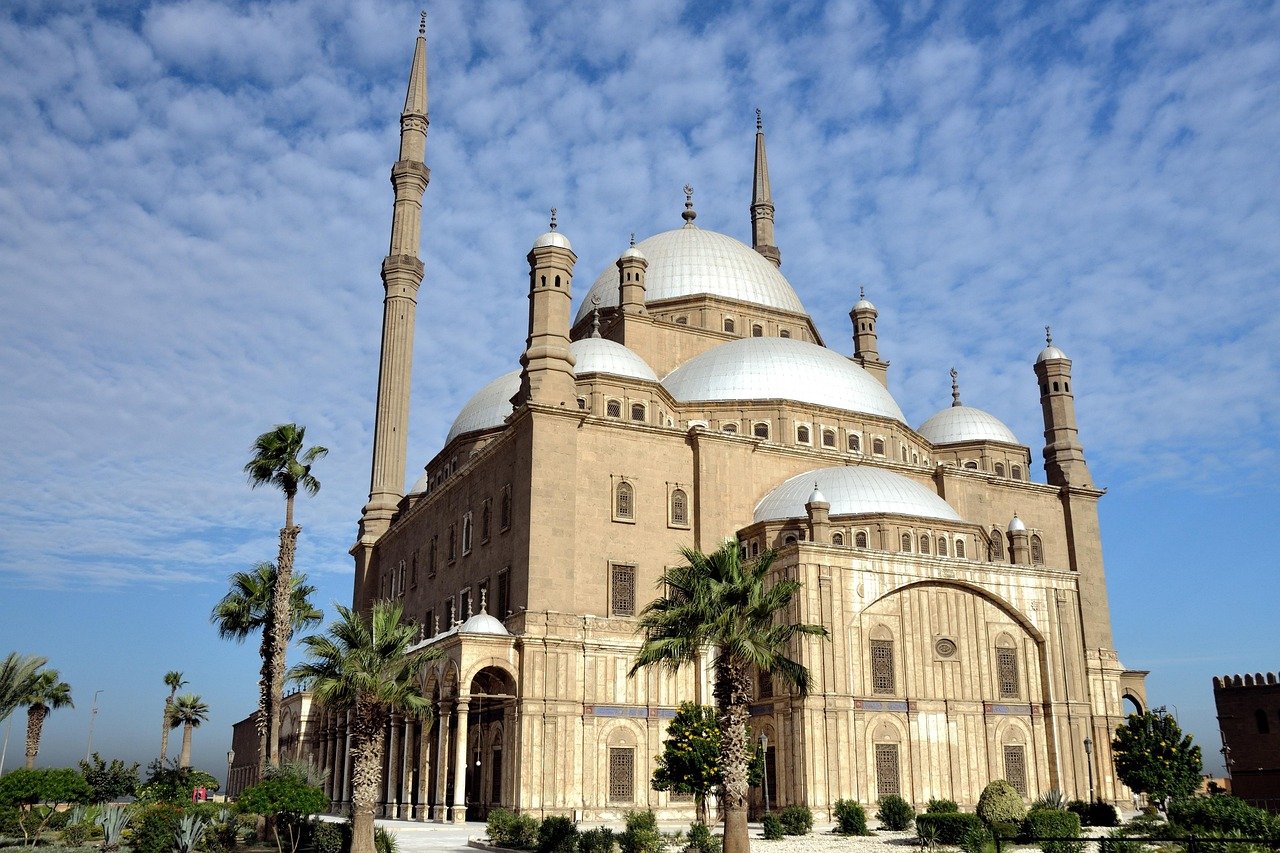
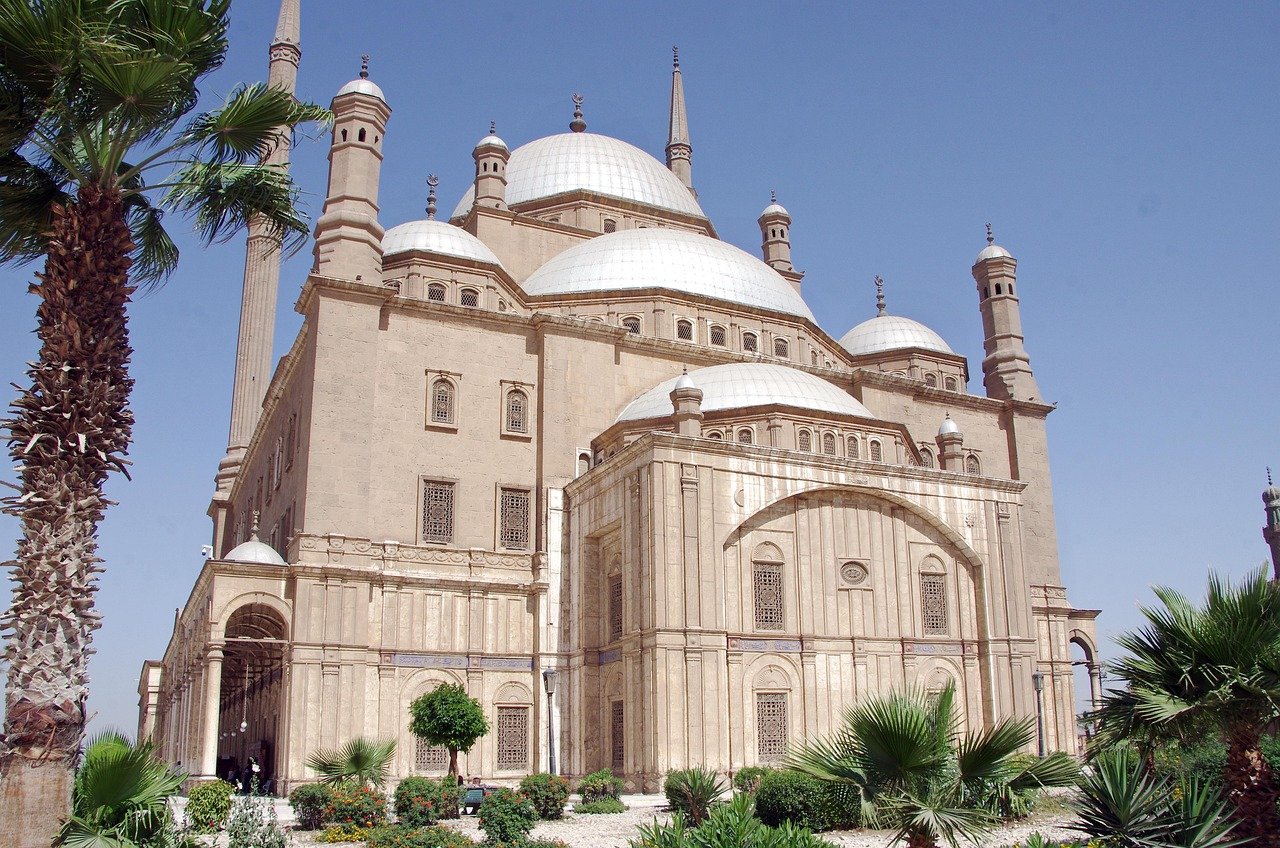
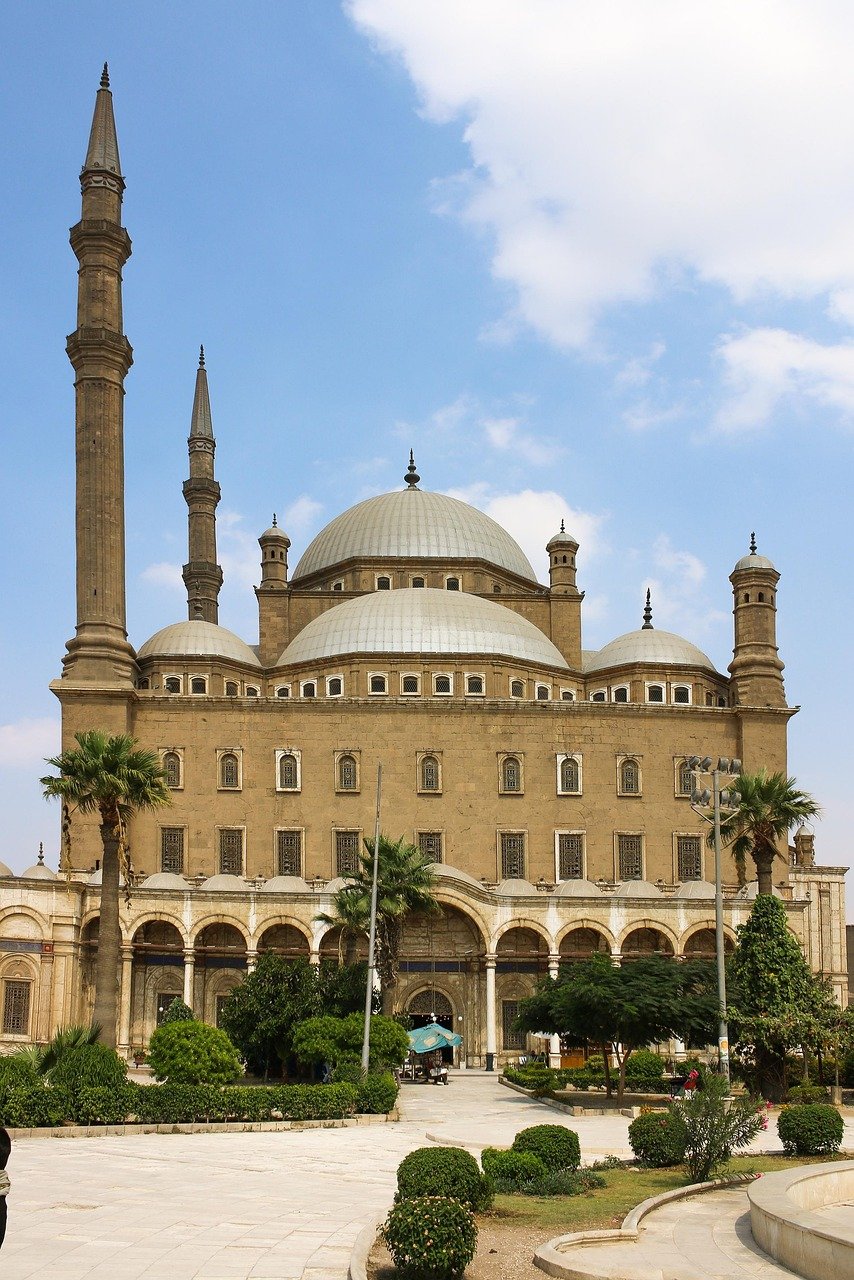
The Mosque of Muhammad Ali, often called the Alabaster Mosque for the Egyptian alabaster that sheathes its courtyard walls, is one of the most recognisable silhouettes in Africa. Designed by the Greek architect Yusuf Bushnak in Ottoman-Turkish style, it draws clear inspiration from the Sultan Ahmed Mosque in Istanbul — a central dome flanked by semi-domes, the whole assembly rising to 52 metres, surrounded by four slender pencil minarets. The courtyard contains an ornate ablution fountain and a French clock tower; the clock was a gift from King Louis-Philippe of France in 1846, exchanged for the obelisk of Luxor that now stands in the Place de la Concorde in Paris. Inside, the ceiling is covered in painted medallions and the central dome creates a vast canopy of light. Muhammad Ali and his direct descendants are buried in a marble mausoleum in the south-eastern corner. Visitors are welcome outside prayer times; modest dress and bare feet are required.
The Citadel Walls and Al-Gawhara Palace
Walking the Citadel’s outer ramparts gives a sense of the original Ayyubid engineering: walls up to three metres thick, round towers projecting to allow defenders to fire along the wall face, and gateway corridors designed to slow and trap attackers. The towers of Burg al-Muqattam on the northern enclosure are the best-preserved Ayyubid military architecture in Cairo. Within the Southern Enclosure, Al-Gawhara Palace (completed 1814) was Muhammad Ali’s jewel-box reception hall, built in the Ottoman rococo style that was fashionable in Istanbul at the time. Its painted ceilings, French chandeliers, and gilded furniture reflect a ruler determined to signal his dynasty’s European connections. The adjacent museum displays thrones, uniforms, and personal effects of the Muhammad Ali dynasty through to King Farouk, who was deposed in 1952. Entry to the palace is included in the general Citadel ticket.
The Panoramic Terrace and Bir Yusuf
The Citadel’s northern terrace offers the finest elevated view of Cairo available to the public — on a clear winter morning the Giza pyramids are visible over 20 km to the southwest. At 10–11 AM, before the haze builds, this terrace delivers a photograph that encapsulates the entire layered geography of the city: medieval minarets in the foreground, Nile glinting in the middle distance, desert plateau beyond. Bir Yusuf, Saladin’s famous well, is accessible in the northern enclosure — descend the spiral staircase (175 steps) to peer into the shaft and appreciate the medieval engineering that guaranteed this fortress could withstand siege. The well was dug through limestone using the rotating motion of oxen descending two parallel ramps, a system described in detail by the medieval traveller Ibn Battuta. Allow 20 minutes for the descent and return.
The Military Museum and Carriage Museum
The Citadel Northern Enclosure contains two museums that are often skipped but reward the curious visitor. The Military Museum, housed in the former Harim Palace built by Muhammad Ali son Ibrahim Pasha in 1827, traces Egyptian military history from the Pharaonic era through the Napoleonic period, the Urabi revolt of 1882, both World Wars, and the October War of 1973. The dioramas are old-fashioned by modern standards but the collection of actual weaponry — Mamluk swords, Ottoman cannon, and WWII-era field equipment used at El-Alamein — gives concrete weight to the centuries of warfare that shaped this nation. The Carriage Museum, a separate small building near the main entrance, holds the ornate gilded state carriages of the Muhammad Ali dynasty, including the coach used for royal ceremonies under both Khedival and British Protectorate rule. Neither museum charges separately from the general Citadel ticket, and both are usually quiet enough to explore at a genuinely reflective pace.
The National Police Museum, located in the Southern Enclosure, touches on a more recent and politically sensitive dimension of Egyptian history: it covers the history of the national police force from the Ottoman period through to the present, including exhibits on the 1952 revolution and the role of security forces in modern Egypt. The rooftop of the police museum building offers one of the best views of the Southern Enclosure, including the full facade of the Muhammad Ali Mosque at close range. Combine a visit to the police museum roof with the main panorama terrace on the Northern Enclosure for two distinct perspectives on the city spread below.
Local Insights
The Citadel rewards visitors who plan slightly beyond the obvious path through the main gate.
- Arrive before 10 AM for the panorama and the mosque interior. By mid-morning, tour groups pack the Muhammad Ali Mosque courtyard and the northern terrace simultaneously. The first hour after opening gives you the courtyard effectively to yourself, with the morning light on the alabaster at its most beautiful. The last ticket is at 3 PM — plan accordingly.
- Buy your ticket at the main gate, not from touts outside. Men will approach near the entrance offering to help with tickets or guide you in. Official tickets are purchased at the gate window only. The ticket price includes access to both the Northern and Southern Enclosures and all internal museums; a separate ticket is not required for individual buildings within the compound.
- Combine with the Sultan Hassan Mosque directly below. Walking five minutes downhill from the Citadel’s main gate brings you to the Mosque-Madrasa of Sultan Hassan (1356) and the adjacent Mosque of Al-Rifa’i (1912, where the last Shah of Iran is buried). These two buildings face each other across a square and together form one of the most architecturally impressive pairings in the Middle East — don’t skip them on the way down.
- Dress modestly and bring shoe bags. The Muhammad Ali Mosque requires bare feet; the marble floor inside can be cold in winter months (November–February) and blisteringly hot in summer. Wearing socks under removable sandals solves both problems. Women need to cover hair inside the mosque; loose scarves are offered at the entrance.
- Check for the Sound and Light Show schedule. On select evenings the Citadel hosts a son et lumiere show projecting images onto the Muhammad Ali Mosque’s domes and minarets, narrated in English and several other languages. Tickets are sold separately (approximately 300 EGP); the show runs in cooler months. Check the Egyptian Ministry of Tourism website or ask your hotel concierge for the current season’s dates.
Planning Your Visit
- Tickets: 550 EGP (~1 USD) for foreign adults; 275 EGP for foreign students with valid ID. Egyptian nationals pay 100 EGP. All internal sites included in the single compound ticket. Children under 5 free.
- Opening hours: Daily 9:00 AM – 5:00 PM; last ticket sold at 3:00 PM. The Muhammad Ali Mosque closes approximately 30 minutes during noon prayers on Fridays. The compound may close early on national holidays.
- Best time: October to April for comfortable temperatures. Tuesday through Thursday mornings are least crowded. Avoid Fridays if possible — noon prayers bring the largest local attendance. The golden hour before sunset in winter offers spectacular photography of the minarets.
- Duration: 2–3 hours covers the major sites: Muhammad Ali Mosque, Al-Gawhara Palace, the northern panorama terrace, and Bir Yusuf. A full half-day allows you to visit the Military Museum and walk the full perimeter of the walls.
- Booking: No advance booking required. Walk-up tickets at the main gate. For groups of 10 or more, contact the Supreme Council of Antiquities in advance. Online tickets also available via egymonuments.gov.eg.
Getting There
- Metro: No direct Metro station. Take Cairo Metro Line 1 to Al-Sayeda Zeinab station, then a 15-minute taxi or tuk-tuk ride uphill to the Citadel gate. Alternatively, Line 2 to El-Ataba station and a 20-minute taxi from there.
- By car: The main visitor entrance is on Salah Salem Road on the eastern side of the Citadel. Parking is available in the lot adjacent to the entrance gate. Traffic on Salah Salem Road can be heavy; allow extra time from the city centre.
- On foot: About 30 minutes’ uphill walk from Khan el-Khalili bazaar in Islamic Cairo, following Al-Muizz Street south and then uphill via the Sultan Hassan square. The walk through the southern part of Islamic Cairo is interesting in its own right.
- Taxi/ride-share: Uber and Careem both service the Citadel reliably. Request Saladin Citadel or Qalat Salah al-Din as your destination. Fare from Tahrir Square is typically 60–100 EGP depending on traffic.
Frequently asked questions
What is the difference between the Cairo Citadel and the Grand Egyptian Museum?
The Cairo Citadel (Citadel of Saladin) is a medieval Islamic fortress built in 1176 CE on the Mokattam Hills, containing mosques, palaces, and military museums spanning the Ayyubid, Mamluk, and Ottoman periods. The Grand Egyptian Museum is a purpose-built 21st-century museum on the edge of the Giza plateau containing ancient Egyptian artefacts, including the complete Tutankhamun collection. They are entirely separate attractions in different parts of the city, covering different eras of Egyptian history, and both are worth visiting independently.
Is the view of Cairo from the Citadel really worth it?
Yes — it is one of the best elevated viewpoints of any major city in Africa or the Middle East. On a clear winter morning, the panorama from the northern terrace spans the entire city: the medieval minarets of Islamic Cairo in the foreground, the Nile curving through the modern city beyond, and the Giza pyramids visible on the desert horizon over 20 kilometres away. The view is at its best between October and February before the summer heat haze builds. The same vantage point that Saladin chose for strategic domination in 1176 turns out to be an extraordinary place for photography nearly 850 years later.
Can I visit the Citadel and the pyramids on the same day?
Yes, this is a popular and manageable combination. Spend the morning at the Citadel (arriving at 9 AM and leaving by noon), then take an Uber or Careem directly to the Giza plateau — the drive is approximately 25–35 minutes in moderate traffic, covering around 15 km. Arrive at Giza in early afternoon, when the morning tour groups are leaving. Alternatively, stop at the Grand Egyptian Museum at Giza en route. This makes for a full but rewarding day covering both Islamic Cairo’s medieval heritage and the ancient world of the pharaohs in a single outing.
Why is it called the Alabaster Mosque?
The Muhammad Ali Mosque earns its popular nickname from the extensive use of Egyptian alabaster — a translucent, cream-coloured calcium carbonate stone — that sheathes the walls and pillars of its open courtyard. The alabaster was quarried near Beni Suef in Upper Egypt and gives the courtyard a warm, luminous quality in morning sunlight. The interior of the mosque itself is covered in painted plaster and gilded medallions rather than alabaster, but the courtyard’s gleaming stone is distinctive enough to have become the building’s defining characteristic and the origin of its common name.