
Berlin Wall
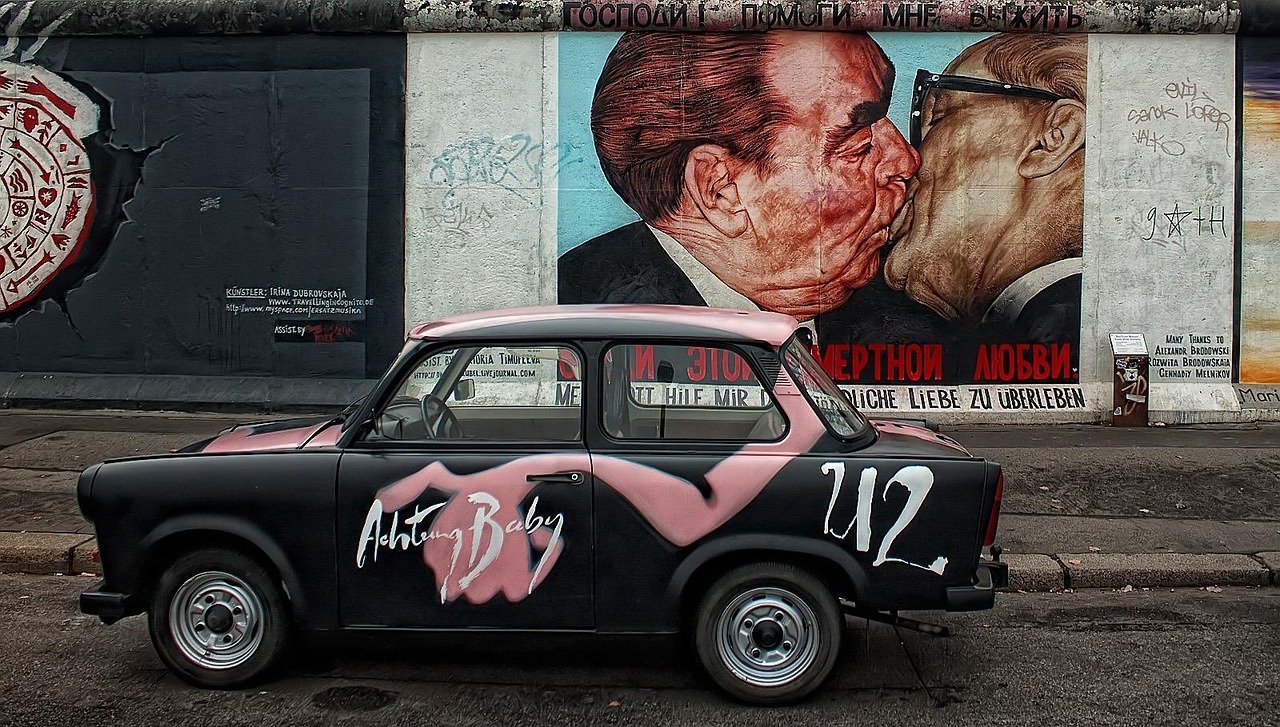
Stand at the East Side Gallery and look at Dmitri Vrubel’s “Fraternal Kiss” — Brezhnev and Honecker locked in an absurd embrace, painted on the last great stretch of concrete that divided a city and a continent for 28 years. The mural is a work of political satire so pointed that it became one of the most reproduced images of the 20th century’s end. Behind you is the Spree river; ahead, the glass towers of reunified Berlin. The Wall is gone, but the 1,316-metre gallery keeps the memory vivid and the art alive.
History of the Berlin Wall
The Berlin Wall was constructed beginning on 13 August 1961, when the East German government, under Soviet pressure and facing an exodus of its citizens through West Berlin, began erecting barbed wire barriers across the city overnight. Over the following years, the improvised barrier was replaced with a sophisticated fortification system: a concrete wall up to 4.2 metres high, a “death strip” of raked sand (to show footprints), watchtowers, anti-vehicle ditches, floodlights, and guard dog runs. The Wall ultimately stretched 155 kilometres around West Berlin, which it completely encircled.
Between 1961 and 1989, approximately 140 people died attempting to cross the Berlin Wall, though some estimates put the total higher. Thousands of successful escape attempts were made by tunnel, homemade aircraft, vehicles disguised as diplomatic cars, and acts of individual courage. The Wall fell on 9 November 1989 after a miscommunication at a press conference caused the East German spokesman to announce that travel restrictions would be lifted “immediately, without delay” — within hours, jubilant Berliners were climbing the Wall and dismantling it with hammers and picks, an event that remains one of the defining images of the 20th century.
The East Side Gallery

The East Side Gallery is the longest remaining section of the Berlin Wall, preserved as an open-air gallery of 105 paintings by artists from 21 countries. Immediately after the Wall came down in November 1989, artists began painting the eastern face of the surviving concrete sections in the Friedrichshain district; the gallery was officially opened on 28 September 1990. The works range from political statements to abstract art to direct celebrations of freedom, and the 1,316-metre stretch along the Spree River constitutes the largest open-air gallery in the world.
The most famous works include Vrubel’s “Fraternal Kiss” (Erich Honecker and Leonid Brezhnev locked in a socialist embrace, captioned “God, help me to survive this deadly love”), Birgit Kinders’s Trabant breaking through the Wall (symbolising the East German car breaking free), and Thierry Noir’s brightly coloured heads that became symbols of the gallery’s early days. Many of the originals have been restored or repainted as the exposed concrete weathered, a process that raised questions about the authentic nature of the works.
Berlin Wall Memorial Sites

Beyond the East Side Gallery, Berlin maintains several significant memorial sites related to the Wall. The Berlin Wall Memorial on Bernauer Strasse preserves an outdoor section of the complete border fortification system — wall, death strip, watchtowers, and inner wall — along with an excellent documentation centre that tells the full story of the Wall’s construction, operation, and fall. This is the most comprehensive memorial experience available and includes a chapel that stands on the site of a house that was demolished during the Wall’s construction.
Checkpoint Charlie, in the Kreuzberg district, is the most famous crossing point between East and West Berlin, where American and Soviet tanks faced each other in 1961 in the tensest standoff of the Cold War. The original checkpoint building is gone (replaced by a replica), and the area is heavily touristed, but the Checkpoint Charlie Museum adjacent provides genuine documentation of escape attempts and Cold War history. The Topography of Terror, built on the site of the SS and Gestapo headquarters, provides the broader historical context of Nazi terror and its connection to post-war German division.
Practical Information
- East Side Gallery: Free and open 24 hours; visitor information centre at Muhlenstrasse 73 open daily 10:00-17:00
- Berlin Wall Memorial (Bernauer Strasse): Free; outdoor section always open; documentation centre Tuesday-Sunday 10:00-18:00
- Checkpoint Charlie Museum: Daily 9:00-22:00; adult admission approximately EUR 20
- Best time to visit: Early morning for East Side Gallery (good photography light, fewer crowds)
- Duration: 1-1.5 hours for East Side Gallery walk; half-day to visit multiple memorial sites
Local Insights
What locals know that guidebooks don’t always tell you:
- Walk the East Side Gallery from east to west (starting at the Warschauer Strasse end) to see the murals in the order most visitors find works best, ending with the most famous pieces near Ostbahnhof.
- The Berlin Wall Memorial on Bernauer Strasse is more historically significant and less crowded than Checkpoint Charlie; it’s the more authentic experience for understanding what the Wall actually was.
- The Topography of Terror exhibition (free) near Checkpoint Charlie is consistently rated one of Berlin’s best historical museums and is completely overlooked by many visitors who only go to Checkpoint Charlie itself.
- The Fall of the Wall anniversary on November 9 every year sees events at multiple memorial sites; if visiting at this time, check the official programme for commemorative events.
- The DDR Museum (GDR Museum) provides a fascinating ground-level perspective on everyday life in East Germany; it’s entertaining rather than solemn and gives context to the political history of the other Wall sites.
Getting There
- East Side Gallery: S-Bahn to Ostbahnhof station or U-Bahn U1 to Warschauer Strasse; the gallery runs between these two stations
- Checkpoint Charlie: U-Bahn U6 to Kochstrasse station; 2-minute walk
- Berlin Wall Memorial: U-Bahn U8 to Bernauer Strasse or S-Bahn to Nordbahnhof
- By bike: Berlin’s extensive cycle network connects all major Wall sites; cycling the former Wall route is a popular half-day activity
Frequently asked questions
How much of the Berlin Wall still exists?
Of the original 155-kilometre Wall, less than 3 kilometres of concrete sections remain standing in various locations across Berlin. The East Side Gallery at 1,316 metres is the longest continuous section. Small preserved sections exist at the Berlin Wall Memorial, near Potsdamer Platz, and at Niederkirchnerstrasse near the Topography of Terror.
Is Checkpoint Charlie the original barrier?
No – the original Checkpoint Charlie was dismantled in 1990. The current checkpoint structure in the street is a replica erected for tourism purposes. The real artifacts from the checkpoint are displayed in the Checkpoint Charlie Museum adjacent to the site.
When did the Berlin Wall fall?
The Wall fell on 9 November 1989, after an East German government announcement that travel restrictions would be lifted immediately caused crowds to gather at crossings and demand passage. The actual demolition of the Wall happened over the following weeks and months; the Brandenburg Gate section was one of the last to be removed.
Can I take a piece of the Berlin Wall home?
The preserved sections at the East Side Gallery and memorial sites are protected monuments and cannot be touched or chipped. Authentic pieces of Berlin Wall (verified by certificates of origin) are sold by licensed dealers, but be cautious of unverified pieces offered by street vendors.
What is the best time of year to visit Berlin Wall sites?
The East Side Gallery is best in morning light before the tourist crowds arrive. The period around November 9 (the anniversary of the Wall’s fall) sees special commemorative events across Berlin. Summer provides the most comfortable conditions but also the most crowds.