
Amphawa Floating Market
As the afternoon heat softens and the canal town of Amphawa comes to life, wooden boats loaded with grilled river prawns, pad thai, and sticky rice desserts begin nudging against the wooden boardwalks that line the waterways, and the vendors and their customers conduct their transactions in a ritual that feels unchanged from the photographs on the market’s walls — black-and-white images of the same scene from the 1940s and 1950s. Amphawa Floating Market operates only on weekends, which makes it feel like a shared secret among the Bangkok residents who make the 90-minute journey to experience Thailand’s most atmospheric and least commercialised floating market.
History of Amphawa Floating Market
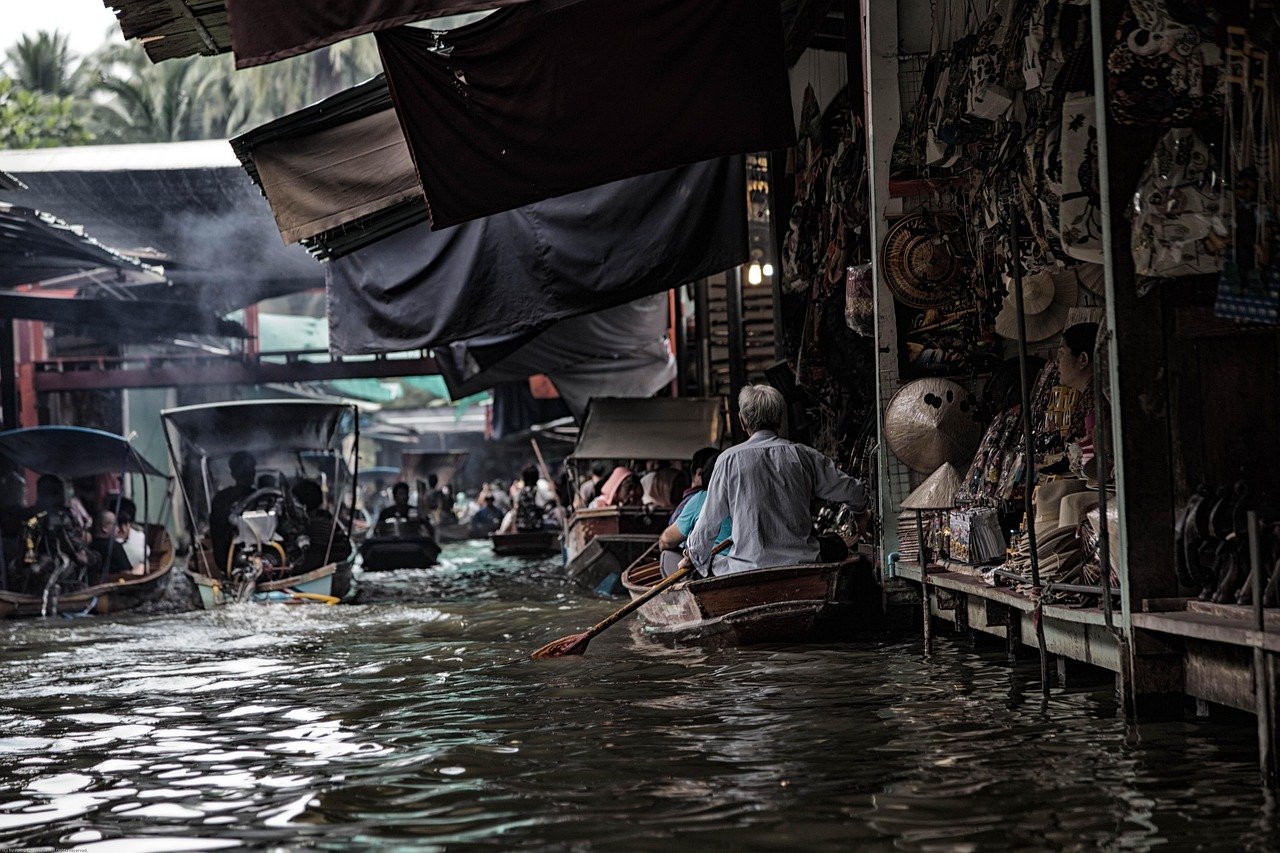
Amphawa District in Samut Songkhram Province was a prosperous canal community throughout the nineteenth and early twentieth centuries, its waterways serving as the highways of central Thailand at a time when roads were secondary to canals (khlongs) for trade and communication. The town’s historic wooden shophouses and canal-side temples date from this period of prosperity, and the canal-based commerce — with vendors selling goods directly from boats — was the natural infrastructure of daily life. As road transport developed through the mid-twentieth century, many floating markets around Bangkok declined or disappeared entirely. Amphawa survived because it remained a functioning community rather than becoming a purely tourist operation.
The revival of Amphawa as a tourism destination began in the early 2000s, driven partly by government heritage promotion and partly by Bangkok’s growing nostalgia for traditional Thai life. The market was recognised as a cultural heritage site, and investment in restoring the wooden shophouses created a district that functioned simultaneously as a genuine community and a heritage attraction. Today visitors come from Bangkok and beyond, and the market — held Friday to Sunday evenings — has expanded to include not only boat vendors but also dozens of food stalls and craft shops along the boardwalks. Despite this expansion, Amphawa retains a less commercialised feel than Damnoen Saduak (the larger, more famous floating market near Bangkok) because its vendors are predominantly local residents rather than tourism operators.
What to See
The floating market experience at Amphawa is concentrated on the stretch of canal running through the town centre, where long-tail boats convert to floating restaurants in the late afternoon, grilling tiger prawns, squid, and river fish over charcoal on deck while customers eat at tables on the boardwalks or purchase food directly across the water. The atmosphere in the early evening — with temple lights reflecting in the dark water, the smell of charcoal and seafood drifting through the warm air, and the gentle noise of boats and conversation — is genuinely enchanting and photographs wonderfully.
The historic Wat Amphawan Chetiyaram, a nineteenth-century temple immediately beside the market, is free to enter and provides quiet contrast to the market bustle. The temple’s cloisters contain murals depicting daily life in nineteenth-century Amphawa that are historically valuable and remarkably detailed. The surrounding streets hold traditional Thai wooden shophouses that have been converted to small guesthouses, art galleries, and boutiques selling products from the Samut Songkhram region — fresh coconut products, fruit preserves, and woven palm-leaf crafts are the most distinctive local specialities.
Firefly Watching
Amphawa’s most talked-about nocturnal experience is the firefly boat tour, operated by local guides from the canal-side pier from sunset until approximately 10pm. Small longtail boats carry groups of 6–8 passengers along the dark canal into the mangrove belt beyond the town, where specific trees along the riverbank become covered in synchronously flashing fireflies — hundreds of insects pulsing in precise coordination in a display that is simultaneously a scientific phenomenon (the synchronisation is a form of sexual signalling) and one of the most beautiful natural sights in Thailand.
The synchronous firefly species (Pteroptyx malaccae) that inhabits the Amphawa canal system requires specific ecological conditions — clean water, native Sonneratia trees for breeding, and low light pollution — that have been preserved in this district partly by its distance from the city and partly by local conservation awareness. The boats typically spend 20–30 minutes in the firefly zone before returning; the whole tour takes about an hour. On clear, moonless nights the combination of stars overhead and firefly trees lining the black water creates an experience visitors consistently describe as extraordinary.
Practical Information
- Tickets: No entry fee to the market; firefly boat tour approximately THB 60–100 per person; food and craft purchases additional
- Opening hours: Friday to Sunday, approximately 3:00 pm–9:00 pm for the canal market; firefly tours from sunset
- Best time to visit: Cool season November to February for comfortable evenings; arrive by 4pm to get the best selection before peak crowds at 6–7pm
- Duration: 3–4 hours for the market and firefly tour; option to stay overnight in the guesthouses along the canal
- Booking: No booking required for the market or firefly tours (pay at the pier); weekends in peak season can fill boats quickly so arrive early
Local Insights

What locals know that guidebooks don’t always tell you:
- The grilled river prawns (goong pao) served from the boat vendors are the signature dish of Amphawa and are substantially better than anything available in Bangkok — order them immediately on arrival before the best catches sell out.
- Staying overnight in one of the canal-side guesthouses (several heritage wooden shophouses have been converted) allows you to experience the early morning market when Bangkok day-trippers haven’t yet arrived — the quieter version of Amphawa is even more charming.
- The Samut Songkhram train from Bangkok’s Wongwian Yai station is slower than the minibus but considerably more atmospheric — an old diesel locomotive pottering through coconut plantations and rice paddies to the provincial capital, from which Amphawa is a short taxi ride.
- On full-moon nights the firefly display is less visible because the moonlight competes with the fireflies’ flash — if you have date flexibility, plan for new moon periods.
- The Mae Klong Railway Market (a few kilometres away) is an extraordinary combination with Amphawa: a train market where vendors pull their stalls back as a train passes directly through, then reset them — one of Thailand’s most photographed everyday scenes.
Getting There
- By minibus: Air-conditioned minibuses depart regularly from Bangkok’s Victory Monument (approx. 1.5 hours, THB 80–100); the most convenient option
- By car: Approximately 90 minutes from central Bangkok via Highway 35 (Rama II Road); free parking available at the market
- By train: Commuter train from Wongwian Yai to Samut Songkhram (very scenic); then local songthaew or taxi to Amphawa
- Taxi/Rideshare: Grab does not easily operate for this distance from Bangkok; the minibus is the recommended option
Frequently asked questions
Is Amphawa better than Damnoen Saduak Floating Market?
The two markets offer different experiences. Damnoen Saduak is larger, more famous, and more intensively marketed toward foreign tourists, with its colourful boats and photogenic setup. Amphawa is smaller, more authentic, predominantly Thai in its visitor base, and feels more like a genuinely functioning community. Most Thai residents and experienced Bangkok visitors prefer Amphawa for its atmosphere; first-time visitors sometimes prefer the scale of Damnoen Saduak. Ideally, visit both.
Do I need to book the firefly tour in advance?
No advance booking is required. Boats depart from the main pier near the market on a queue basis as they fill up. On busy weekend evenings there can be a wait of 15–30 minutes for a boat, but the queue moves steadily.
Is Amphawa family-friendly?
Yes — children enjoy the boats, the fireflies, and the market food enormously. The firefly boat tour is suitable for all ages. Ensure children are kept seated in the longtail boat for safety.
What should I eat at Amphawa?
Grilled river prawns (goong pao) are the essential order. Hoy tod (crispy oyster omelette), mango sticky rice, and coconut sugar candy are all specialities of the Samut Songkhram region. The floating seafood restaurants in the canal are uniformly excellent and priced very reasonably by Bangkok standards.
Can I visit Amphawa without a car?
Yes — the minibus from Victory Monument is the most practical option and requires no planning. The train option is romantic but slower. On weekends, the minibus runs frequently enough that you can turn up at Victory Monument and depart within 20 minutes.