
Alexanderplatz
Few buildings in the world carry as much history per square metre as the Reichstag. Since its completion in 1894, this imposing neo-Renaissance structure on the bank of the River Spree has witnessed the proclamation of the German Republic, a mysterious arson attack that became a pretext for dictatorship, decades of ruin and neglect during the Cold War, and finally — after reunification — a spectacular architectural rebirth under British architect Sir Norman Foster. Today it functions as the seat of the German Bundestag, the federal parliament, and its iconic glass dome is one of Berlin’s most popular attractions. The combination of democratic symbolism, architectural ingenuity, and breathtaking panoramic views over the capital makes a visit to the Reichstag one of the most intellectually and visually rewarding experiences the city has to offer — and it is entirely free of charge.
History of the Reichstag Building
The Reichstag was built between 1884 and 1894 to house the Imperial Diet of the newly unified German Empire, a project beset from the beginning by political tension between the parliament it was meant to serve and Kaiser Wilhelm II, who reportedly despised the building and the institution it represented. Architect Paul Wallot designed a monumental structure in the style of Italian High Renaissance, topped with a large glass and iron dome that became an immediate landmark on the Berlin skyline. The inscription carved above the main western portal — “Dem Deutschen Volke” (To the German People) — was only added in 1916, during the First World War, after decades of opposition from the Kaiser who resented the implication that sovereignty lay with the people rather than the crown. The Weimar Republic was actually proclaimed from the building’s windows on 9 November 1918, a moment of democratic hope that would prove tragically short-lived.
The Reichstag fire of 27 February 1933 remains one of history’s most consequential and contested events. The blaze gutted the building’s interior and provided the newly appointed Chancellor Adolf Hitler with the pretext he needed to suspend civil liberties and consolidate power through the Reichstag Fire Decree. Whether the fire was set by Marinus van der Lubbe, the Dutch communist arrested at the scene, or was the work of the Nazi Party itself, remains debated by historians. What is beyond dispute is that the Reichstag fire marked the effective end of German democracy for twelve years. The building itself was patched up but never properly repaired during the Nazi period — the Reichstag parliament had been stripped of any real power, and the building was used mainly for exhibitions and propaganda events. Further damage came in the last weeks of the war, when fierce fighting around the building left it a shattered shell. Soviet soldiers famously raised the Red Flag over the ruins on 2 May 1945. For the next four decades, the Reichstag stood just inside the Western sector of divided Berlin, a few metres from the Wall, serving variously as an exhibition space and as a symbol of German longing for reunification. Artists Christo and Jeanne-Claude controversially wrapped the entire building in silvery fabric for two weeks in June 1995 — an event that drew five million visitors and, unexpectedly, became one of the most celebrated public artworks of the twentieth century. Restoration under Norman Foster began shortly after and was completed in 1999, restoring the Reichstag to full parliamentary use with a bold, transparency-conscious redesign.
What to See at the Reichstag Building
The Glass Dome and Roof Terrace

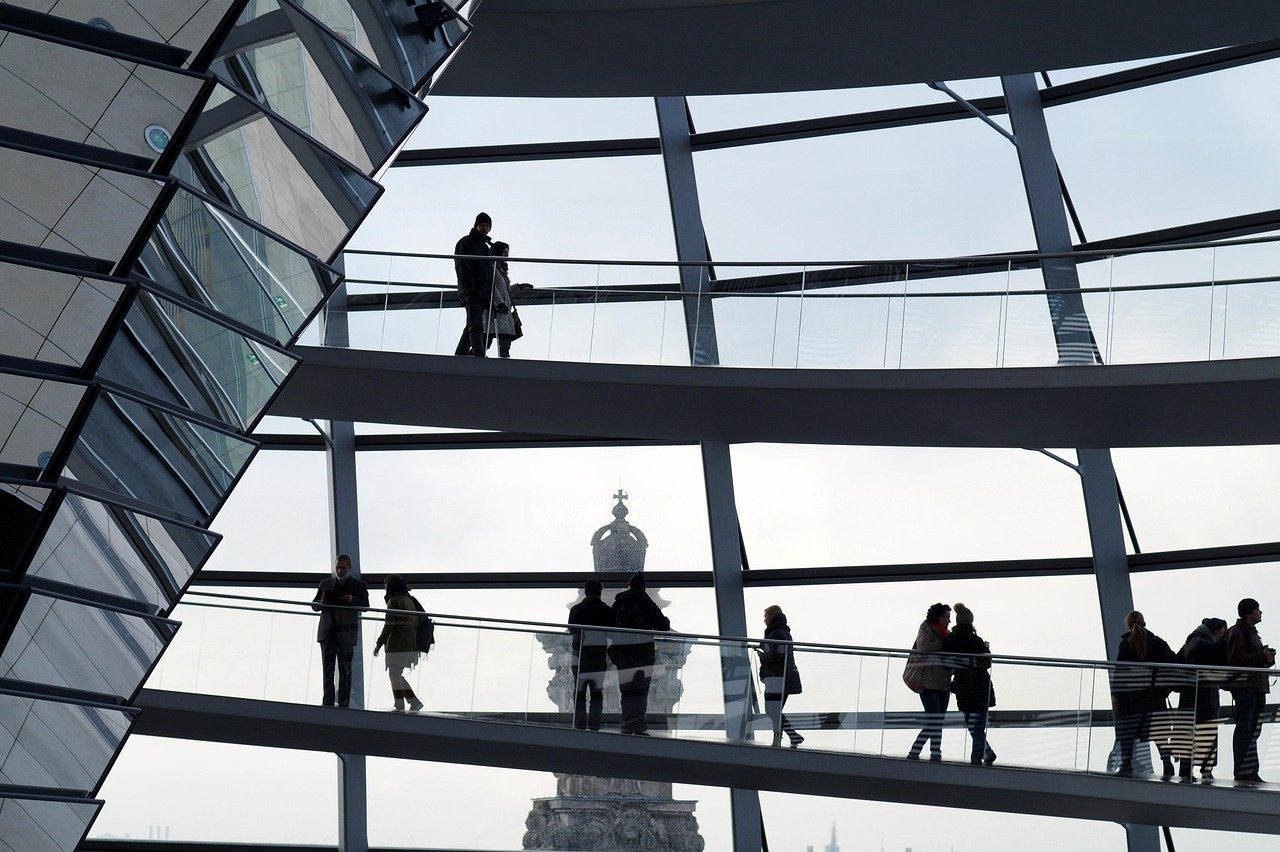
Norman Foster’s glass dome is the architectural centrepiece of the modern Reichstag and the primary reason most visitors make the trip. The dome sits 23.5 metres tall and 38 metres in diameter, rising above the rebuilt Reichstag roof and offering a 360-degree panorama over the Berlin cityscape. Its structural concept is as ingenious as it is beautiful: a double helix of ascending ramps winds around a mirrored central funnel — the “light sculptor” — that reflects natural daylight down into the plenary chamber below while simultaneously allowing visitors looking down through the glass floor panels to observe parliament in session. This deliberate transparency was Foster’s architectural statement about open democratic governance, a counterpoint to the opacity of the building’s darker historical associations. A free audio guide (available in 12 languages, with special versions for children and visitors with disabilities) accompanies visitors up the ramp and provides commentary on the Berlin landmarks visible through the glass, the history of the building, and the workings of the German parliament. The roof terrace surrounding the dome offers unobstructed views toward the Brandenburg Gate, the Tiergarten, the Chancellery, and the Television Tower — some of the finest urban panoramas in Germany.
The Plenary Chamber
The rebuilt plenary chamber where the Bundestag meets is a work of stripped-back modernist precision, a deliberate contrast to the ornate imperial grandeur of the Reichstag’s exterior. The chamber seats all 736 members of the German parliament in a semicircular arrangement around a central podium, with the federal eagle — a simplified, almost abstracted version of Germany’s national symbol, nicknamed “the fat hen” by some observers — mounted prominently above the speaker’s chair. The chamber is open to public observation during parliamentary sessions via a gallery level accessible from the dome visit route. Being present when parliament is in session, looking down through the glass funnel from the dome onto the debating chamber below, creates a powerfully direct sense of representative democracy at work. The Bundestag’s public visitor service also offers guided tours of the plenary chamber and other areas of the building on days when parliament is not sitting, providing access to spaces not reached on the standard dome visit. These tours must be booked separately through the official Bundestag visitor service.
Art in the Reichstag and Historical Traces
Throughout the restoration, Norman Foster and the Bundestag authorities made a conscious decision to preserve traces of the building’s turbulent history rather than erase them. Visible in several areas of the building are Russian inscriptions left by Soviet soldiers in 1945 — names, unit designations, and messages scratched into the stone walls in the chaotic final days of the war. These graffiti, carefully preserved under glass or behind protective barriers, provide an unexpectedly intimate and moving counterpoint to the polished steel and glass of the contemporary interiors. The building also houses a significant collection of contemporary art, with works by major German and international artists installed in corridors, meeting rooms, and public areas. Sigmar Polke, Georg Baselitz, Gerhard Richter, and many others are represented in this collection, which is one of the most important displays of post-war German art in a public building anywhere in the country. Visitors on guided tours are introduced to selected works; independent visitors can observe pieces in the publicly accessible areas around the dome and roof terrace.
Local Insights
The Reichstag rewards visitors who plan ahead and arrive knowing a few things that most tourists do not. These five tips make a significant practical difference.
- Book your dome slot at least three to four weeks in advance, especially for visits between April and October. Registration is free and mandatory, done via the official Bundestag website (bundestag.de). Slots are released three months ahead, and popular time windows — sunset visits from 19:00 to 21:00 in summer — fill within hours of becoming available. If you miss the online booking, the service centre near Republic Square sometimes has same-day cancellation slots, but this is unreliable and involves queuing.
- Sunset and early evening visits (19:00–21:00 in summer) offer the most spectacular panoramic experience — the golden light over the Tiergarten and Brandenburg Gate is extraordinary, and the city lights beginning to appear as dusk settles transforms the view entirely. The dome is open until midnight with last entry at 21:45, so late visits are entirely feasible and dramatically less crowded than afternoon peak hours.
- Bring valid photo ID — a passport or national identity card is required for entry and will be checked against your booking. Copies are not accepted. If you forget your ID, you will be turned away regardless of your reservation. Groups must ensure every individual member presents their own identification document; a single group ID or letter is not sufficient.
- The roof terrace restaurant, Kafer Dachgarten, is one of Berlin’s most scenically positioned dining spots — but it requires a separate reservation well in advance and is priced accordingly. A more budget-friendly approach is to bring a snack, enjoy the panorama from the free public terrace around the dome base, and eat afterwards at one of the many excellent restaurants in the Mitte neighbourhood a short walk south.
- Note the 2026 maintenance closure dates: the dome will be shut for cleaning and maintenance during 15-19 June, 29 June–3 July, 14-18 September, 28 September–2 October, and 19-30 October. The roof terrace remains accessible during these closures, but the dome ramp walk is not available. Check the Bundestag website before finalising your travel dates if the dome is a priority.
Planning Your Visit
- Tickets: Free admission — dome, roof terrace, and audio guide all at no charge
- Opening hours: Daily 8:00–midnight; last entry to dome at 21:45. Service centre (for walk-in registrations) open summer 8:00–20:00, winter 8:00–18:00; weekends 10:00–18:00
- Best time: Early morning (8:00–10:00) for small crowds; sunset slot (19:00–21:00 in summer) for spectacular light and views
- Duration: 45–75 minutes for the dome and roof terrace visit; longer if attending a guided parliamentary tour on a separate booking
- Booking: Advance registration mandatory — book free slots at bundestag.de up to three months ahead; reserve 3–4 weeks minimum for popular dates
Getting There
- U-Bahn/S-Bahn: S-Bahn lines S1, S2, S25, S26 to Brandenburger Tor (8-minute walk); U-Bahn U55 to Brandenburger Tor (10-minute walk along Scheidemannstrasse)
- Bus/Tram: Bus 100 stops at Reichstag/Bundestag directly; Bus TXL (airport bus) stops at the Brandenburg Gate stop (10-minute walk)
- On foot: 5 minutes east of the Brandenburg Gate along the north side of the Tiergarten; 15 minutes from Potsdamer Platz through the Tiergarten park
- Taxi/ride-share: Drop-off on Scheidemannstrasse on the north side of the building; give the driver “Reichstag, Platz der Republik” as the destination
Frequently asked questions
Why is the Reichstag dome free to visit?
The free public access policy reflects the building’s symbolic function as the seat of German parliamentary democracy. The Bundestag has maintained a deliberate commitment to opening the building to citizens and visitors without charge since the Foster restoration was completed in 1999, seeing this accessibility as an expression of the transparency and accountability that democratic governance demands. The architectural design reinforces this philosophy: the dome’s glass walls, the view through to the plenary chamber below, and the free audio guide all communicate that this is a building that belongs to the public rather than to any government or party. The cost of maintaining the visitor programme is absorbed by the federal parliament’s budget. Pre-registration is required for security and crowd management purposes but carries no fee.
What happens if it rains during my dome visit?
The dome itself is fully enclosed in glass and is unaffected by rain — the climate inside remains comfortable and dry regardless of weather conditions outside. The roof terrace surrounding the base of the dome is open to the elements, and in heavy rain or strong wind some sections may be temporarily closed for safety. The panoramic views through the dome glass are somewhat reduced in overcast or rainy conditions, as atmospheric haze and low cloud can obscure landmarks on the horizon, but the dome architecture, the audio guide experience, and the views down into the plenary chamber below are entirely unaffected. Berlin’s weather is changeable, and many visitors find grey or overcast conditions actually reduce the dome glare and make interior photography easier. There is no need to cancel or reschedule your visit for light rain.
Can I see parliament in session from the dome?
Yes, when the Bundestag is in plenary session, visitors in the dome can look directly down through the glass funnel — the central mirrored element Foster called the “light sculptor” — into the chamber below and observe proceedings. Parliamentary sessions are publicly listed on the Bundestag website, and it is worth checking whether parliament is sitting on your chosen visit date if observing a live session is a priority. Sessions typically run on Tuesdays to Fridays during parliamentary weeks; recess periods, which vary across the year, mean the chamber is empty. Even when parliament is not sitting, the dome visit and audio guide remain fully available and worthwhile. The audio guide explains the chamber layout, the roles of key participants, and the history of German parliamentary democracy in considerable and accessible detail.
Is the Reichstag suitable for visitors with disabilities?
The building has been designed with comprehensive accessibility in mind. The dome ramp is a continuous, gradually ascending spiral with no steps, making it fully accessible to wheelchair users and those with mobility limitations. Lifts provide access to the roof terrace level from the building entrance. The audio guide is available in versions adapted for visitors with hearing impairments (written transcript format) and for visitors with visual impairments (enhanced audio description). Service animals are permitted throughout the publicly accessible areas of the building. Visitors requiring wheelchair access or other specific assistance should note this when making their online booking, which allows the security and visitor management staff to ensure appropriate arrangements are in place at the entry checkpoint. The Bundestag visitor service can be contacted in advance for any specific accessibility queries.