
Al-Azhar Mosque
Remove your shoes, step across the threshold, and enter a courtyard that has been reciting prayers for over a thousand years. Al-Azhar Mosque in the heart of Islamic Cairo is not a relic — it is one of the most continuously active religious and intellectual institutions in the world. Founded in 970 AD by the Fatimid general Jawhar al-Siqilli, it became home to one of the earliest universities on earth, attracting scholars of theology, law, astronomy, and medicine from across the Islamic world. Today, pilgrims still press their foreheads to its ancient marble floors, students still bend over manuscripts in its arcaded halls, and the five minarets that have punctuated Cairo’s skyline across twelve centuries still call the city to prayer. For a visitor willing to approach it with patience and respect, Al-Azhar offers an encounter with living history unlike anything else in Egypt.
History of Al-Azhar Mosque
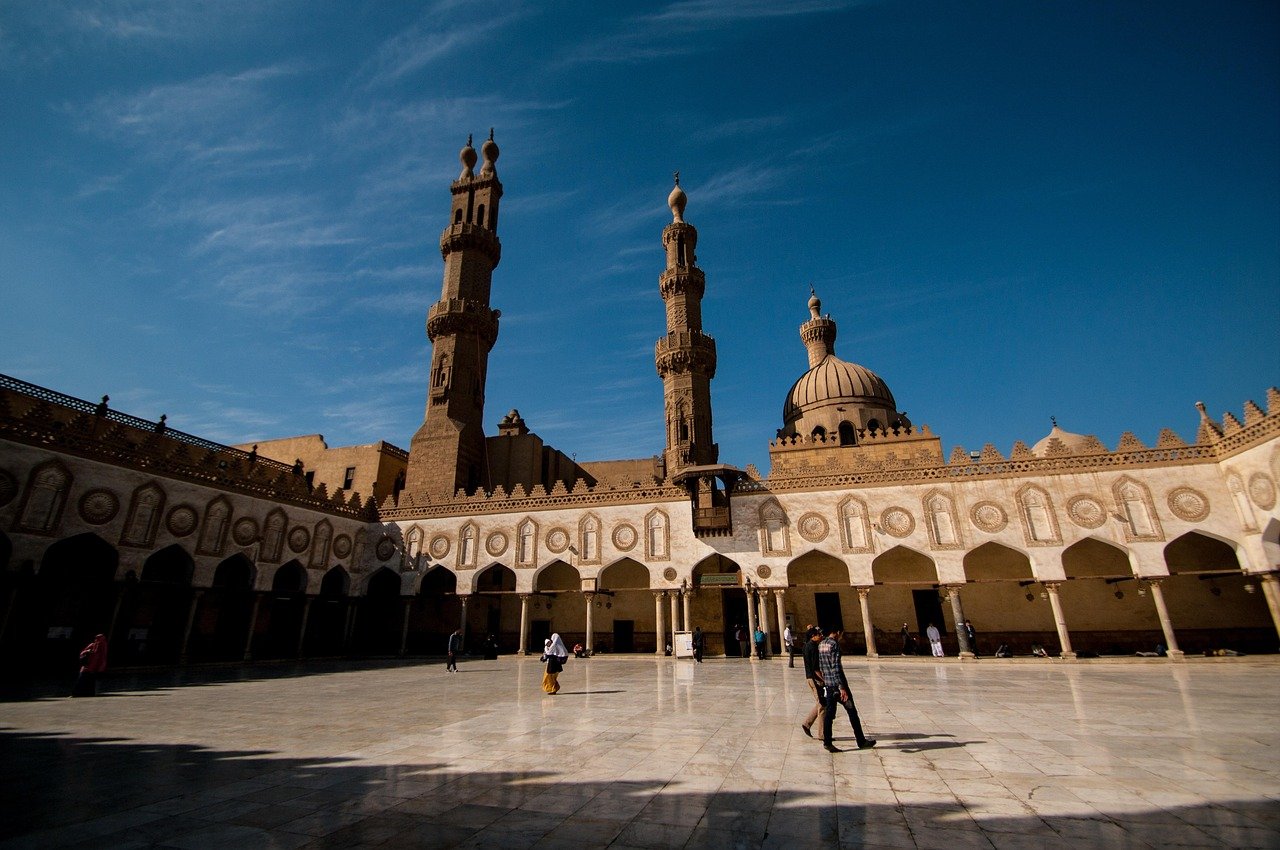
Al-Azhar was founded in 970 AD, just one year after the Fatimid Caliph al-Muizz li-Din Allah marched his army into Egypt and established his new capital, Al-Qahira — the city we now call Cairo. General Jawhar al-Siqilli oversaw construction of the mosque as the centrepiece of the new imperial city, naming it Al-Azhar in honor of Fatima al-Zahra, the daughter of the Prophet Muhammad. The Fatimids were Ismaili Shia Muslims, and from its earliest days Al-Azhar served as a platform for Ismaili religious teaching alongside its function as a congregational mosque. The founding of a structured teaching institution — what would become Al-Azhar University — followed within a few decades, making it one of the world’s oldest continuously operating universities.
The mosque’s subsequent history mirrors Egypt’s own political and religious transformations. When Saladin overthrew the Fatimid dynasty in 1171, he suppressed Al-Azhar’s Ismaili teachings and briefly suspended Friday prayers there, redirecting the institution toward Sunni scholarship. The Mamluk sultans of the 13th through 16th centuries became Al-Azhar’s greatest patrons, funding spectacular expansions including additional prayer halls, minarets, and the ornate entrance gate that still impresses visitors today. Under Ottoman rule (1517–1798), Al-Azhar maintained its independence and authority as the pre-eminent center of Sunni Islamic learning in the Arabic-speaking world — a status it has never surrendered. Today, Al-Azhar University enrolls students from over 100 countries, and the Grand Sheikh of Al-Azhar is one of the most influential religious voices in global Islam.
What to See at Al-Azhar Mosque
The Main Prayer Hall and Fatimid Columns
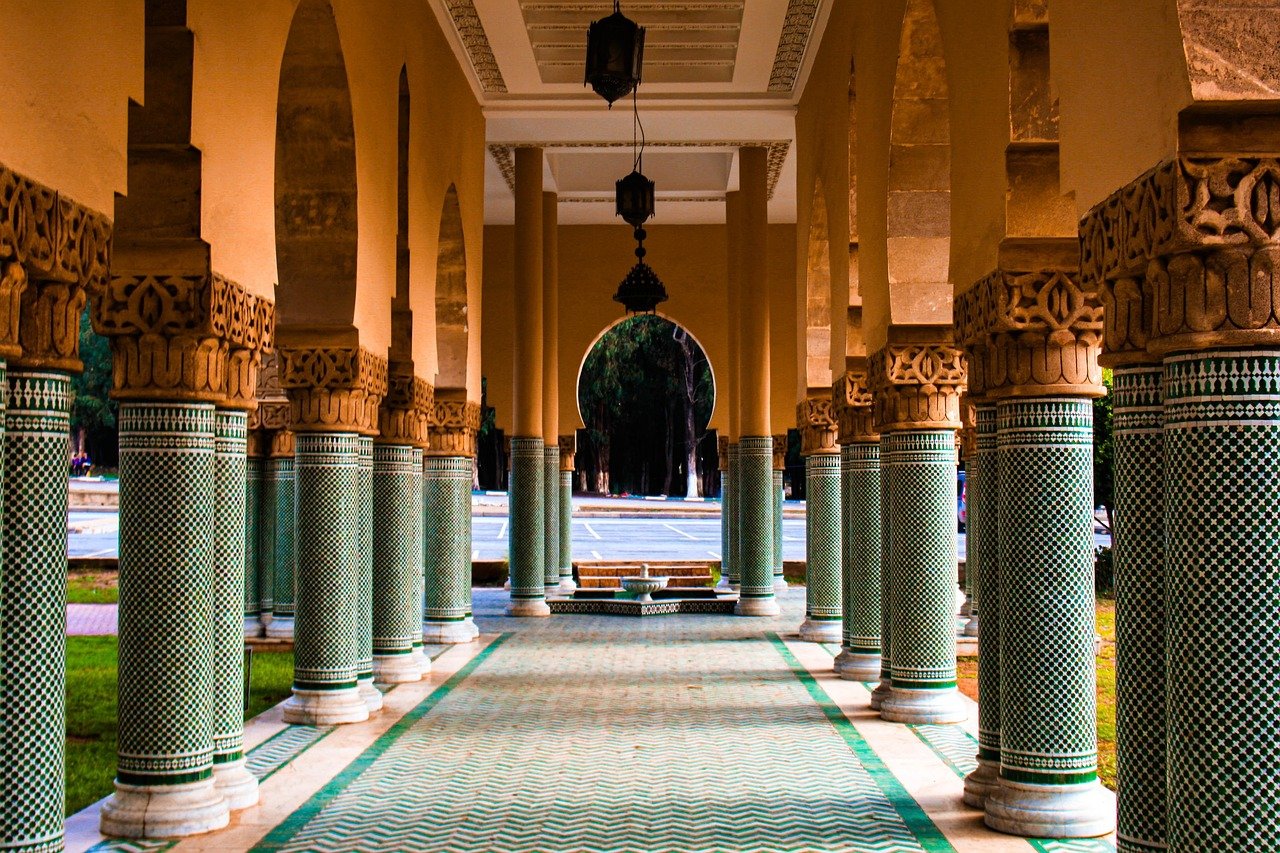
The heart of Al-Azhar is its main prayer hall, a vast hypostyle space supported by rows of ancient columns — many of them pharaonic and Greco-Roman columns recycled from earlier structures, a common practice in early Islamic architecture in Egypt. The hall’s oldest sections date to the original 970 AD construction, though successive renovations have added decorative stucco panels, Kufic inscription friezes, and carved stone capitals. The mihrab (the niche indicating the direction of Mecca) is a particularly fine example of Fatimid decorative work, with interlocking geometric patterns and Arabic calligraphy executed in carved plaster. Natural light filters through high clerestory windows, creating shifting patterns across the stone floor throughout the day. The hall is an active place of worship — visitors will often share the space with students and worshippers at prayer, which requires respectful silence and careful positioning to avoid disturbing devotions.
The Minarets and Exterior Architecture

Al-Azhar’s five minarets represent a living timeline of Islamic architectural development in Egypt. The oldest, the Fatimid minaret, rises above the courtyard in the simple, squared Fatimid style of the 10th century. Two Mamluk minarets — added by Sultan Qaytbay in the 15th century and Sultan Al-Ghuri in the early 16th century — display the ornate double and triple finial forms that characterize the high Mamluk style, with intricate carvings covering every surface. The later Ottoman-era additions bring a more slender, pencil-shaped profile that speaks to the changing fashions of mosque architecture under Turkish influence. Viewing all five together from the courtyard or from the entrance gate on Al-Azhar Street is one of the great architectural vistas of Islamic Cairo — a compressed history of 1,000 years of Egyptian mosque-building visible from a single vantage point.
The Courtyard and Teaching Arcades
The ablution courtyard of Al-Azhar — an open marble-paved space at the heart of the complex — is where the mosque’s identity as both a house of worship and a place of learning converges most visibly. Arcades of pointed arches surround the courtyard on three sides, their columns creating shaded colonnades where students have gathered to study since the 10th century. Today, young men from across the Muslim world still sit in small groups along these arcades, reading texts, memorizing the Quran, and engaging in discussion under the guidance of senior scholars. The fountain at the courtyard’s center, used for ritual ablution before prayer, is a quiet focal point. Visitors are welcome in the courtyard and outer prayer halls outside of the five daily prayer times — during prayers, non-Muslim visitors are asked to wait respectfully at the perimeter or to exit temporarily.
Decorative Detail and Inscriptions
One of the quieter rewards of visiting Al-Azhar is the wealth of decorative detail that rewards close looking. The carved stucco panels flanking the main mihrab display interlocking arabesque patterns of extraordinary complexity — geometric forms that never resolve into simple repetition, drawing the eye inward along progressively finer subdivisions. Bands of Arabic calligraphy run at eye level along the qibla wall, rendering Quranic verses in a Kufic script that dates to the Fatimid period, with the sharp, angular letterforms of early Arabic writing gradually softening into the more flowing Naskh script of later Mamluk additions. The carved stone portal of the 15th-century Qaytbay entrance gate — the main public entrance from Al-Azhar Street — features a stalactite muqarnas hood of particular refinement, each individual cell carved and fitted with the precision of a stone puzzle. Running your eye across this gate’s surface reveals the full vocabulary of Mamluk decorative architecture compressed into a single doorway: interlocking geometric stars, floral medallions, inscribed cartouches, and the signature Qaytbay blazon that marks his patronage across dozens of Cairo monuments.
Local Insights
Visiting Al-Azhar with awareness and preparation transforms the experience from a quick photo stop into a genuinely memorable encounter:
- Dress for the mosque before you leave your hotel: Women must cover hair, arms to the wrists, and legs to the ankles; men must wear long trousers and sleeved shirts. Headscarves are available to borrow at the entrance for women who arrive without one, but bringing your own is more comfortable. Shoes are removed at the entrance and stored in the provided racks — bring slip-on shoes or sandals for easy removal.
- Avoid visiting at Friday noon prayer: The mosque is closed to non-worshipping visitors during the Friday khutba and prayer (approximately 12:00–1:30 PM). The rest of Friday is accessible, but Friday afternoons see large numbers of worshippers. Weekday mornings between 9 AM and 11 AM offer the quietest, most photogenic conditions in the prayer hall and courtyard.
- Al-Azhar Park is a separate attraction nearby: The Aga Khan Trust for Culture developed a stunning hilltop park overlooking Islamic Cairo just 15 minutes’ walk east of the mosque. It offers one of the best elevated views of Al-Azhar’s minarets and the medieval city’s roofscape. Combining the mosque visit with an hour in Al-Azhar Park and lunch at its café is an excellent half-day itinerary.
- The Khan el-Khalili bazaar is immediately adjacent: Al-Azhar Street connects directly to Khan el-Khalili, Cairo’s most famous medieval market. Allow extra time after the mosque to walk the covered alleyways of the bazaar, which sells spices, perfume oils, silver jewelry, papyrus, and hand-blown glass. Bargaining is expected and prices are negotiable — the first quote is rarely the final price.
- Free admission but guided tours add context: Entering Al-Azhar is free for all visitors, but the mosque’s architectural and historical layers benefit greatly from expert explanation. A licensed Egyptologist or Islamic heritage guide (bookable through reputable Cairo tour operators) will help you read the calligraphic inscriptions, identify the different historical construction phases, and understand the ongoing role of Al-Azhar University in contemporary Islamic scholarship.
Planning Your Visit
- Tickets: Free admission for all visitors. No ticket purchase required. A donation to the mosque’s maintenance fund is welcomed but not required.
- Opening hours: Generally open daily 9:00 AM – 4:00 PM for non-Muslim visitors, excluding prayer times (approximately 5 times daily). Closed to tourists during Friday noon prayers (roughly 12:00–1:30 PM). Check locally for exact prayer time schedules as they shift seasonally.
- Best time: October through April for comfortable temperatures. Weekday mornings 9–11 AM for fewest crowds. Ramadan evenings create a magical atmosphere in Islamic Cairo but significantly increase visitor numbers around the mosque.
- Duration: Allow 45 minutes to 1.5 hours for the mosque itself. A half-day itinerary including Khan el-Khalili, Al-Azhar Park, and the surrounding medieval streets requires 4–5 hours.
- Booking: No booking required for independent visitors. Guided group tours should be booked in advance through licensed operators, especially November through March when demand is highest.
Getting There
- Metro: The closest Cairo Metro station is El-Sayeda Zeinab on Line 1, approximately 15 minutes’ walk west of Al-Azhar. Alternatively, take Line 2 to Ataba station and walk east through the El-Azhar Street area (about 20 minutes on foot through vibrant street markets).
- By car: Al-Azhar Mosque is located on Al-Azhar Street in the heart of Islamic Cairo. Parking in the immediate area is very limited — it is strongly advisable to take a taxi or ride-share rather than driving. If driving, park near the Citadel and take a tuk-tuk or walk to the mosque.
- On foot: From Khan el-Khalili bazaar, the mosque entrance is a 2-minute walk west along Al-Azhar Street. From Hussein Square, it is visible and reachable within 3 minutes on foot.
- Taxi/ride-share: Uber and Careem both serve the area. Request drop-off at “Al-Azhar Mosque” or “Masjid al-Azhar” — every driver in Cairo knows the location. Note that Al-Azhar Street can be congested; the driver may drop you a short walk from the entrance during peak hours.
Frequently asked questions
Can non-Muslims visit Al-Azhar Mosque?
Yes, Al-Azhar Mosque welcomes non-Muslim visitors during its regular visiting hours, outside of the five daily prayer times. Visitors are expected to dress modestly — women covering hair, arms, and legs; men wearing long trousers and sleeved shirts. Shoes must be removed at the entrance. During prayer times, non-Muslim visitors are asked to wait respectfully outside or at the perimeter of the prayer hall. The mosque’s staff and volunteer guides are generally courteous and happy to answer questions about the building’s history and the function of Al-Azhar University.
Is Al-Azhar Mosque the oldest mosque in Cairo?
Al-Azhar, founded in 970 AD, is the oldest mosque still in active use in Cairo, though it is not the oldest mosque ever built in Egypt — the Mosque of Amr ibn al-As in Fustat, founded in 642 AD, predates it by over three centuries. However, the Amr ibn al-As Mosque has been substantially rebuilt multiple times and retains little original fabric. Al-Azhar’s claim to historical prominence rests not just on age but on its unbroken 1,000-year role as Egypt’s leading center of Islamic scholarship — a continuity of intellectual and religious function that is genuinely extraordinary.
What is Al-Azhar University and how does it relate to the mosque?
Al-Azhar University, founded alongside the mosque in the 10th century, is considered one of the oldest continuously operating universities in the world. For centuries, all teaching happened within the mosque’s arcades and attached buildings. In the 20th century, the modern university campus was relocated to a larger site in eastern Cairo, though the mosque itself retains educational functions, particularly for advanced Quran memorization and traditional Islamic sciences. The university today enrolls students from over 100 countries across faculties of Islamic law, Arabic language, medicine, engineering, and commerce. The Grand Sheikh of Al-Azhar, appointed by Egypt’s government, is among the most authoritative voices in Sunni Islam globally.
What is the best way to combine Al-Azhar with other nearby sites?
Al-Azhar sits at the epicenter of Islamic Cairo’s medieval heritage. A highly recommended half-day route starts at Al-Azhar Mosque when it opens at 9 AM, then walks through the adjacent Khan el-Khalili bazaar (best explored before 11 AM when it is quietest), continues south along Muizz Street — Cairo’s most intact medieval thoroughfare, lined with Mamluk monuments — and finishes with a late morning coffee at one of the traditional ahwa (coffeehouses) near Hussein Square. Add Al-Azhar Park for elevated views in the afternoon, or combine with the Citadel of Saladin, a 15-minute drive south.