
Marble Temple (Wat Benchamabophit)
There is a moment, entering Wat Benchamabophit from the rear through the broad marble courtyard, when you stop walking. The light is brilliant — everything is white Carrara marble, white walls, and gold spire — and against this bleached canvas the orange and saffron of monk robes move in a way that seems almost choreographed. The Marble Temple, completed in 1911, is the last major temple built in Bangkok under royal patronage and is widely considered the finest example of late Thai ecclesiastical architecture, a building where traditional forms were executed with Western precision and materials to produce something entirely its own.
History of the Marble Temple
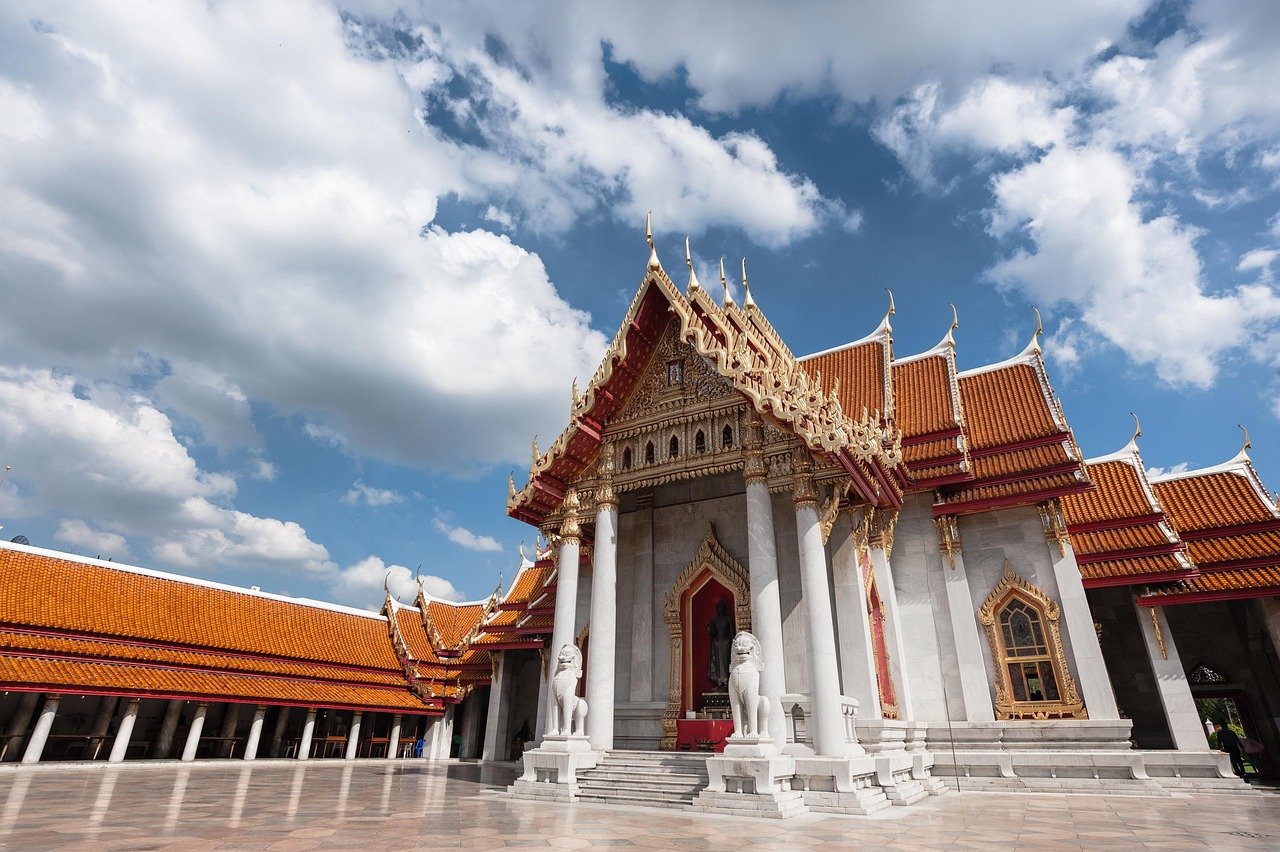
Wat Benchamabophit Dusitvanaram — the Marble Temple — was commissioned by King Rama V (Chulalongkorn) as part of his ambitious redevelopment of the Dusit district of Bangkok, which he envisioned as a modern royal city in the European style. The temple was designed by Prince Naris, the king half-brother and the most talented architect of the era, in collaboration with Italian craftsmen. Construction began in 1899 and the main ubosot (ordination hall) was completed in 1900, with the cloister and surrounding structures finished by 1911. The white Carrara marble used for the exterior was imported from Italy, a deliberate choice that gave the temple its popular name and its distinctive luminosity.
The temple compound contains one of Thailand most comprehensive collections of Buddha image replicas — 53 images in the cloister galleries, representing the major styles of Buddhist iconography from across Thailand and neighboring countries. This was a deliberate educational project by Rama V, intended to document and preserve the diversity of Thai Buddhist art at a time when the kingdom was modernizing rapidly. The temple remains an active monastery and one of the most photographically celebrated religious buildings in Asia, appearing on the 5-baht coin and in countless travel publications.
What to See

The main ubosot is the architectural centerpiece — a white marble building with a multi-tiered roof in glazed yellow and orange tiles, flanked by ornamental gables covered in carved and gilded wood backed with colored glass. The interior houses the principal Buddha image, Phra Buddha Chinnarat, a magnificent replica of the original image at Phitsanulok — considered one of the most beautiful Buddha images in Thailand. The interior walls are decorated with scenes from the life of the Buddha in a style that blends Thai iconographic tradition with European perspective painting techniques.
The cruciform canal that surrounds the temple compound is one of Bangkok finest examples of ornamental water architecture — lined with marble balustrades and populated with turtles and fish that residents believe are the reincarnated souls of the deceased. The cloister running around the inner courtyard houses the 53 Buddha image replicas in niches — a circuit walk that functions both as religious devotion and as a survey of Southeast Asian Buddhist artistic traditions. Early morning, when monks collect alms in the surrounding streets, is the most atmospheric time to visit.
The Marble Architecture
The use of Carrara marble at Wat Benchamabophit reflects Rama V’s desire to demonstrate that Thailand could produce buildings equal in material quality to any in Europe, while maintaining Thai architectural forms and religious function. Italian craftsmen worked alongside Thai artisans on the project — the marble was quarried, cut, and partially finished in Italy before shipping, then installed and refined in Bangkok. The result is a building where the technical perfection of European craftsmanship is subordinated to Thai design sensibility: the marble is used not to create classical colonnades or Roman forms, but to give Thai roof forms and gable decoration a crystalline, permanent quality unlike any other building in the country.
The luminosity of the white marble under Bangkok’s tropical light is one of the temple’s defining qualities. In the harsh midday sun, it can be almost blindingly bright; in the soft light of early morning or late afternoon, it has a gentle, warm quality that makes it one of the most photogenic religious buildings in Asia. The reflections in the canal surrounding the compound add another dimension to the visual experience — the entire building seems to float in light and water simultaneously.
Practical Information
- Tickets: 20 THB (approximately USD 0.60). No audio guide available — explore independently or hire a local guide.
- Opening hours: Daily 08:00-17:00. Morning is best for monk activity; the marble is most photogenic in early morning and late afternoon light.
- Best time to visit: Early morning (before 09:00) for the least crowds and the possibility of seeing monks collecting alms in surrounding streets. November-February for comfortable temperatures.
- Duration: 45-75 minutes for a thorough visit including the cloister circuit and main ubosot.
- Booking: No booking required. Dress code strictly enforced — shoulders and knees covered.
Local Insights
What locals know that guidebooks do not always tell you:
- The 53 Buddha images in the cloister are often overlooked by visitors focused on the main ubosot — spend time with these replicas, which include images from as far as India, China, and Japan, for a remarkable compressed survey of Buddhist art.
- The rear entrance through the monks quarters (off Si Ayutthaya Road) often has shorter queues than the main front entrance on Rama V Road.
- The temple is at its most atmospheric at dawn when monks perform morning chanting and alms collection — arrive before 07:00 to witness this. Respectful observation from outside the monks quarters is acceptable.
- The royal Dusit Zoo and Vimanmek Mansion (the world largest golden teak building) are both within a 10-minute walk, making the Dusit district a rewarding half-day cluster of attractions.
- The canal turtles at the temple are considered sacred — feeding them is a popular merit-making activity for local Buddhists, and turtle food is sold at the entrance gates.
Getting There
- Taxi/Grab: Most convenient option from central Bangkok. Ask for “Wat Marble” or “Wat Ben” — both are understood by drivers.
- Bus: Routes 16, 17, 23, and 72 pass near the temple on Rama V Road.
- From Grand Palace: About 3 km north — a short taxi or tuk-tuk ride. Easily combined in a half-day Bangkok temple circuit.
- On foot: From Victory Monument BTS station, about 25 minutes walk south along Phaya Thai Road.
Frequently asked questions
Why is Wat Benchamabophit called the Marble Temple?
The exterior of the main ordination hall is clad in Carrara marble imported from Italy, commissioned by King Rama V in the early 1900s. The brilliant white marble gives the building its distinctive luminosity and its popular English name — though its official name honors the Fifth Reign and the Dusit district.
Is Wat Benchamabophit an active temple?
Yes — it is an active Buddhist monastery. Monks reside in the compound, and religious ceremonies take place regularly. Visitors should dress respectfully, maintain quiet, and not disturb monks or religious activities. The temple is also used for royal ceremonies.
Is Wat Benchamabophit worth visiting?
Yes — particularly for visitors who want a Bangkok temple experience without the overwhelming crowds of Wat Pho or the Grand Palace. The Marble Temple is architecturally unique and the 53 Buddha image collection in the cloisters is one of the finest in Thailand.
What is the best time to photograph Wat Benchamabophit?
Early morning (before 09:00) in the dry season (November-February) offers the best combination of soft light, manageable crowds, and possible monk activity. The marble is most luminous in overcast light, which diffuses shadows without bleaching contrast.
How does Wat Benchamabophit compare to Wat Pho?
Wat Pho is larger and more historically significant, housing the famous Reclining Buddha and one of Thailand oldest massage schools. Wat Benchamabophit is smaller and more serene, architecturally more refined, and significantly less crowded. The two temples complement each other well on a Bangkok temple circuit.