
Port Arthur 💎 Hidden Gem
The ruins of Port Arthur rise from the Tasman Peninsula in sandstone and silence, a vast penal settlement that once held the most hardened convicts of the British Empire and now holds its visitors in a grip that is difficult to explain. The weathered stone of the Penitentiary and church glow amber in afternoon light, starlings dart through window holes where iron bars once kept desperate men, and the stillness of the former settlement is broken only by the lap of the harbour and the commentary of guides who seem unable to keep emotion entirely from their voices. Port Arthur is beautiful. It is also haunting in a way that statistics about chain gangs and solitary confinement cannot adequately prepare you for.
History of Port Arthur
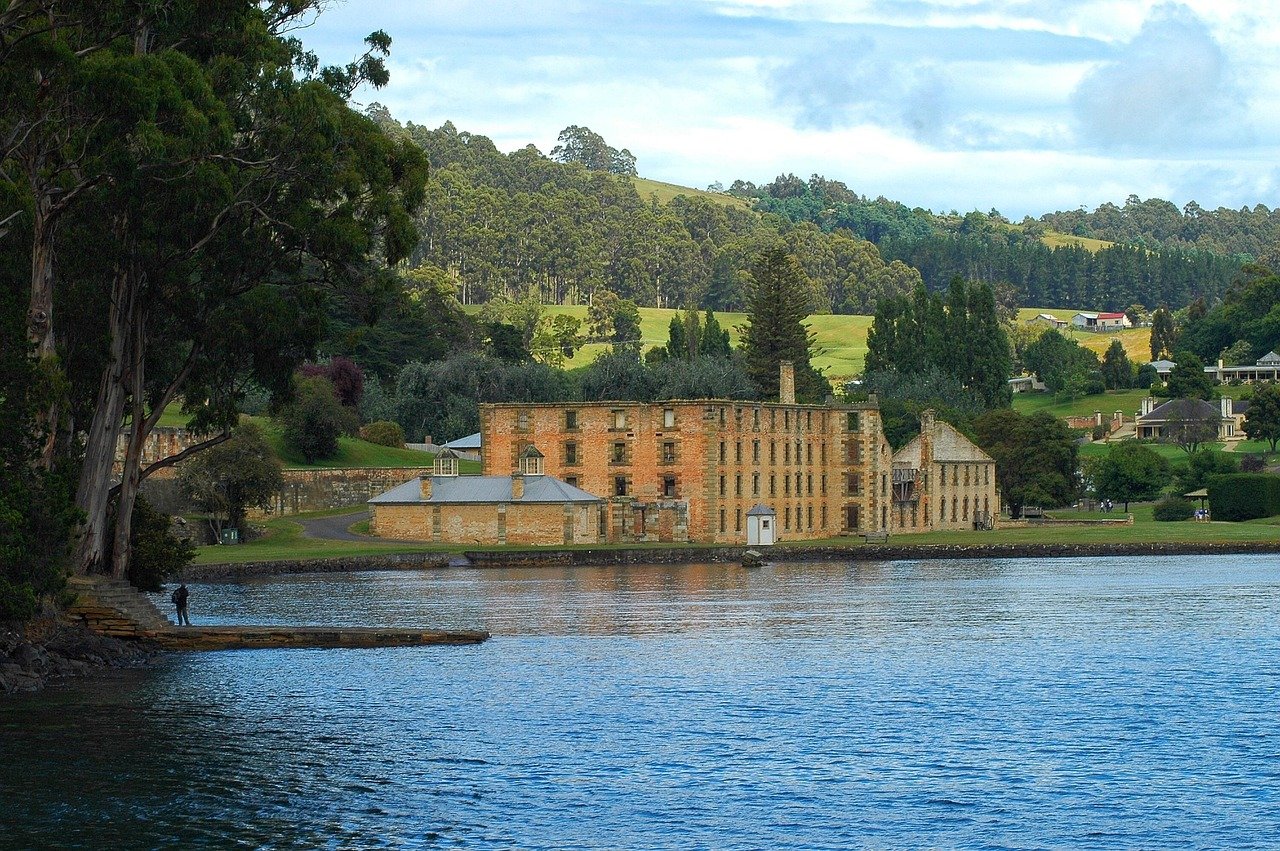
Port Arthur was established in 1830 as a timber-getting station at the southern tip of the Tasman Peninsula, taking advantage of the area’s rich Huon pine forests for shipbuilding. Its geographic isolation — connected to the rest of Van Diemen’s Land (Tasmania) by the narrow Eaglehawk Neck — made it a natural prison, and by 1833 it had been converted to a secondary punishment site for convicts who had reoffended after transportation from Britain. Over the following three decades it became the most feared destination in the convict system, housing around 12,000 men over its operational life and earning a reputation for punishments both physical and psychological that its administrators believed would deter crime.
The settlement grew into a substantial self-sufficient community: it produced its own timber, bricks, boots, and clothing; it had a working railway (pushed by convicts rather than powered by steam); it operated Tasmania’s first steamship; and it ran a model school for convict boys on Point Puer across the harbour. The most infamous innovation was the Separate Prison, completed in 1849, where solitary confinement was administered in absolute silence — prisoners were kept in individual exercise yards, attended chapel in individual boxes where they could not see other prisoners, and were identified by number rather than name. The system was based on the Philadelphia model of prisoner reform through isolation and reflected the era’s belief that sensory deprivation would break criminal habits. In practice it frequently produced madness.
What to See
The site encompasses more than 30 historic buildings and ruins across a sweeping waterfront setting. The Penitentiary — a four-storey sandstone building that once housed 480 prisoners — is the most imposing structure, its roofless shell still communicating authority and scale even in ruin. The Gothic-revival church, struck by lightning and never rebuilt, is perhaps the most photographed ruin in Australia: its window tracery and stone walls are intact, creating the impression of a medieval chapel frozen at the moment of disaster. The Separate Prison is the most chilling structure: visitors can enter the cells, stand in the small exercise yards, and sit in the chapel boxes where men sat in enforced solitude for up to 23 hours a day.
Included in the standard admission is a harbour cruise that circles the Isle of the Dead — the settlement’s burial ground — and passes the ruins of Point Puer boys’ prison, where child convicts as young as nine were sent. The interpretation on these cruises is frank and historically rigorous. A separately ticketed ghost tour operates every night, drawing on the site’s extensive records and the numerous reported paranormal experiences of visitors and staff. Port Arthur has been described by paranormal investigators as one of the most haunted places in Australia, and the night tours have a well-established reputation for unsettling encounters that rational explanations don’t always satisfy.
The 1996 Massacre and Memorial Garden
On 28 April 1996, Port Arthur became the site of Australia’s worst mass shooting, when 35 people were killed and 23 wounded at the historic site. The tragedy changed Australian society profoundly: within twelve days the government introduced sweeping gun control legislation that remains among the most comprehensive in the world, and public debate on the issue shifted decisively. For the historic site itself, the attack created an additional layer of commemoration that now coexists with the convict history.
The Memorial Garden, established on the ground where some of the victims fell, is a place of considerable restraint and dignity. A circular pool reflects the sky, and 35 flowering plants — one for each victim — surround it. The site’s management has chosen not to name the perpetrator or display photographs, focusing entirely on the victims and the survivors. The Broad Arrow Café, where many of the shootings occurred, was left as a ruin and incorporated into the memorial landscape. Visitors are invited to spend time in the garden in silence, and most do.
Practical Information
- Tickets: Adults AUD 45; children (4–17) AUD 22; family (2 adults + 4 children) AUD 110; ghost tour additional AUD 25–35 per person
- Opening hours: Open 9:00 am to dusk daily; ghost tours depart at dusk (check website for exact times)
- Best time to visit: Autumn (March–May) for low crowds and spectacular foliage; winter mornings for mist over the ruins and minimal visitors
- Duration: 3–5 hours for the full site including harbour cruise; full day if combining with ghost tour
- Booking: Ghost tours book out quickly and should be reserved in advance online; standard admission can be purchased at the gate
Local Insights
What locals know that guidebooks don’t always tell you:
- The Separate Prison is the most powerful part of the site — most visitors spend 20 minutes in the church ruin and then rush past the Separate Prison, not realising that it is where the most viscerally affecting history happened. Spend at least 30 minutes there.
- The harbour cruise is included in admission and provides the only way to see the Isle of the Dead and Point Puer boys’ prison from the water — it is not optional even for those prone to seasickness on larger vessels (the boat is small and the harbour calm).
- Eaglehawk Neck, on the road between Hobart and Port Arthur, is worth a stop for its blowhole, tessellated pavement (natural geometric rock formations), and the story of the Neck itself — the narrow land bridge that made the peninsula a natural prison.
- The Port Arthur Historic Site Café serves very good Tasmanian produce including local smoked salmon, cheese, and wine — a meal here is considerably better than expected for a tourist attraction canteen.
- Wombats are sometimes seen on the site’s outer grounds at dusk — another reason to stay for the ghost tour even if you’re sceptical about the paranormal element.
Getting There
- By car: 90 minutes from Hobart via the Arthur Highway (A9); sealed road throughout; free parking at the site
- By organised tour: Multiple Hobart operators run day trips to Port Arthur including transport, admission, and guided interpretation; a good option if you don’t have a hire car
- By bus: Tassielink runs coach services from Hobart; check timetables as services are limited
- Taxi/Rideshare: Uber operates in Hobart but may have limited availability for the 90-kilometre run; private transfer services can be arranged through Hobart accommodation
Frequently asked questions
Is the ghost tour suitable for children?
Ghost tours are recommended for ages 10 and over. Younger children may find the content frightening and the 90-minute standing tour physically tiring in the dark. Some sections of the ghost tour visit the Separate Prison at night, which can be very affecting even for adults.
How long should I allow for a visit to Port Arthur?
Allow a minimum of 3 hours for the main site and harbour cruise; 4–5 hours is better. If you’re combining a daytime visit with the evening ghost tour, plan to be on-site for approximately 6–8 hours and bring warm clothing as Tasmanian evenings are cool year-round.
Is Port Arthur accessible for wheelchair users?
The main pathways through the site are accessible, and a mobility vehicle is available to transport visitors with limited mobility between key points. The harbour cruise vessel is accessible. Some of the historic building interiors have uneven floors. Contact the site in advance to discuss specific requirements.
Can I photograph inside the historic buildings?
Yes, photography is freely permitted throughout the site. The Memorial Garden requests that photography be respectful given the nature of what it commemorates. Drone flying is not permitted without prior approval from the site management.
Is Port Arthur worth visiting in winter?
Absolutely. The ruins look spectacular in winter light and morning mist, the crowds are dramatically smaller, and the ghost tours are arguably more atmospheric in the cold. The site is fully operational year-round and the harbour cruise runs weather permitting.