
Hill of Seven Colors (Cerro de los Siete Colores)
Standing in the dusty main plaza of Purmamarca at dawn, you watch the rising sun set the mountain behind the village on fire. First gold, then amber, then a spectrum of ochre, burgundy, green, and purple as each mineral layer catches a different angle of light. The Cerro de los Siete Colores — the Hill of Seven Colors — is not a geological curiosity that happens to be beautiful. It is one of the most genuinely astonishing natural spectacles in South America, a mountain that looks hand-painted against the high Andean sky.
History of the Hill of Seven Colors
The Hill of Seven Colors has been a landmark of the Quebrada de Humahuaca — a spectacular Andean valley listed as a UNESCO World Heritage Site — for as long as human memory reaches in this region. The Omaguaca people who inhabited these valleys before the Inca conquest knew the mountain as a sacred marker in the landscape. The Inca themselves incorporated this region into their empire around 1430, and the road through Purmamarca became part of the Inca road network (Qhapaq Nan) linking Cuzco to the southern reaches of Tawantinsuyu.
The geological history that created the hill’s extraordinary colours spans millions of years. Each coloured layer represents a different rock type deposited in a different era: the deep reds and purples come from iron-rich clay sediments; the greens from copper-bearing rocks; the yellows and whites from calcium-rich deposits; the darker bands from ancient volcanic activity. The landscape here is a natural museum of geological time, compressed into a single dramatic escarpment that rises directly behind the colonial village.
What to See
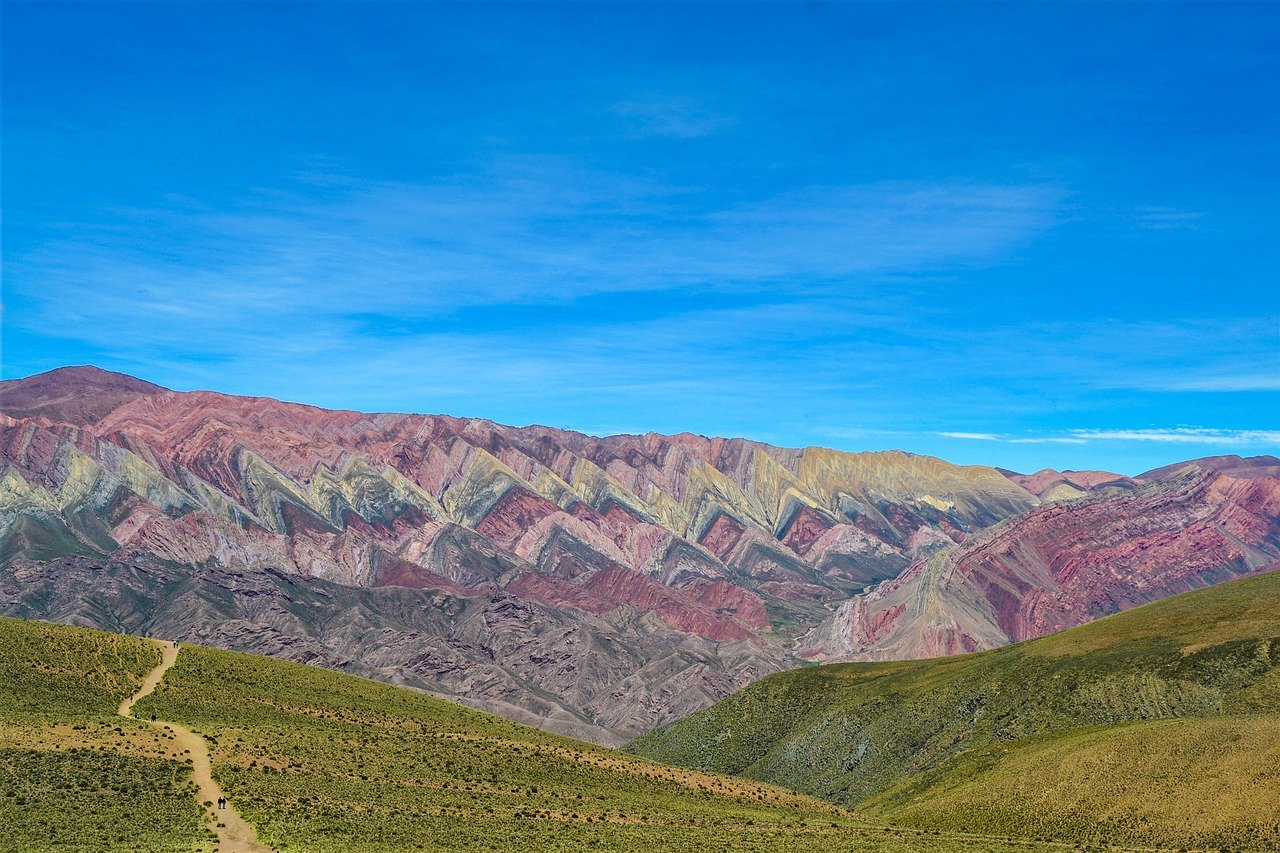
The hill is best appreciated from the small plaza in front of Purmamarca’s colonial church (Iglesia Santa Rosa de Lima, dating from 1648), where the full sweep of the coloured rock face is visible. A 3-kilometre walking circuit called the Paseo Chico (small walk) loops around the base of the hill through desert scrubland, getting close enough to appreciate the texture and complexity of the rock formations. The full circuit takes 45-90 minutes and requires no special equipment, though the high altitude (2,192 metres above sea level) means you should walk slowly.
The village of Purmamarca is itself worth spending time in. A daily artisan market fills the main plaza with local crafts: woven textiles in traditional Andean patterns, ceramics, carved wood, and semi-precious stones from the region. The market begins in the morning and continues through the afternoon. Several small restaurants and cafes serve locro (a thick Andean stew), empanadas, and humitas (fresh corn patties) using recipes unchanged for generations.
The Geology
The seven distinct colors of the hill are a consequence of the varied mineral composition of sedimentary rocks laid down over approximately 600 million years of geological history. The specific colours visitors see depend on the angle of sunlight, which is why early morning (when the sun illuminates the western face directly) and late afternoon (when horizontal light accentuates shadows and depth) provide the most dramatic viewing conditions. Midday light flattens the colours somewhat, reducing the contrast that makes the hill so spectacular.
The wider Quebrada de Humahuaca valley that contains Purmamarca is a geological wonder in its own right: a narrow canyon cut by the Rio Grande river through layers of ancient sedimentary rock, with walls rising hundreds of metres on either side. The colours change throughout the valley, and a longer drive north through the Quebrada to Tilcara and Humahuaca reveals successive variations on the geological theme established at the Hill of Seven Colors.
Practical Information
- Entry: Free; the hill and walking circuit are open to all visitors
- Opening hours: No restrictions; accessible at any hour, though day visits are standard
- Best time to visit: Early morning (7-9am) or late afternoon (4-6pm) for the most dramatic light and colours
- Duration: 1-3 hours including the walking circuit and market browsing
- Altitude: Purmamarca sits at 2,192 metres; take altitude sickness seriously and rest on arrival
Local Insights
What locals know that guidebooks don’t always tell you:
- The absolute best light for photography is the hour after sunrise – the warm horizontal light creates extraordinary depth in the coloured layers.
- Altitude sickness is real at over 2,000 metres – drink coca tea (mate de coca) before and during your visit, walk slowly, and avoid alcohol for the first day.
- The artisan market prices are negotiable, especially if you buy multiple items from the same vendor; this is expected and not rude in this context.
- Drive further north through the Quebrada to Tilcara and Humahuaca on the same day – the entire valley is UNESCO-listed and each village has its own character and geology.
- The village has only a handful of accommodation options; book well in advance if staying overnight, as the sunrises and sunsets from Purmamarca are exceptional.
Getting There
- By bus: Buses from Jujuy city (1 hour) and Tilcara (15 minutes) run regularly; ask at the Jujuy terminal for Purmamarca services
- By car: Purmamarca is on Ruta Nacional 52, clearly signposted off Route 9 north of Jujuy; drive takes about 1 hour from Jujuy
- From Salta: The city of Salta is 2.5 hours away by car or bus via Route 9; many tour operators in Salta offer day trips to the Quebrada
- By tour: Day tours from both Jujuy and Salta typically cover Purmamarca, Tilcara, and Humahuaca in a single loop
Frequently asked questions
How many colours can I actually see?
The name says seven, but geologists have identified up to fourteen distinct mineral layers in the hill. The exact count visible depends on the light conditions; early morning or late afternoon illumination reveals the most colours and contrast.
Is the walking circuit suitable for children and older visitors?
The 3 km Paseo Chico circuit is largely flat and unpaved. The main challenge is altitude at 2,192 metres. Allow extra time, walk slowly, and ensure everyone in the group is acclimatised before attempting the full loop.
Can I photograph the hill and the village freely?
The hill and public spaces are open for photography. When photographing market vendors and local people, it is considered courteous to ask permission first and offer to purchase something if you photograph a vendor’s stall.
What is the best accommodation near Purmamarca?
Purmamarca has a handful of charming posadas and boutique hotels. El Manantial del Silencio is consistently praised for its location and service. Book well in advance for peak season (July and Argentine holidays).
Is there anything to do in the evening in Purmamarca?
The village is small and quiet at night, which is part of its charm. Dinner at one of the small restaurants, a walk around the lit plaza, and the extraordinary night sky (minimal light pollution at altitude) are the evening entertainments.