
Obelisk (Obelisco de Buenos Aires)
Stand at the base of the Obelisco on Avenida 9 de Julio and look up: 67.5 metres of white otraite stone taper to a fine point against the Buenos Aires sky. Around you, twelve lanes of traffic flow past on the widest avenue in the world. The noise is extraordinary — colectivos, taxis, motorcycles, and the rumble of the Subte beneath your feet. Yet somehow the monument holds its own against all of it. The Obelisco de Buenos Aires is the city irreducible landmark, the one image that appears on every postcard, the meeting point that porteños give when they have nowhere more specific to name. Since November 2025, visitors can take an elevator to a viewing platform near the apex and look out over the grid of a city of fifteen million people. But even from the pavement, the Obelisco commands attention.
History of the Obelisco de Buenos Aires
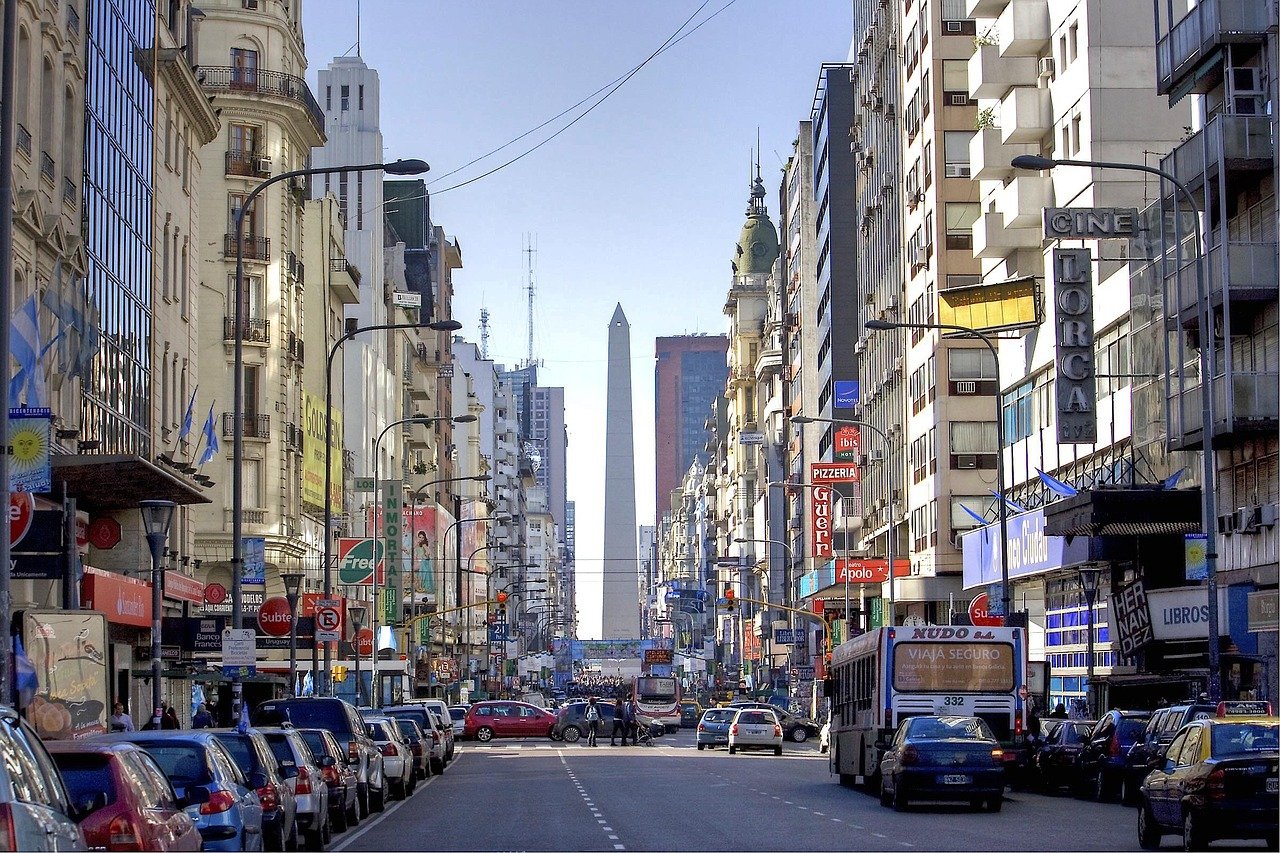
The Obelisco was built for a centennial that was actually a quadricentennial — the 400th anniversary of the first founding of Buenos Aires by Pedro de Mendoza in 1536. Architect Alberto Prebisch, one of Argentina leading modernists, designed the monument in a stripped classical style that owed something to Washington D.C. but asserted its own geometric confidence. Construction began on March 20, 1936, and was completed in just 31 days — a feat of engineering that impressed even critics of the design. The site was chosen deliberately: it marks the intersection of Avenida 9 de Julio and Avenida Corrientes, and more symbolically, it stands on the exact spot where the Argentine national flag was raised in the city for the first time in 1812.
Public reaction was mixed, to put it gently. A significant faction of Buenos Aires residents considered the monument ugly, inappropriate, and out of scale with the surrounding European-style architecture. Three years after its inauguration, the city council voted to demolish it — a decision that was vetoed by Mayor Mariano de Vedia y Mitre, who argued that such a young city should not destroy the monuments it had only just created. The decision to preserve it proved prescient. Within a generation the Obelisco had become so embedded in Buenos Aires identity that dismantling it would have been unthinkable. Today it serves as the focal point for every major public celebration: World Cup victories, election nights, carnival, and the annual commemorations of the May 25 national holiday all draw enormous crowds here.
What to See at the Obelisco de Buenos Aires
The Observation Deck — Top of the Obelisco
Since November 2025, visitors can experience the Obelisco from the inside for the first time in its 90-year history. An elevator carries visitors through seven internal levels, passing through the hollow stone core of the monument, before a 35-step spiral staircase leads to the observation platform at 65 metres. Four directional windows frame panoramic views: Avenida 9 de Julio stretching north and south (the full 140-metre width of the avenue is breathtaking from above), Avenida Corrientes leading west toward Teatro Colon, the modern Puerto Madero skyline to the east, and the southern neighbourhoods extending toward Constitucion Station. Each visit is capped at 20 minutes and a maximum of four people per time slot to preserve the intimacy of the experience. Tickets must be reserved in advance at miradorobelisco.com.ar. Non-Argentine visitors pay approximately 38,000 ARS (roughly USD 25 at current rates); Argentine residents with ID pay 18,000 ARS. Note that the narrow staircase to the apex makes the observation deck inaccessible for wheelchair users.
Avenida 9 de Julio and the Surrounding Cityscape
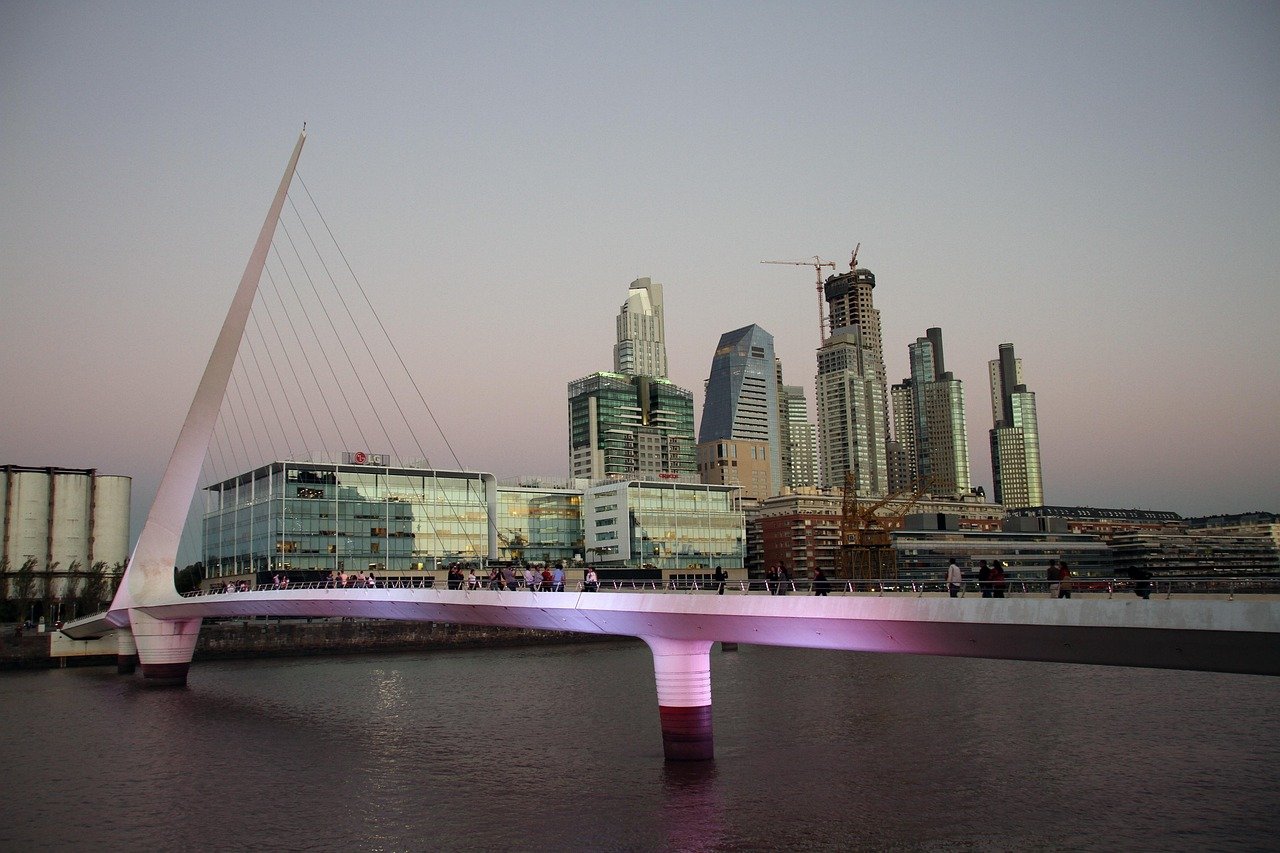
Even without going inside, the Obelisco sits at the centre of one of the world great urban set-pieces. Avenida 9 de Julio — named for Argentine Independence Day, July 9, 1816 — is officially the widest avenue on earth, stretching 140 metres across with service roads, medians, and pedestrian zones. The spectacle of the traffic flowing past the monument is itself worth experiencing, particularly at rush hour when the sheer scale of Buenos Aires urban life becomes palpable. Walk one block west along Corrientes and you enter the theatre district — this stretch of Corrientes is Buenos Aires Broadway, lined with bookshops open until midnight, pizza restaurants, and the facades of dozens of playhouses. Walk one block east and you begin the approach to Puerto Madero, the former port district now transformed into a sleek waterfront of converted grain warehouses, contemporary restaurants, and the striking Puente de la Mujer pedestrian bridge designed by Santiago Calatrava.
The Obelisco at Night and During Celebrations
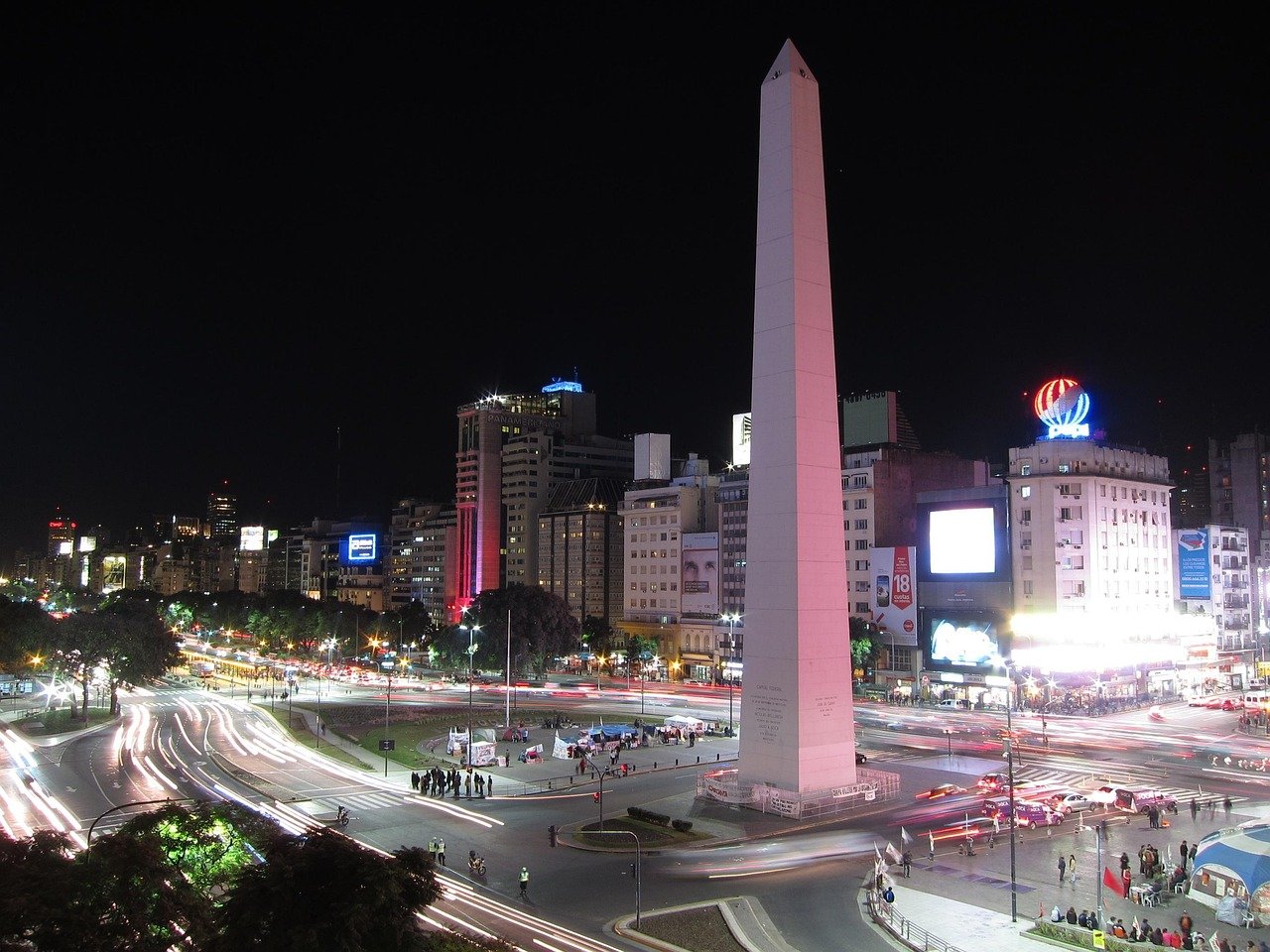
If there is a World Cup final involving Argentina, a national election result, or a major carnival night, there is precisely one place where Buenos Aires gathers: around the Obelisco. The monument becomes the spontaneous stage for collective joy and collective grief in equal measure, illuminated by floodlights, wrapped in blue-and-white flags, and surrounded by hundreds of thousands of people in a spectacle that has no formal organisation and no entry requirement. The monument is also periodically wrapped in giant art installations — most famously in red for AIDS awareness, in rainbow colours for Pride, and in Argentine blue-and-white for World Cup campaigns. If your visit coincides with any national celebration or sporting event, the Obelisco at night is an unmissable experience regardless of your interest in football or politics.
Local Insights
Local Buenos Aires residents share these tips for getting the most from the Obelisco and its surroundings:
- Book the observation deck well in advance: Since opening in November 2025, the Top of the Obelisco has been extremely popular with visitors and locals alike. Slots fill quickly, especially on weekends. Book at miradorobelisco.com.ar at least 3–5 days ahead for weekend visits, and bring valid ID — Argentine residents need national ID to claim the reduced price, and non-residents may be asked to show a passport.
- Walk Corrientes at midnight: Avenida Corrientes is one of the few streets in Buenos Aires where the cultural life genuinely intensifies after midnight rather than winding down. The bookshops (several are open until 2 am), the pizza and empanada joints, and the post-theatre crowds make a late-night walk from the Obelisco toward the Abasto neighbourhood a quintessentially Buenos Aires experience — and entirely safe on the well-lit main strip.
- Photograph from the Diagonal Norte intersection: The best wide-angle photograph of the Obelisco is taken from the median of Diagonal Norte (Avenida Presidente Roque Saenz Pena), the diagonal avenue that cuts across the Buenos Aires grid. The angle gives you the monument in full with the avenue converging lines in the foreground — the shot that appears on most travel guides.
- Check for World Cup or major event dates: If Argentina plays an important football match during your trip, be at the Obelisco for the final whistle if they win. The spontaneous celebrations that erupt around the monument within minutes of an Argentina victory are one of the most electrifying collective experiences in world sport — nothing organised, nothing charged, just an entire city pouring into the streets.
- Use the Subte to avoid the surface traffic: The intersection of 9 de Julio and Corrientes is one of the most congested in Buenos Aires, and surface-level crossings can take several light cycles. The Subte stations at Carlos Pellegrini (Line B), 9 de Julio (Line D), and Diagonal Norte (Line C) all exit within half a block of the monument — far faster and more comfortable than any surface option during peak hours.
Planning Your Visit
- Tickets: Viewing the exterior is free. Observation deck (Top of the Obelisco): approximately 38,000 ARS for non-residents (roughly USD 25); 18,000 ARS for Argentine residents with ID. Prices subject to change given ARS volatility — check miradorobelisco.com.ar for current pricing.
- Opening hours: The exterior is accessible 24 hours. The observation deck opens daily 9:00 am to 5:00 pm. Last entry slot at 4:45 pm.
- Best time: Early morning weekdays for the observation deck (fewest crowds, clearest air). Sunday evenings for the street atmosphere, when the Corrientes theatre district comes alive. Avoid peak rush hour (7–9 am and 5–7 pm) if crossing the avenue on foot.
- Duration: The observation deck visit takes approximately 20 minutes inside. Allow 30–45 minutes total including queuing and the approach. Exploring the surrounding avenues and neighbourhood adds 1–2 hours comfortably.
- Booking: Mandatory advance reservation for the observation deck at miradorobelisco.com.ar. Reservations required, maximum 4 people per slot. Exterior viewing requires no booking.
Getting There
- Subte (Subway): Line B — Carlos Pellegrini station (exit onto Corrientes, 1 minute walk); Line D — 9 de Julio station (exit directly onto the avenue); Line C — Diagonal Norte station (exit 2 minutes walk). The Subte costs approximately 650–800 ARS per journey (around USD 0.65–0.80).
- By colectivo (bus): Dozens of bus lines stop on or near Corrientes and 9 de Julio. Lines 5, 6, 7, 9, 10, 17, 23, 24, 26, 29, 45, 61, 64, 67, 70, 75, 86, 92, 93, 99, 105, 109, 115, 126, 132, 140, 143, 150, 152, and 168 all serve the area. Use the Moovit app with your Buenos Aires accommodation address to find the direct line.
- By car: Parking is impractical near the Obelisco. Use a paid garage on Lavalle, Tucuman, or Sarmiento streets (1–2 blocks from the monument) and walk. The intersection of 9 de Julio and Corrientes is heavily regulated and parking on the main avenues is not permitted.
- Taxi/ride-share: Uber, Cabify, and radio taxis all service the area. Request drop-off at the intersection of Corrientes and 9 de Julio. From Palermo, expect 20–30 minutes in normal traffic; from San Telmo, 10–15 minutes. The Subte is typically faster and cheaper during peak hours.
Frequently asked questions
Can you go inside the Obelisco de Buenos Aires?
Yes — since November 2025, the Obelisco has opened an observation deck accessible via an internal elevator and a 35-step spiral staircase. Visits are capped at 20 minutes per group, with a maximum of 4 people per time slot. Tickets must be booked in advance at miradorobelisco.com.ar. The deck offers four directional windows with panoramic views across Buenos Aires at 65 metres height. Note that the spiral staircase to the apex makes the experience inaccessible for visitors who cannot manage stairs, and there is no lift to the final level.
What is special about Avenida 9 de Julio?
Avenida 9 de Julio is widely cited as the widest avenue in the world, stretching 140 metres across including its service roads and medians — wide enough that crossing on foot requires two separate traffic light cycles. It was constructed in the 1930s by demolishing entire blocks of 19th-century buildings, a controversial urban project that reshaped the centre of Buenos Aires. Named for Argentine Independence Day (July 9, 1816), the avenue runs from north to south through the heart of the city, with the Obelisco marking its most famous point. Crossing it at rush hour is a Buenos Aires rite of passage.
How did the Obelisco survive an attempt to demolish it?
Just three years after the Obelisco was inaugurated in 1936, the Buenos Aires city council voted to tear it down, responding to sustained criticism that the monument was architecturally inappropriate and disrupted the European streetscape of the surrounding microcentro. Mayor Mariano de Vedia y Mitre vetoed the demolition order, arguing that a city should not destroy its own monuments so soon after creating them. The decision proved consequential: within a decade, the Obelisco had become a focal point for mass gatherings, political events, and celebrations, cementing a place in the city identity that made any future demolition inconceivable.
What events take place at the Obelisco?
The Obelisco is the spontaneous gathering point for every major public celebration in Buenos Aires. Football victories — particularly World Cup wins, of which Argentina has claimed three (1978, 1986, 2022) — draw hundreds of thousands of people to the surrounding avenues within minutes of the final whistle. National holidays including May 25 and July 9 also concentrate celebrations here. The monument is periodically wrapped in themed lighting and art installations for Pride, World AIDS Day, and other civic campaigns. There is no ticketing or formal organisation for these events — they are simply where Buenos Aires goes when it has something to celebrate.
What currency do I need at the Obelisco and how does ARS pricing work?
The observation deck admission is priced in Argentine pesos (ARS) — approximately 38,000 ARS for non-residents and 18,000 ARS for Argentine residents at current rates, which translates to roughly USD 25 and USD 12 respectively. The ARS is subject to ongoing volatility, so these USD equivalents may differ significantly at time of visit. Check miradorobelisco.com.ar for current ARS pricing before booking. Payment methods accepted at the ticket desk typically include credit cards and cash pesos. The Subte rides connecting to the Obelisco cost around 650–800 ARS per journey (under USD 1). Bring some small-denomination peso notes for colectivo fares, as bus payment machines may not accept large bills. Nearby ATMs on Corrientes dispense pesos if needed.