
Recoleta Cemetery (Cementerio de Recoleta)
Sunlight filters through the cypress trees as you pass through the iron gates of the Recoleta Cemetery, stepping into a city of the dead that rivals any living neighbourhood in grandeur. Marble angels gaze down from elaborate mausoleums, their stone faces serene above epitaphs in Spanish, French, and Italian. The air is cool and hushed, carrying the faint scent of fresh flowers left at famous tombs, and the sound of the city fades away as the labyrinthine alleys close around you. This is not simply a cemetery — it is Buenos Aires itself, condensed into a few immaculate hectares.
History of Recoleta Cemetery

The cemetery was established in 1822, making it one of the oldest in Argentina. It grew up around the Basilica de Nuestra Señora del Pilar, a Franciscan convent founded in 1732, and the friars who once tended its garden could not have imagined the extraordinary necropolis it would become. The first burial took place in 1822, and over the following century Buenos Aires’s most powerful families competed to build ever more elaborate funerary monuments, importing marble from Carrara, bronze from France, and stained glass from Belgium.
The Recoleta district itself takes its name from the Recoleta Franciscan order, and for much of the eighteenth century the area lay on the northern fringes of the colonial city. As Buenos Aires expanded and the Argentine ruling class grew wealthy on the profits of the beef and grain trade, the neighbourhood transformed into an enclave of palatial mansions. The cemetery mirrored that transformation: successive waves of immigration brought Italian, French, and British architectural influences, and today the 4,691 vaults within its walls represent a compressed history of Argentine art and architecture from neoclassical to art nouveau to art deco.
By the early twentieth century the cemetery had become something of a social register in stone. Only the most influential families — presidents, generals, Nobel Prize winners, cardinals — were interred here, and the waiting list for plots grew so long that the city eventually closed it to new burials. Today some 90 notable people are recognised with plaques, and the Secretariat of Culture has designated the entire site a National Historic Monument.
What to See
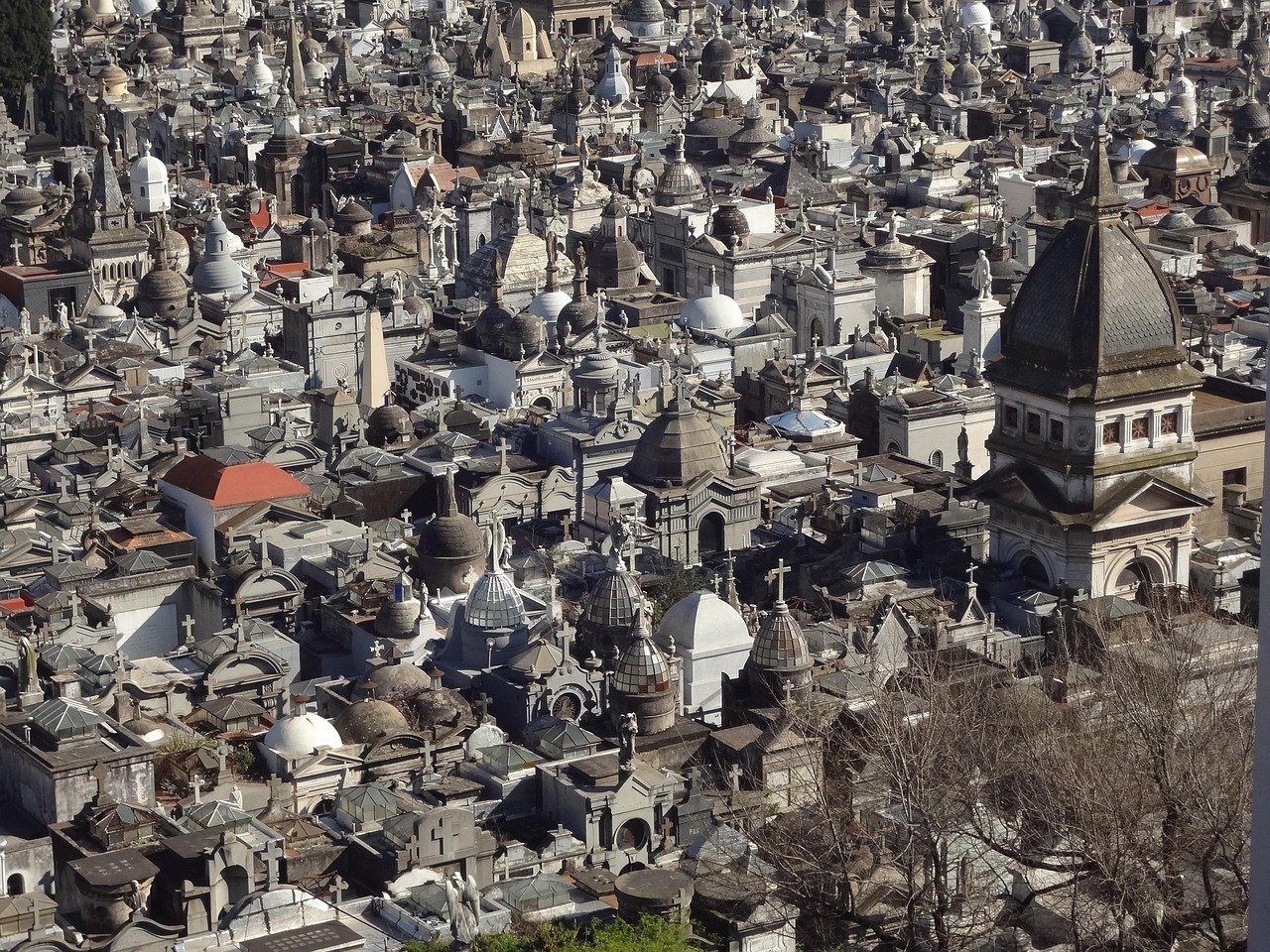
The cemetery’s 14 blocks of interconnected avenues and passages hold more than 4,800 above-ground vaults, and the variety of architectural styles is astonishing. Some mausoleums stand the size of small chapels, complete with stained-glass windows, marble altars, and bronze chandeliers. Others are modest obelisks or neoclassical sarcophagi. Look for the Egyptian revival tombs near the main entrance, identifiable by their lotus-column doorframes and hieroglyphic motifs — a fashion that swept Buenos Aires in the 1880s after the opening of the Suez Canal sparked fascination with ancient Egypt.
Among the unmissable stops is the vault of Rufina Cambaceres, marked by a life-sized marble sculpture of a young woman pushing open a heavy door. According to local legend, Rufina was mistakenly buried alive in 1902 and found scratching at the lid of her coffin — the statue captures her emerging, though historians regard this as a myth born from her youth and sudden death. The monument to Liliana Crociati de Szaszak is equally striking: an exact replica of her bedroom in marble and bronze, created by her grieving parents after she died in an avalanche in Innsbruck in 1970, and her dog is buried at her feet. These personal narratives, embedded in stone and bronze, transform a stroll through the cemetery into something profoundly human.
The Tomb of Eva Perón
No visit to Recoleta Cemetery is complete without finding the Duarte family vault, where María Eva Duarte de Perón — Evita — rests beneath a plain black marble plaque. In life she was a polarising figure: Argentina’s First Lady from 1946 until her death from cervical cancer in 1952, she championed workers’ rights, women’s suffrage, and the descamisados (shirtless ones) with an evangelical fervour that made her a secular saint to millions and a dangerous demagogue to her enemies. In death she became something even more complicated.
After Juan Perón was ousted by a military coup in 1955, Evita’s embalmed body disappeared for seventeen years, allegedly hidden in an Italian cemetery under a false name to prevent it becoming a focus for political resistance. Her body was returned to Perón in Madrid in 1971 and finally interred in the Duarte family vault in 1976. The vault itself is unremarkable by Recoleta standards — a modest dark stone structure in a narrow side alley — but fresh flowers appear on the step almost every day, and pilgrims from across Latin America queue to lay tributes. A steel plate beneath the marble floor reputedly contains eight locks, and the concrete is metres thick; the family installed these measures to prevent further desecration.
Practical Information
- Tickets: Free admission; guided tours available for approximately ARS 5,000–8,000 per person (prices vary by operator)
- Opening hours: Daily 7:00 am – 6:00 pm
- Best time to visit: Weekday mornings in spring (October–November) or autumn (March–April) for pleasant temperatures and fewer crowds
- Duration: 1.5–3 hours for a thorough visit; guided tours typically last 90 minutes
- Booking: No booking required for self-guided visits; guided tours can be arranged at the entrance or via Viator and local tour operators
Local Insights
What locals know that guidebooks don’t always tell you:
- The free walking map available at the entrance gate is excellent — pick one up before entering rather than relying on your phone, as the signal inside can be patchy and alleys look identical.
- Evita’s tomb is signposted but the sign is small; look for the clusters of tourists and fresh flowers in a narrow alley on the left-hand side of the cemetery, roughly one-third of the way in from the main entrance.
- The Recoleta Cultural Centre directly opposite the cemetery entrance hosts free art exhibitions and a weekend craft fair (Saturday–Sunday) that locals prize for artisan jewellery, leather goods, and handmade textiles.
- Cats live in the cemetery and are considered guardians — you’ll often find them sleeping on warm stone vaults. Locals feed them and tourists find them charming; do not shoo them away.
- The neighbourhood’s finest café con leche can be found at the century-old Café La Biela, just outside the cemetery on Avenida Quintana — a perfect spot to decompress after the visit with a medialuna pastry.
Getting There
- Metro/Subway: Line H to Las Heras station (5-minute walk); Line D to Pueyrredón station (10-minute walk)
- Bus: Lines 10, 17, 60, 67, 92, 93, 95, 101, 102, 130 all stop near the cemetery on Avenida del Libertador or Avenida Las Heras
- On foot: Approximately 25 minutes from the Obelisco along Avenida Callao north; 10 minutes from the MALBA museum
- Taxi/Rideshare: Ask for “Cementerio de la Recoleta” or “Junín 1760” — taxis drop off on Avenida Quintana directly in front of the entrance
Frequently asked questions
Is entry to Recoleta Cemetery free?
Yes, general admission is free for all visitors. Organised guided tours charge a fee (typically ARS 5,000–8,000 per person depending on the operator), but you are not required to take a guided tour to enter.
Can I photograph inside the cemetery?
Photography is freely permitted throughout the cemetery, including inside open mausoleums. There are no restrictions on personal cameras or smartphones. Commercial photography and film shoots require a separate permit from the Buenos Aires city government.
How do I find Eva Perón’s tomb without a guide?
Enter the main gate and follow the central avenue. Take the third or fourth alley on the left and look for small directional signs reading “Bóveda Familia Duarte.” Fresh flowers and quiet groups of visitors gathered around a dark marble plaque are usually a reliable indicator that you are in the right spot.
Is the cemetery accessible for wheelchair users?
The main avenues have smooth paving and are accessible. Many of the narrower side alleys have uneven cobblestones that can be difficult for wheelchairs. The main entrance and the Duarte vault are reachable via accessible paths.
What other attractions are near the cemetery?
The Basilica de Nuestra Señora del Pilar is immediately adjacent. The MALBA art museum is a 10-minute walk. The Buenos Aires Design Centre and the Museo Nacional de Bellas Artes are both within a 15-minute stroll, making the Recoleta district an ideal half-day cultural circuit.