
Iguazu Falls
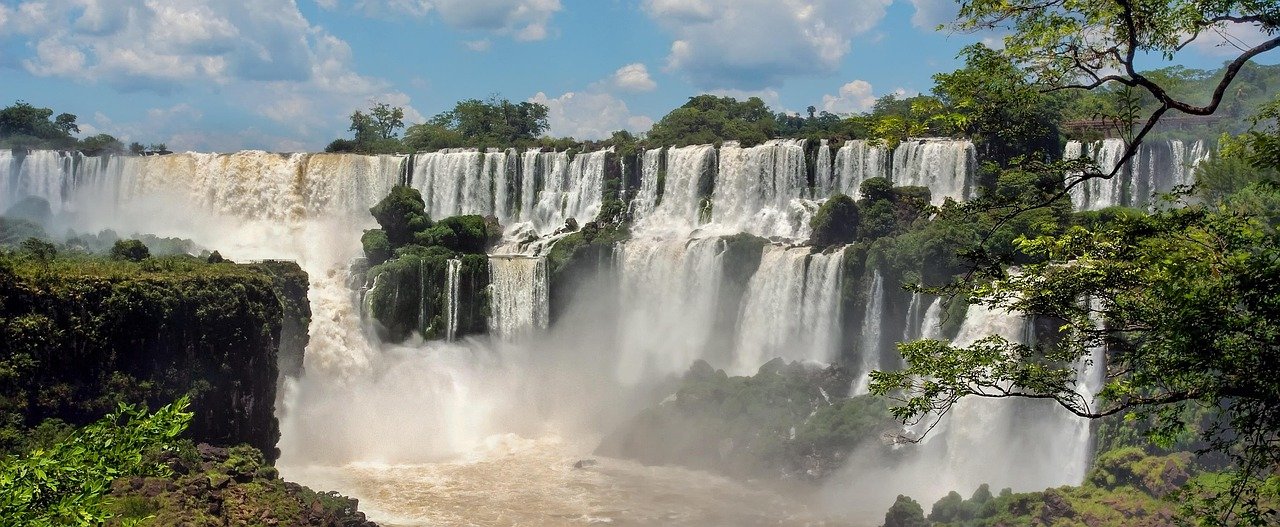
The roar reaches you before you see it. Standing on the walkways of Iguazu National Park, the ground trembles beneath your feet as 275 individual waterfalls thunder down from the surrounding jungle cliffs. Mist rises in great rolling clouds, catching the morning light into fleeting rainbows, and the sheer volume of water pouring over the edge at Garganta del Diablo — the Devil’s Throat — makes your chest vibrate. Nothing prepares you for the scale of Iguazu Falls. Not photographs, not films, not even other great natural wonders of the world.
History of Iguazu Falls
The Guarani people knew these falls long before Europeans arrived. Their legend tells of a deity who, furious that a young couple had fled downriver by canoe, sliced the river apart with a great blade — creating the falls as an act of divine wrath. When Spanish conquistador Alvar Nunez Cabeza de Vaca became the first European to document the falls in 1541, he described them in terms of pure astonishment, calling them the most magnificent thing he had ever seen.
For centuries the falls remained largely unknown to the outside world, protected by the dense subtropical jungle. Argentina and Brazil established national parks on either side of the river — Argentina’s Iguazu National Park in 1934 and Brazil’s Iguacu National Park in 1939. UNESCO designated both parks as World Heritage Sites in the 1980s, cementing their status as one of the most important natural areas on the planet. Eleanor Roosevelt, upon first seeing Iguazu, reportedly exclaimed, “Poor Niagara!”
What to See

The Argentine side offers the most immersive experience, with three main circuits of elevated walkways threading through the jungle and over the water. The Lower Circuit puts you at the base of the falls, drenched in spray and eye-level with cascades that seem impossibly wide. The Upper Circuit places you atop the falls themselves, looking down into the churning white water below. The unmissable climax of any visit is Garganta del Diablo — an extended walkway that reaches into the U-shaped canyon where the greatest concentration of water plunges 82 metres into a perpetual cloud of mist.
The Brazilian side offers something entirely different: panoramic views of the entire system from a distance, allowing you to appreciate the scale that the Argentine side’s intimacy conceals. A single 1.2-kilometre path leads to a platform at the foot of the Devil’s Throat from the Brazilian perspective, often with a rainbow arcing overhead in the afternoon. Many visitors do both sides on consecutive days, and the contrast in perspectives is genuinely revelatory.
The Wildlife
Iguazu is not just waterfalls — it is one of the most biodiverse regions in South America. The national park protects 2,000 plant species and more than 400 bird species, including the great dusky swift, which nests behind the falls themselves and swoops through the spray in great wheeling flocks each evening. Toucans, parrots, and hummingbirds are regular sightings along the walkways. Capybaras graze unconcerned near the visitor centre, and coatis — raccoon-like creatures with long curved snouts — have become bold enough to approach visitors hoping for food.
Jaguars, tapirs, and giant anteaters inhabit the deeper jungle, though sightings are rare. The Iguazu river itself teems with catfish and dorado, and the forests shelter two species of caiman. For birdwatchers, early morning on the trails before the crowds arrive is prime time, when the jungle fills with song and the falls themselves are often veiled in low cloud that burns off as the sun rises.
Practical Information
- Tickets (Argentine side): Approx. USD 40 for international visitors; Argentine citizens pay less. Purchase online in advance to skip queues.
- Tickets (Brazilian side): Approx. USD 20 for international visitors. Combined visits are recommended.
- Opening hours: Daily 8:00–17:00 (last entry around 16:00)
- Best time to visit: April–October (dry season) for clearest views; rainy season (Nov–Mar) sees higher water volume but muddier trails
- Duration: 4–6 hours per side; allow two days if visiting both Argentina and Brazil
- Booking: Book tickets online at the official park website or through Viator; tickets sell out during Argentine national holidays
Local Insights
What locals know that guidebooks don’t always tell you:
- Arrive at opening time (8am) to reach Devil’s Throat before the crowds — the walkway gets dangerously congested by mid-morning on weekends.
- A raincoat or poncho is essential at Devil’s Throat; you will be thoroughly drenched, especially in high-water season, even with a waterproof camera bag.
- The boat rides (Gran Aventura) deliberately drive into the base of the falls for a soaking — wear your least important clothes and use the waterproof bags provided.
- Tuesday mornings are the quietest on the Argentine side — weekends and Argentine public holidays see enormous crowds.
- The park restaurant La Selva is surprisingly good and saves the long walk back to the entrance.
Getting There
- By air: Cataratas del Iguazu International Airport (IGR) is 20 km from the park entrance; taxis take about 30 minutes
- By bus: From Puerto Iguazu town, public buses run frequently to the Argentine park entrance (approx. 30 minutes)
- From Brazil: Foz do Iguacu on the Brazilian side has its own international airport (IGU); shared shuttle buses connect both sides
- By taxi/rideshare: Taxis from Puerto Iguazu to the park entrance cost around USD 10–15 each way
Frequently asked questions
Do I need to book tickets in advance for Iguazu Falls?
Strongly recommended, especially during Argentine public holidays and peak season (July and January). Online booking through the official park websites avoids potentially long queues at the entrance.
Is it worth visiting both the Argentine and Brazilian sides?
Yes — they offer entirely different perspectives. Argentina gives you intimacy and multiple walking circuits right alongside the falls, while Brazil provides the sweeping panoramic view. If you have one day, choose Argentina; with two days, do both.
Are the walkways accessible for wheelchairs and pushchairs?
Much of the Argentine side is accessible, including Devil’s Throat walkway, with paved paths and elevators. The Lower Circuit has some uneven sections. The Brazilian side is largely accessible along its main path.
Can I take photos at the falls?
Absolutely — photography is encouraged throughout the park. However, at Devil’s Throat and on the boat rides, spray is intense. Use a waterproof case or dry bag for your phone and camera.
What else is near Iguazu to extend my trip?
The Wanda Mines offer tours of semi-precious stone deposits. The Itaipu Dam, 40 km away on the Brazil-Paraguay border, is one of the world’s largest hydroelectric plants and offers guided tours. Puerto Iguazu town has good restaurants and a small local market.